
Originally posted on 7th Feb 2025
Choosing the right bag to use for food waste helps reduce harmful emissions and supports sustainable waste practices. Whether you compost at home or rely on municipal programs, your choice of bag can impact our environment.
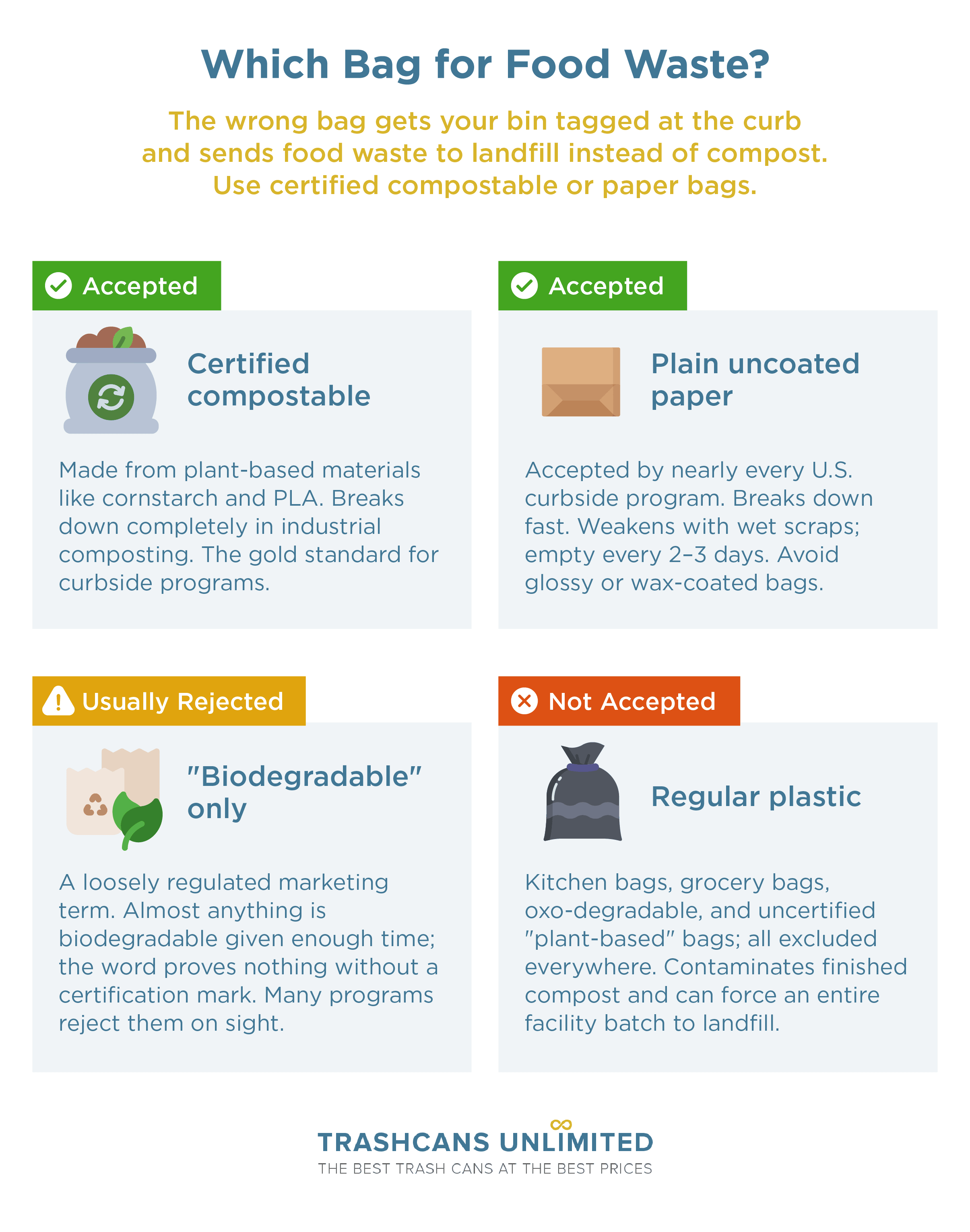
For most U.S. households, the right bags to use for food waste are certified compostable bags. Look for BPI, ASTM D6400, EN 13432, or CMA on the package, or plain, uncoated paper bags. Regular plastic and kitchen trash bags should never enter a food waste stream. And bags labeled only "biodegradable"? Many programs reject them on sight, because the word itself doesn't guarantee a bag will actually break down. "Compostable," "biodegradable," "plant-based," "eco-friendly" labels may sound interchangeable, but they’re not.
This guide walks through main bag types, how curbside and backyard rules differ, and a four-step way to confirm what your city accepts.
Key Takeaways
- "Compostable" has a technical definition. Under ASTM D6400, a product must achieve 90% biodegradation within 180 days and 90% disintegration within 12 weeks (84 days) in an industrial composting environment, plus pass heavy-metal and plant-toxicity limits.
- Home and industrial are different categories. Industrial-certified bags are engineered for facility temperatures of 131–160°F that most backyard piles never sustain.
- Rules vary by city. Your municipality, county, or private hauler sets the final word, so check your local program's accepted-bag list or call the hotline.
Why Your Bag Choice Matters More Than You Think
The most immediate consequence is the rejection tag. Haulers and compost facilities can't sort bag-by-bag at the curb, so if a driver spots what looks like a regular plastic liner in a food waste cart, the whole bin gets skipped or flagged for contamination. It's a small, visible failure caused almost entirely by a label that sounded right at the checkout counter.
The downstream consequence is bigger. Food waste sent to landfill decomposes without oxygen and produces methane — a greenhouse gas roughly 28 times as powerful as CO2 at trapping heat in the atmosphere. The EPA estimates wasted food is responsible for 58% of landfill methane emissions. Curbside compost programs exist to divert that waste into productive use. Contaminated loads break the chain: a single bin of the wrong plastic can force a facility to landfill the whole batch.
Then there's the label problem itself. "Biodegradable," "eco-friendly," and "plant-based" are only loosely regulated as marketing terms. The FTC's Green Guides warn marketers not to make unqualified "degradable" claims unless the product fully breaks down within a year of customary disposal. That matters because almost anything is biodegradable given enough time — the word alone promises nothing specific. "Compostable," by contrast, has a technical definition tied to third-party certification. That distinction is the single most important thing to understand before you shop.
Compostable Bags: The Gold Standard for Food Waste Collection
Certified compostable bags are the benchmark for food waste collection in most U.S. households. They're made from plant-based feedstocks: cornstarch, sugarcane derivatives, and PLA (polylactic acid, a bioplastic fermented from plant sugars). These bags are widely accepted because they're engineered to break down alongside food scraps at industrial composting facilities — the high-heat, actively managed environments where most curbside food waste ends up. For a closer look at what food waste bags are made of, that's a topic worth its own read.
The certifications to look for separate a real compostable bag from clever packaging. You want at least one of these visible on the label:
- BPI (Biodegradable Products Institute) — the most recognized certification in the U.S., verified through independent lab testing. BPI uses ASTM D6400 as its base standard, and every certified item appears in a searchable product catalog on BPI's site so you can verify a product's status.
- ASTM D6400 — the technical standard itself. Per the U.S. Composting Council, a product must achieve 90% biodegradation within 180 days and 90% disintegration within 12 weeks (84 days), and pass heavy-metal and plant-toxicity limits. The standard itself is published by ASTM International.
- EN 13432 — the European counterpart to ASTM D6400. BPI treats the two as the harmonized industrial-compostability frameworks for North America and Europe respectively, which is why EN 13432 still appears on many U.S.-sold bags.
- CMA (Compost Manufacturing Alliance) — a newer certification gaining credibility specifically because it goes beyond the lab. CMA is the only North American third-party certifier that combines ASTM lab-report review with field disintegration testing at real operating facilities — windrow, covered in-vessel, and aerated static pile — where turning schedules, moisture, and feedstock mix don't always match lab conditions.
Certified compostable bags cost several times more than conventional plastic, and they have a real shelf life. The same features that let them break down in compost make them vulnerable to heat and humidity during storage: a bag sitting in a humid garage for a year may start degrading before you use it. They aren't designed for long-term storage of wet waste either — once they're consistently wet, the breakdown has already started. And they should never end up in regular recycling or trash streams, where they either contaminate the recycling or simply get landfilled.
Home compostable is a separate category. Industrial-certified bags are engineered for the thermophilic conditions of a commercial facility — sustained temperatures between 131°F and 160°F, per EPA guidance — and most backyard piles never reach that range. A bag that breaks down in six weeks at a facility may sit largely intact in a backyard bin for a year. If you compost at home, look for certification that tests for breakdown at the lower, fluctuating temperatures of a garden heap rather than the 55–60°C industrial range.
Biodegradable Bags: Why the Label Alone Isn't Enough
"Biodegradable" on its own is not a reliable signal. It's a loosely regulated marketing term. Taken literally, almost anything is biodegradable given enough time (or centuries). That's not what a compost facility needs. Compostable means the bag has been tested and certified to break down within a specific timeframe, under specific conditions, leaving no harmful residue.
Uncertified biodegradable bags are frequently rejected at the curb by municipal composters. Facility operators can't tell at a glance whether a bag will break down in their process, and many of these products don't degrade at the speed or under the conditions a commercial facility requires. Partial breakdown is also a problem: bags that fragment without fully biodegrading can leave plastic pieces in the finished compost, which is one reason many facilities treat uncertified biodegradable products with the same caution they apply to regular plastic.
When a biodegradable bag is actually fine: Only if it also carries a compost certification. A bag labeled "biodegradable and BPI certified" is a compostable bag — that's the one that counts. A bag labeled only "biodegradable," with no BPI, ASTM D6400, CMA, or EN 13432 mark? Treat it as regular plastic, and keep it out of your food waste bin.
If the certification maze feels overwhelming, there's a lower-tech option that sidesteps it entirely: paper.
Paper Bags: The Simple, Low-Tech Option That Usually Works
Nearly every U.S. curbside food waste program that permits bagged drop-off accepts plain, uncoated paper bags. They break down quickly in both industrial facilities and backyard piles, require no label-reading, and cost less than certified compostable liners. For many households, paper food scrap bags are the least-stress answer.
The honest trade-off is moisture. Paper works well for dry and low-moisture scraps — coffee grounds, eggshells, produce trimmings, stale bread, paper towels. It struggles with melon rinds, citrus peels, or anything soupy. The fix is simple: line the caddy's bottom with a sheet of newspaper to absorb moisture, or empty it more often. Every two or three days prevents the problem entirely.
Best for:
- Lining a small countertop caddy before transferring contents to the outdoor bin
- Dry compostables like coffee filters, shredded paper, and eggshells
- Households on a budget or in areas where certified compostable bags are hard to find
Watch out for:
- Glossy or wax-coated bags — often not compostable despite looking like paper
- Heavily printed or dyed bags — uncoated brown kraft is the safest bet
- High-moisture scraps held over multiple days in warm weather
Both plain brown paper grocery bags and purpose-made compost-caddy paper bags work. The main difference is fit: caddy-specific bags match standard countertop bins and don't slump.
Regular Plastic Bags and Garbage Bags: What You Need to Know
This is the easy part. Standard plastic bags, kitchen trash bags, and grocery bags are not accepted in curbside food waste or compost programs anywhere in the U.S. There are no regional exceptions worth planning around.
Plastic doesn't break down in a compost cycle. It contaminates the finished product, jams equipment at sorting facilities, and forces operators to landfill entire batches when contamination runs high. One contaminated load can undo a facility's whole day.
The trap to watch for: "plant-based" and "oxo-degradable" plastic bags without compost certification fall into the same ban category. "Plant-based" just means the bag contains some plant-derived material — it says nothing about whether the bag will actually compost. Oxo-degradable plastics break into smaller plastic fragments rather than biodegrading, and the FTC warns oxodegradable bag marketers that their claims may be deceptive, since landfills lack the oxygen such bags need to actually degrade. They're widely excluded at compost facilities for the same reason.
Do not use:
- Regular kitchen trash bags
- Plastic grocery bags, even reused ones
- Oxo-degradable or "degradable" plastic bags
- Uncertified "plant-based" plastic bags
- Any plastic bag without a BPI, ASTM D6400, EN 13432, or CMA logo
If you have no other option right now: Skip the bag entirely. Food scraps can go directly into a clean caddy or compost bin — rinse the container after emptying, and pick up certified compostable or paper bags before your next pickup. Whether you need a bag at all depends on your specific program; some actively prefer loose scraps.
Dedicated Food Caddy Bags and Bin Liners — Are They Worth It?
Purpose-made food caddy bags and kitchen compost bin liners are sized to fit standard countertop caddies — typically 1.6 to 2.6 gallons — and the larger outdoor carts most municipalities provide. They're almost always certified compostable and engineered specifically for the wet-waste challenges of food scraps rather than general kitchen trash.
Matching liner size to bin size matters more than most shoppers realize. An oversized liner sags, bunches at the bottom, and traps moisture against the caddy walls. An undersized liner stretches and tears. Typical pairings look like this:
- 1.6 gallon caddy → 6 liter liner
- 2.6 gallon caddy → 10 liter liner
- Outdoor cart → check cart size, typically 13, 21, or 32 gallons
Materials are usually the same plant-based feedstocks as other certified compostable bags — PLA, PBAT, cornstarch blends, or paper. Some carry home-compostable certifications as well, worth looking for if you compost in the backyard.
Features worth paying attention to:
- Breathability. Ventilated caddies paired with breathable bags reduce odor significantly by letting moisture evaporate rather than trapping it. This is the single biggest quality-of-life difference between a good caddy setup and a bad one.
- Thickness. Measured in microns or mils. Thicker isn't always better — very thick bags can slow breakdown at the facility. A middle range (roughly 0.7 to 1.0 mil) handles most kitchens.
- Starch-based odor inhibitors. Some liners include these. They help modestly, but ventilation and frequent emptying matter more.
For most households, dedicated caddy bags are worth the small premium. They fit properly, meet certification standards, and reduce the daily friction of managing food scraps — which is ultimately what determines whether a household sticks with composting at all. Tight-budget alternative: certified compostable kitchen bags in an appropriate size, or paper.
If you're still pairing a caddy with a bag, it's worth looking at options together — browse compost bins sized to match different bag types.
How to Check What Your City Actually Accepts
Food waste programs are managed locally. Yours might be run by a city public works department, a county solid waste district, a regional authority, or a private hauler under contract, each with different equipment, standards, and tolerances.
Here's a four-step process that works for almost any U.S. household:
- Search your city or county website. Try "[Your City] food waste," "[Your City] organics recycling," or "[Your County] compost program." Public works and solid waste departments usually maintain a program page.
- Look for "accepted bags" or "approved liners." Good program pages list this explicitly. A BPI or ASTM D6400 reference is your green light for curbside compost bags with those certifications. If you see no bag guidance at all, move to step 3.
- Call or email the program directly. Most have a waste hotline or email form. Ask specifically: "Do you accept certified compostable bags? Do you accept paper bags? Is a specific certification required?" You'll usually get a same-day answer.
- If you use a private hauler, check their site or your service agreement. Private programs sometimes run stricter than city-run ones because they contract with specific processing facilities. A quick customer-service call settles it.
If your area has no published guidance: default to certified compostable bags (BPI or ASTM D6400) or plain uncoated paper. These are accepted by more programs than any other bag type, and neither will cause a rejection tag in any program that accepts bagged food waste.
Not sure whether bags are even required? Some programs accept loose food scraps with no liner at all.
Backyard Composting vs. Curbside Collection — Does the Bag Type Change?
Yes, meaningfully. Curbside programs send waste to industrial facilities running at sustained high temperatures for weeks at a time, which is why industrial-certified compostable bags break down reliably there. Backyard bins run at much lower temperatures, often barely above ambient, on much longer timelines. Bags that work in one environment don't always work in the other.
Backyard composting gives you more flexibility on input and less on speed. You can use:
- Plain uncoated paper bags (fastest backyard breakdown)
- Certified home-compostable bags
- No bag at all — add food scraps directly to the pile
Why industrial-certified bags may not fully break down in a backyard bin: They're engineered for the 131–160°F EPA associates with optimal composting activity, and most home piles never sustain it. A home pile hitting 120°F for a few days is doing well; an industrial facility holds 140°F for weeks. Industrial-certified bags will eventually degrade in a backyard system, but it can take a year or more, and they'll look unsightly in finished compost the whole time.
What to avoid in a backyard bin regardless of the bag: meat scraps, dairy, oily foods, and pet waste. These don't break down well at low temperatures and attract pests. Stick to fruit and vegetable trimmings, coffee grounds, eggshells, and yard trimmings, and you'll have a healthy pile. If you're just getting started, here's a primer on backyard composting with a trash can.
Quick Comparison: Which Bags to Use for Food Waste, Side by Side
|
Bag Type |
Curbside Accepted? |
Backyard Compost? |
Moisture Resistance |
Cost |
Odor Control |
|
Certified Compostable (BPI/ASTM D6400/CMA) |
Usually yes |
Partial — slower breakdown |
Good |
Higher |
Good with ventilation |
|
Paper (uncoated) |
Usually yes |
Yes — breaks down fast |
Weakens when wet |
Lower |
Moderate |
|
Biodegradable (non-certified) |
Usually no |
No — may leave fragments |
Varies |
Lower to moderate |
Varies |
|
Regular Plastic |
Never |
No |
Excellent |
Lowest |
Poor (traps moisture) |
|
Dedicated Caddy Liner (usually certified) |
Usually yes |
Depends on certification |
Good |
Moderate to higher |
Best — engineered for it |
Municipal acceptance is the first gate — if a bag gets your bin tagged, nothing else matters. After that, cost, moisture resistance, odor control, and how often you plan to empty the caddy all play a role. For most households, certified compostable or paper wins because they're the only two options accepted across the widest range of programs.
The best default for most U.S. households: Certified compostable bags with BPI or ASTM D6400 certification — backed up by plain paper bags as a budget alternative.
Once you have the right bags, browse compost bins and kitchen caddies sized to match them — the right bin makes the right bag work much better.