
Originally posted on 3rd Jan 2025
Most food waste bags are made from one of six materials: PLA (a plant-based plastic), PBAT (a petroleum-based biodegradable plastic), starch blends, PHA (a biopolymer grown by microbes), conventional polyethylene (standard plastic), or paper. The bags sold as "compostable" are almost always blends of two or more, rarely pure anything.
This guide walks through each of the six materials, what the labels actually mean, how these bags get made, which certifications hold weight, and how to pick the right bag for your setup. Some materials are exactly as good as they sound. Others come with caveats the box doesn't always mention.
Key Takeaways
- PLA bags need industrial heat you can't get at home. PLA requires sustained temperatures of 55–60°C (roughly 131–140°F) and high moisture to biodegrade in a reasonable timeframe. A backyard pile, even a well-maintained one that reaches 130–160°F, rarely holds the sustained heat and humidity needed.
- PBAT is fossil-fuel-derived but genuinely biodegradable. It's the stretchy, tear-resistant ingredient that makes most "compostable" bags feel like real bags, and it's almost always blended with plant-based polymers.
- Starch-based bags derive their functional properties from polymer blending ratios. Higher starch content increases biodegradation rates and reduces lifecycle carbon input but compromises mechanical strength and moisture tolerance, while higher PBAT or PLA content improves durability at the expense of compostability.
- PHA is the one material that breaks down nearly everywhere, including seawater, with a legitimate marine biodegradation certification to back that up. It's also the most expensive to produce, which is why it's still rare on shelves.
- Polyethylene bags do not biodegrade at all—they fragment into microplastics over decades or centuries. Labels like “degradable” or “oxo-degradable” simply accelerate this fragmentation process and do not make the material compostable or environmentally benign.
- Paper bags are fully compostable across both home and industrial systems. However, their low durability makes them best suited for short-duration use with relatively dry, lightweight food waste.
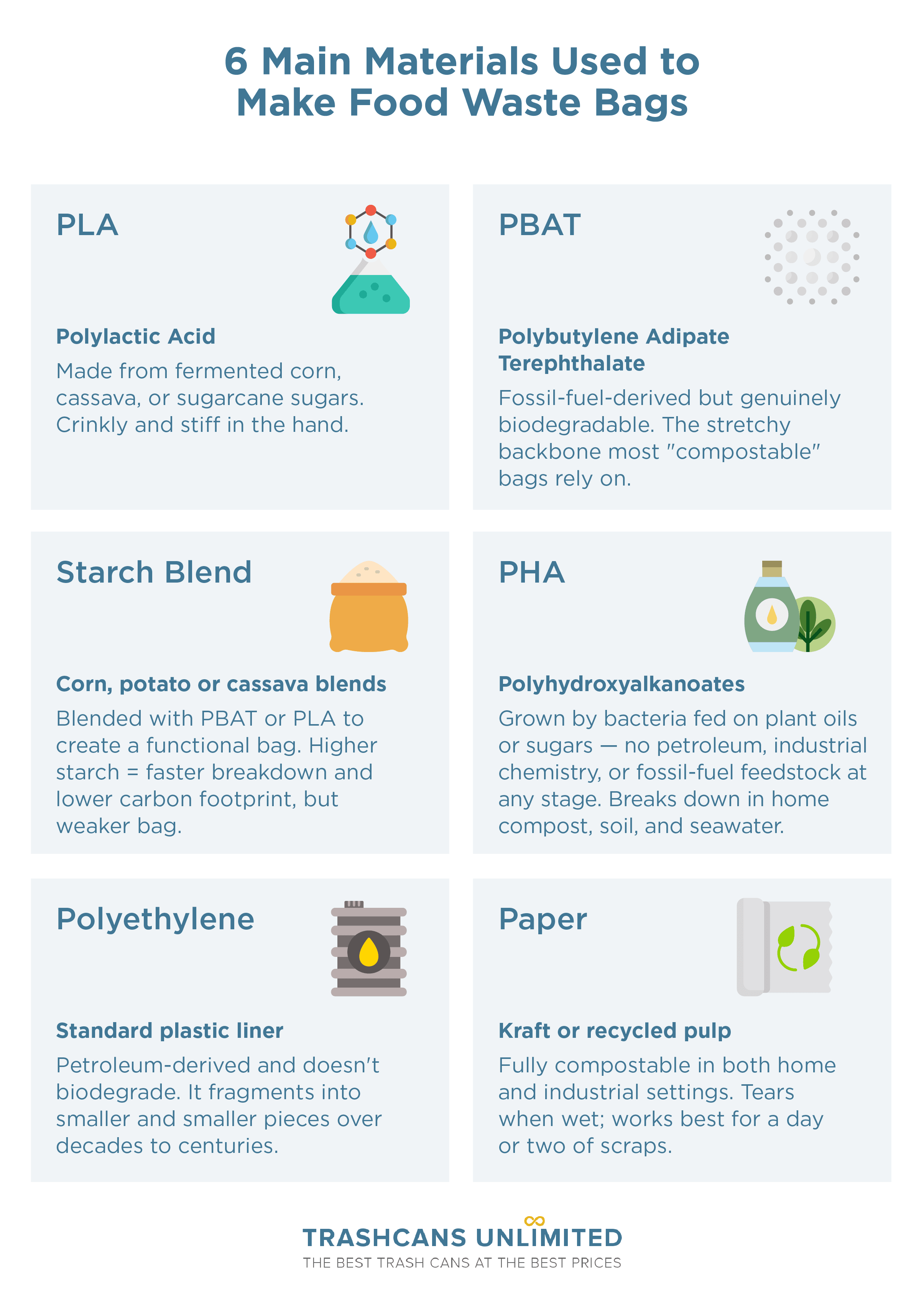
The Six Main Materials Used to Make Food Waste Bags (And What They Actually Are)
|
Material |
Source |
Home Compostable? |
Industrial Compostable? |
Durability |
Typical Label |
|
PLA |
Plants (corn, cassava) |
No |
Yes |
Medium |
"Compostable" |
|
PBAT |
Fossil fuels |
Sometimes |
Yes |
High |
"Compostable" |
|
Starch Blends |
Plants (corn, potato, cassava) + polymers |
Often |
Yes |
Medium |
"Home compostable" |
|
PHA |
Microbes fed plant oils/sugars |
Yes |
Yes |
Medium |
"Home compostable" |
|
Polyethylene |
Fossil fuels |
No |
No |
Very High |
"Plastic" or "Degradable" |
|
Paper |
Wood pulp |
Yes |
Yes |
Low |
"Compostable" |
PLA (Polylactic Acid) — The Corn-Derived Plastic That Isn't Quite Plastic
Pick up a PLA bag and it feels crinkly, a little stiff, noticeably thinner than a traditional liner. You've probably handled PLA before without knowing it — it's the same bioplastic used in clear compostable cups and cutlery.
PLA is a rigid, clear plastic made from fermented plant sugars, most often corn starch (though cassava and sugarcane work too). The plant sugars are converted into lactic acid, and those acid molecules are chemically linked into long chains — a process called polymerization, which just means "hooking small molecules into a long one." The result looks, feels, and behaves remarkably like conventional plastic.
Here's the catch. PLA bags need industrial composting conditions to actually break down — sustained temperatures in the 55–60°C range (about 131–140°F) for several weeks, plus high moisture and active microbial activity. A well-maintained backyard pile can reach 130–160°F on its best days, but rarely holds that peak heat consistently enough, or with the controlled humidity, to reliably mineralize PLA. A PLA bag tossed into a typical home pile will still be recognizably intact months, sometimes years, later. In a landfill, with no oxygen and no heat, it essentially doesn't break down at all.
You'll find PLA in thinner, crinkly food waste liners marketed as "compostable." The label is technically accurate, but only if you have access to an industrial facility that takes them.
PBAT (Polybutylene Adipate Terephthalate) — The Flexible Backbone Most Bags Rely On
PBAT is the ingredient that makes a "compostable" bag feel like a real bag. It's stretchy, tear-resistant, and drapes in your hand the way a grocery bag does. It's also petroleum-derived — yes, from fossil fuels — and genuinely biodegradable under the right conditions. It's almost always blended with PLA or starch to compensate for how brittle those plant-based materials are on their own.
PBAT is biodegradable under certified composting conditions. It will break down. But it's also fossil-fuel-based, which means marketing copy that calls a PBAT-blend bag "plant-based" or "eco-friendly" without qualification is stretching the truth. The bag might compost properly. The story on the box is just incomplete.
If a compostable bag feels soft, stretchy, and drapes like a grocery bag, it almost certainly contains a significant amount of PBAT.
Starch-Based Bags — Corn, Potato, and Cassava as a Base Material
Starch-based bags start with vegetable starch — corn, potato, or cassava — and combine it with other polymers, usually PBAT and sometimes PLA, to create a workable film. Pure starch on its own is too brittle and too sensitive to water to function as a bag. Drop food scraps into a pure-starch film and you'll have a soggy, torn mess in an hour. Blending is the whole point.
The ratio matters more than most labels let on. Higher starch content means faster decomposition and a lower carbon footprint during production — but also a weaker, more water-sensitive bag. Lower starch content (more PBAT) means a sturdier bag but slower breakdown and more fossil-fuel input. Manufacturers tune that ratio for the market they're selling into, which is why two "compostable" bags next to each other on a shelf can behave very differently once you get them home.
The practical takeaway: if you want the best odds of a bag that actually composts in your backyard, look for one where starch — or starch plus PHA — is the primary ingredient, and check for a home compostable certification logo (not just "compostable," which usually means industrial-only). Starch-heavy blends are the most likely to earn legitimate home-composting certification.
PHA (Polyhydroxyalkanoates) — The Newer, Fully Bio-Based Alternative
PHA is the newest material on the list and, from a sustainability standpoint, the most interesting. It's essentially grown and biosynthesized. Specific bacteria naturally accumulate polyester-like molecules as intracellular storage granules when you feed them plant-based oils or sugars, and those molecules are what become PHA. No petroleum, no industrial chemistry, no fossil-fuel feedstock at any stage.
What sets PHA apart is where it breaks down. Unlike PLA, PHA biodegrades in a much wider range of environments — home compost piles, soil, and even marine water. It's one of the only commercially available bioplastics with a legitimate ocean-biodegradation certification. One PHA grade (Tianan Biologic's Enmat Y1000P PHBV) achieved 100% disintegration of a 52-micron part within 12 weeks of seawater exposure.
So why isn't every bag made of PHA? Because it's genuinely hard and expensive to produce at scale. Bacterial fermentation is slower and finickier than the industrial chemistry behind PLA or PBAT, which is why you'll rarely see a 100% PHA bag on the shelf at a mass-market price. Most PHA bags today are blends, and they tend to land in premium bioplastic food scrap bag lines rather than grocery-store aisles. Adoption is growing, though, and PHA is increasingly the material cited in stricter sustainability certifications.
Whichever bag you end up using, it still needs a well-designed bin to live in — especially if you're composting at home. Browse compost bins built for everyday kitchen and outdoor use.
Conventional Polyethylene — What Standard Plastic Bin Liners Are Made Of
Polyethylene is the material you already know. It's made from ethylene — a petrochemical derived from oil and natural gas — polymerized into the familiar stretchy, moisture-resistant plastic used in grocery bags, trash bags, and standard kitchen liners. Cheap, durable, and extraordinarily effective at its actual job.
It's also not biodegradable. Polyethylene doesn't break down — it fragments. Peer-reviewed research using a harmonized degradation metric extrapolates that HDPE half-lives in the marine environment range from roughly 58 years (for thin-walled bottles) to 1,200 years (for thick pipes), because polyethylene's carbon–carbon backbone resists the hydrolysis and oxidation that drive real biodegradation. Over those timescales, it gradually breaks into smaller and smaller pieces, eventually becoming microplastics. The plastic itself never actually goes away. It just gets harder to see.
This is where the label word games matter most. Some polyethylene bags are marketed as "degradable" or "oxo-degradable" — meaning they contain chemical additives that accelerate fragmentation. Faster fragmentation isn't biodegradation. The bag just becomes microplastic faster.
Polyethylene is still the dominant material in non-compostable food waste bags and standard bin liners worldwide.
If you're on the fence about composting, that's a different question worth a closer look: here's how to start composting in a trash can.
Paper-Based Food Waste Bags — The Low-Tech, High-Transparency Option
Paper bags are made from kraft paper or recycled paper pulp, occasionally with a thin starch or wax lining for moisture resistance. No polymer blends. No additives to decode. No certification ambiguity. Paper is paper, and paper composts.
Paper bags are fully compostable in both home and industrial settings. They break down quickly, leave no microplastic residue, and don't require a chemistry glossary to evaluate. The trade-off is durability: they tear when wet, sag under heavy loads, and work best for short-term use — collecting scraps for a day or two before transferring them to a larger bin.
If you're still deciding whether you even need a bag in the first place, here's a breakdown of when bags help and when they don't.
Compostable vs. Biodegradable Food Waste Bags
These two words sound like synonyms. They aren't.
- "Biodegradable" has no regulated standard. Any material that eventually breaks down can legally use the word. No required timeframe. No required conditions. No verification.
- "Compostable" is a certified standard. To legally use it in most responsible markets, a product has to meet a defined standard — ASTM D6400 in the U.S. or EN 13432 in Europe — tied directly to material composition and decomposition rate.
How the Manufacturing Process Shapes What a Bag Can and Cannot Do
Most food waste bags are made through a process called blown film extrusion. Small polymer pellets get melted (typically at 320–410°F, or roughly 160–210°C), inflated into a long thin tube of film, then flattened, cut, and sealed into bag shape. It's an elegant process, and it's also a big reason "100% plant-based" bags are hard to produce at scale.
The problem is heat. Plant-based feedstocks like starch don't love being melted at 400°F. So manufacturers blend them with more heat-stable polymers like PBAT, which survive extrusion easily, to produce a film that's both workable and partly plant-derived. The blend ratio directly controls how much plant material a bag contains, how flexible it is, and how fast it breaks down. Film thickness is set at the extrusion stage too — thinner film decomposes faster but tears more easily.
This is the manufacturing reality behind the shelf: the cheapest "compostable" bag is almost always a blend, not a pure plant-based product.
Certifications and Standards: What They Actually Test
Not all "compostable" certifications test the same thing, and knowing the difference is how you tell a real claim.
ASTM D6400 (U.S.) and EN 13432 (Europe) both test whether a material biodegrades by at least 90% within 180 days under industrial composting conditions. They're the baseline. The specific polymer types and their ratios in a bag's composition determine whether it can pass these tests, which is why material composition and certification are directly linked.
Home composting certifications apply stricter, lower-temperature criteria designed to mimic an actual backyard pile, where temperatures are clearly lower and less constant than in industrial facilities running at 55–60°C. Most PLA-dominant blends fail these tests.
Certification bodies assess the full material composition, including additives and colorants, not just the primary polymer. In the U.S., BPI (the Biodegradable Products Institute) is the main body that verifies products against the ASTM D6400 standard — they're the ones putting the seedling logo on the box.
What to look for on the label (store checklist):
- A specific standard cited (ASTM D6400 or EN 13432), not just the word "compostable."
- A certification logo from a recognized body (BPI seedling or OK Compost).
- A clear indication of whether it's industrial-only or home-compostable.
- A disclosed material composition — or at minimum, the primary polymers used.
If your city offers curbside compost pickup, your bag mostly needs to meet your municipal program's standards. If you're composting at home, the bin you use matters just as much as the bag. See compost bins built for home use.
How to Pick the Right Food Waste Bag for Your Setup
If You're Composting at Home
Look for home compostable certification — any logo that specifically says "home compostable" is the signal you want. Prioritize starch-heavy or PHA-based blends over PLA-dominant ones; PLA needs industrial heat your backyard pile will never reach consistently. Paper bags are a strong, simple, zero-ambiguity choice if your scraps aren't too wet or too heavy. For a deeper breakdown of which bags actually perform in home setups, see what bags to use for food waste.
If You Use a Municipal Curbside Compost Program
Check your program's accepted-bag list first. Policies vary city by city: some programs accept only paper bags, others accept certified compostable plastic bags, and a few accept neither and require loose scraps. ASTM D6400 certification is typically the minimum standard for programs that do accept bags. Never assume a "biodegradable" bag qualifies — if it's not specifically certified compostable, it's probably a contaminant at your local facility.
Once you know which bag fits your setup, the other half of the equation is the bin. Explore compost bins designed for every setup.