
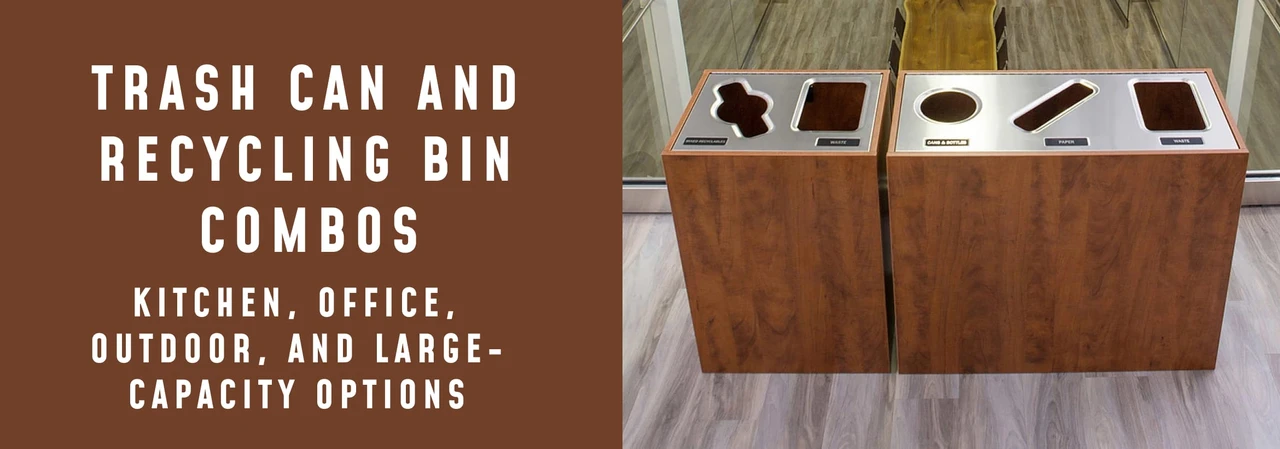
The lid won't close. A pizza box is wedged beside the bin, a yogurt cup sits on the counter because nobody knows where it goes, and the kitchen smells faintly of yesterday. Most waste problems aren't about how much a household throws away. They come from a system that doesn't fit the room.
The right trash can and recycling bin combos for each room are chosen by capacity, compartment split, and build material. A kitchen needs something different from a home office, and both need something different from a driveway. Start with the quick pick for your space, then learn more about the details that confirms it.
Key Takeaways
- Match the combo to the room. Kitchens: a lidded or enclosed dual unit of about 16–30 gallons total. Offices: a slim dual unit of about 5–10 gallons desk-side, or 20–34 gallons in a shared space. Outdoors: a weatherproof station of about 50–96 gallons. High-volume spaces: a reinforced unit of 30+ gallons.
- Let your local program set the format. A 2-in-1 suits areas that collect mixed recycling; a 3-in-1 suits separate paper collection or composting.
- Size from real output. Bags per week × bag size ÷ 7 × days between emptyings, then round up for busy weeks.
- Choose material by location. Stainless steel for kitchens, HDPE, galvanized, or powder-coated steel outdoors, and UV and rust resistance wherever sun and rain reach.
- Pay for the parts that get used. Lids, pedals, and removable buckets fail first on budget units.
- Placement and labels build the habit. Put bins where waste is created, pair recycling with trash, and label with pictures.
Which Trash and Recycling Combo Fits Each Space?
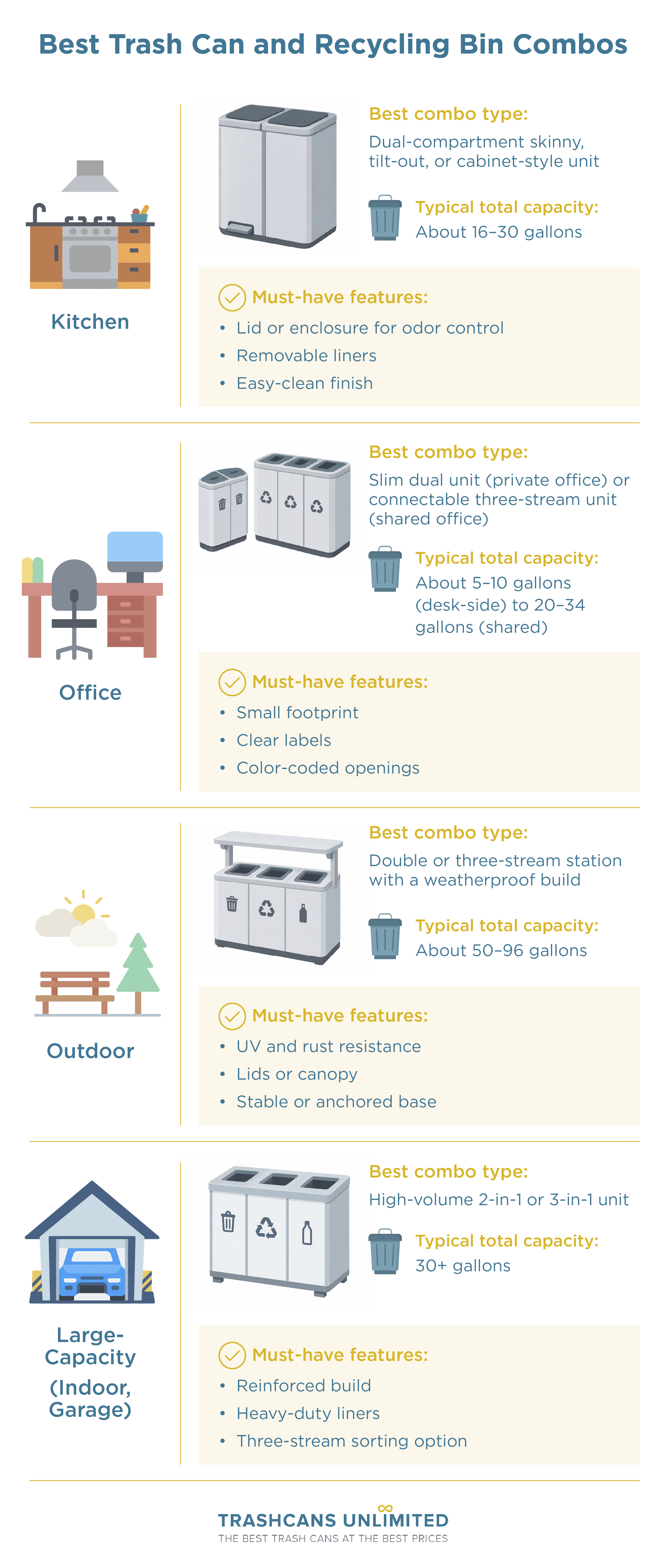
Choose an enclosed or lidded dual unit of about 16–30 gallons for the kitchen, a slim dual unit for the office, a weatherproof station of 50–96 gallons outdoors, and a reinforced 30+ gallon unit wherever volume spikes.
|
Space |
Best combo type |
Typical total capacity |
Must-have features |
|
Kitchen |
Dual-compartment skinny, tilt-out, or cabinet-style unit |
About 16–30 gallons |
Lid or enclosure for odor control, removable liners, easy-clean finish |
|
Office |
Slim dual unit (private office) or connectable three-stream unit (shared office) |
About 5–10 gallons (desk-side) to 20–34 gallons (shared) |
Small footprint, clear labels, color-coded openings |
|
Outdoor |
Double or three-stream station with a weatherproof build |
About 50–96 gallons |
UV and rust resistance, lids or canopy, stable or anchored base |
|
Large-capacity (indoor, garage) |
High-volume 2-in-1 or 3-in-1 unit |
30+ gallons |
Reinforced build, heavy-duty liners, three-stream sorting option |
A well-matched combo delivers four things:
- Fewer trips to the curb, because capacity matches real output
- Less odor, because wet waste stays covered and contained
- Easier sorting, because every stream has an obvious home
- A unified look, because one footprint replaces a cluster of mismatched bins
Shop all trash and recycling combos →
Before comparing rooms, settle one question: how many streams do you sort?
How Trash and Recycling Combos Work: 2-in-1 vs. 3-in-1
A combo is one unit with separate compartments for trash and recyclables that share a single footprint. The format you need depends on how many streams your local program asks you to sort.
|
Format |
Streams |
Best for |
Typical spaces |
|
2-in-1 |
Trash + mixed recycling |
Single-stream recycling areas and most everyday use |
Kitchens, private offices, small patios |
|
3-in-1 |
Trash + recycling + a third stream (paper, bottles and cans, or compost) |
Stricter local sorting rules, composting households, shared workplaces |
Busy kitchens, shared offices, outdoor stations |
A dual trash can and recycling bin covers most kitchens and private offices, because most curbside programs accept mixed recyclables in one bin. Browse 2-in-1 trash can and recycling bin combos if that describes your area. If your town collects paper separately, or you compost, a third compartment handles the paper, or doubles as a built-in compost bin and retires the coffee can of scraps on the counter. 3-in-1 trash can and recycling bin combos handle that without adding another unit.
Check your local recycling guidelines before choosing; as the EPA points out, not every recyclable is collected in every community. The number of streams your town collects is usually the clearest guide to which format you'll actually use.
With the format settled, the next question is which build suits each room.
Choosing the Right Combo for Every Space in Your Home or Office
Each space has a different waste profile, so the right capacity, split, and material change from room to room.
Kitchen Combos: Balancing Capacity, Hygiene, and Design
Onion skins, a leaking chicken tray, three flattened cereal boxes: the kitchen sees more waste, and wetter waste, than any other room. All of it lands a step from where food is prepared, which is why the kitchen trash and recycling bin is where a cheap or poorly sized unit fails first.
Capacity. Kitchen compartments commonly run about 8, 10.5, 13, or 15 gallons each, or about 16–30 gallons total. Most households fill trash faster than recycling, but homes that buy a lot of packaged goods may find the reverse. That's why the split matters as much as the total (see the sizing section below).
Odor control. Food scraps are the usual source of bin odor: as they spoil they release odorous compounds, and laboratory research shows spoilage runs faster at warmer temperatures. A lid or an enclosed cabinet traps smells between emptyings far better than an open top. If you choose an open-top design for its slim profile, plan on emptying it more often and choosing liners that fit snugly.
Hands-free operation. Step-pedal and sensor lids mean never touching a lid with raw-chicken or flour-dusted hands. The USDA advises washing hands immediately after handling raw poultry, and a hands-free lid means one less surface touched before you do. For anyone who cooks, that's hygiene, not a gadget.
Finish. Stainless steel pairs naturally with modern appliances and hardware, and its smooth surface wipes clean in seconds. Matte plastic hides fingerprints and costs less, but it can look dated beside premium finishes. Painted or stained wood cabinets suit farmhouse and traditional kitchens.
Inner buckets and liners. Removable inner buckets let you rinse a spill without tipping the whole unit. Separate buckets also stop drips in the trash side from reaching clean recyclables.
Fit. In galley kitchens, the unit that fits usually beats the unit that's biggest. The 21-gallon skinny kitchen waste and recycle combo pairs two 10.5-gallon stainless steel bins in a slim profile. For a furniture-style look that hides both bins completely, the double tilt out wood trash can and recycle bin encloses two 9- or 13-gallon bins in solid pine, with a countertop surface on top. For high-volume kitchens where floor space is scarce, the 30-gallon wall-mounted trash can and recycling bin combo mounts two 15-gallon bins on the wall, so the space beneath stays easy to sweep.
|
Factor |
Galley kitchen |
Open-plan kitchen |
|
Best form |
Skinny side-by-side or wall-mounted |
Tilt-out trash cabinet or wide-stance dual unit |
|
Priority |
Footprint and lid clearance |
Capacity and visual fit with cabinetry |
|
Typical total |
About 16–21 gallons |
About 21–30 gallons |
Lid choice matters most here; the features section compares every type side by side.
Office Combos: Compact, Professional, and Clutter-Free
Printer misfeeds, a shipping envelope, an empty coffee cup. Office waste is dry, light, and mostly recyclable, so capacity matters less than footprint, quiet operation, and cues that make waste sorting automatic.
Capacity. A single-user home office typically needs about 5–10 gallons total for desk-side placement. Shared offices and break areas need about 20–34 gallons, and more if three streams are collected.
Design. Neutral tones, matte finishes, and low-profile shapes keep a combo from dominating a professional space. Quiet-close lids matter more here than in most rooms, because a clanging lid on a video call is hard to ignore.
Placement. Under-desk units free up floor space but make reaching back awkward. Beside-desk units stay within one arm's reach, and that ease of access is what keeps sorting consistent.
Sorting cues. In shared spaces, a well-designed office recycling bin does the explaining. Color-coded compartments, printed labels, and shaped openings (a slot for paper, a round hole for bottles and cans) guide people to the right stream without anyone reading a sign. In one field study of public waste bins, specialized lids with shaped openings raised the beverage-recycling rate by 34%.
Durability. A single-user home office can use lighter materials. Shared spaces need sturdier steel bodies, non-skid feet, and liners that lift out cleanly, because more hands means more wear.
For small offices, the 20-gallon slim dual trash can and recycle bin pairs two 10-gallon powder-coated steel bins on a 16-by-16-inch footprint, with leak-resistant liners and non-skid feet. For busier shared spaces, the 34-gallon swivel top waste and recycle combo provides two 17-gallon stainless steel bins with labels for trash, recycling, or compost. Workplaces that sort three streams can build a recycling station from the three stream connecting office recycling trash can combo. It uses noncombustible all-metal units in 15-, 23-, or 41-gallon sizes, joined with the included hardware.
|
Factor |
Home office |
Shared office |
|
Capacity |
About 5–10 gallons total |
About 20–34 gallons, or more for three streams |
|
Footprint |
Desk-side or under-desk |
Freestanding station |
|
Noise |
Soft-close preferred |
Soft-close or open-top |
|
Labeling |
Optional |
Essential: color, text, and shaped openings |
Step outside, and the problem shifts from sorting to survival.
Outdoor Combos: Built for Weather, Wear, and Security
Picture a bin after a July of full sun, a January of freeze and thaw, and a raccoon visiting every night. An outdoor trash and recycling bin has to survive all of that, which calls for different materials, heavier construction, and closures that stay shut.
Materials. Three materials are most common in outdoor combos. HDPE (high-density polyethylene, a tough, rust-proof plastic) is light and impact resistant, though UV exposure turns it brittle unless it is UV-stabilized. Galvanized steel (steel coated in zinc to resist rust) is strong and heavy, and at a scratch the zinc corrodes first to protect the steel. Powder coating is a baked-on protective finish applied to steel or aluminum, and it resists rust as long as the coating stays intact.
|
Material |
Weather resistance |
Weight |
Upkeep |
|
HDPE plastic |
Rust-proof, UV-stabilized grades resist fading |
Light, may need anchoring in wind |
Rinse, no repainting |
|
Galvanized steel |
Rust-resistant zinc layer; very durable |
Heavy, stays put |
Rinse, watch for scratches |
|
Powder-coated steel or aluminum |
Strong, UV-resistant finish if intact |
Steel is heavy, aluminum is light |
Touch up chips promptly to stop rust |
Security. Locking lids and animal-resistant latches keep raccoons and dogs out, and they keep wind from scattering recyclables across the yard. State wildlife officials warn that raccoons will get into any can that isn't securely latched. Heavy bases, built-in feet, or anchoring brackets stop a full station from tipping over. If a unit doubles as your curbside cart, unlatch it on collection day.
Capacity. Outdoor compartments commonly run about 25–45 gallons each, and most dual or three-stream stations total about 50–96 gallons. Size for your busiest weeks, not your average ones: the week after a holiday or a backyard party sets the real requirement.
Outdoor-specific design. Canopies and covered openings keep rain out of liners, which prevents soggy cardboard and pooling water. Open liner bases or drainage let rinse water escape, and ventilation helps wet waste dry rather than ferment.
Aesthetic fit. Dark powder-coated finishes recede against landscaping, while brighter colors make sorting obvious in shared areas.
For patios and driveways, the 50-gallon double outdoor recycling trash can pairs two 25-gallon liners in a weatherproof powder-coated steel frame. It has a split lid with a built-in divider and an anchoring bracket. For high-traffic or exposed sites, the 90-gallon dual outdoor waste and recycling bin with canopy holds two 45-gallon liners under a weather-shielding canopy, with a keyed lock and a UV-resistant finish. For sheltered spots such as a covered patio, garage entry, or clubhouse, the 96-gallon three stream skinny trash recycling station lines up three 32-gallon HDPE bins with shaped openings for bottles, paper, and trash.
Weather is one test. Sheer volume, indoors or in the garage, is another.
Large-Capacity Combos: High-Volume Solutions for Busy Households and Spaces
The Sunday after a birthday party tells you whether a bin is big enough. A large-capacity combo holds more than about 13 gallons per compartment, typically 30+ gallons total, so emptying becomes a scheduled chore instead of a daily interruption.
Who benefits most. Large families, frequent entertainers, garage workshops, and shared living spaces all produce waste in bursts. A large capacity trash can absorbs those peaks without overflowing.
Structural reinforcement. More volume means more weight. Look for reinforced hinges, heavy-gauge liners that won't split when lifted, and wide, stable bases that don't rock when full.
Beyond dual-bin. High-volume households are often the ones that compost, so a 3-compartment unit for trash, recycling, and compost earns its footprint here. It keeps food scraps out of the landfill stream, which reduces odor in the trash compartment. The EPA's guide to composting at home covers what belongs in that third bin.
Fewer bags. A compartment emptied less often uses fewer liners over a year. The savings are largest when the liner fits the bin exactly: an oversized bag wastes plastic, and an undersized one tears.
Placement. Oversized units belong where waste is generated but traffic isn't blocked: the end of a kitchen run, a garage wall near the door, or a utility room near the path to the curb. Leave clearance above for lids to open fully and in front for liners to lift out.
Knowing the right size for each space is half the decision. The other half is the features and materials that decide how long a combo lasts.
Evaluating Features, Value, and Long-Term Performance
Features, sizing, and materials are what separate a combo that lasts a decade from one replaced in a year.
Features: What Separates Premium Combos from Budget Options
Press a pedal a dozen times a day for five years and you learn what a cheap hinge is made of. Lid mechanisms get the most use, so they tend to fail first on budget units.
|
Lid type |
Hygiene |
Durability |
Noise |
Best space |
|
Step pedal |
Hands-free |
High if the linkage is metal |
Quiet with a damper |
Kitchen |
|
Sensor |
Hands-free |
Depends on electronics and batteries |
Quiet |
Kitchen, bathroom |
|
Push-top |
Touch required |
Moderate; latches wear. |
Can click |
Office, utility |
|
Swing or swivel |
Touch-light |
High; few moving parts. |
Quiet |
Office, shared spaces |
|
Open-top or canopy |
No touch |
Highest |
Silent |
Office, outdoor |
Inner bucket removability. A bucket that lifts out makes cleaning a two-minute job at the sink. Where dishwasher-safe components are offered, they simplify deep cleaning further. Confirm this on the product listing rather than assuming it.
Bag change convenience. Liner-lock rings, bag hooks, and bag holes stop liners from sliding into the can under load. Some units also have a recessed compartment for storing spare bags, which removes the "no bags left" moment.
Odor control. Carbon filters in the lid trap odor molecules on their surface (a process called adsorption), airtight gaskets seal them in, and built-in antimicrobial additives inhibit odor- and stain-causing bacteria on the bin itself. EPA rules limit such claims to protecting the bin, so be wary of any that promises to fight germs. These features help most in kitchens and least in paper-heavy offices.
Noise reduction. Soft-close lids and dampened pedals prevent the late-night clang in open-plan homes and the distraction in quiet offices.
Features only matter if the unit is sized correctly in the first place.
Sizing: How to Get Capacity, Dimensions, and Compartment Ratios Right
Calculate your capacity in 30 seconds. Start with last week's bag count; everything else follows from it. Count how many bags of trash and recycling you fill in a week, then multiply by the bag size in gallons. Divide by seven and multiply by the number of days you want between emptyings. For example, a household that fills three 13-gallon trash bags and two 13-gallon recycling bags a week produces about 65 gallons of waste. Emptying every three days, it needs about 17 gallons of trash capacity and 11 gallons of recycling capacity, which points to a combo of about 30 gallons total. Treat the result as an estimate and round up for busy weeks.
Compartment split ratios. The split ratio is how a combo's total capacity is divided between its compartments.
|
Ratio |
Best for |
Example household |
|
50/50 |
Balanced trash and recycling output |
A couple who cooks often and buys packaged goods |
|
60/40 |
Trash-heavy households |
A family with young children and diaper waste |
|
70/30 |
Low recycling volume, or a small third stream such as compost |
A home that composts and buys mostly fresh food |
Measuring checklist:
- Measure the width, depth, and height of the spot where the unit will go.
- Add lid-opening clearance above the unit, especially under countertops and wall cabinets.
- Allow room in front to pull out liners or tilt out a cabinet door.
- Check that the path to the curb is wide enough to carry a full liner.
- Compare your measurements with the listed dimensions, not the capacity.
Stated vs. usable capacity. Listed capacity measures the empty container. Tapered buckets, liner overhang, and a lid that won't close over a heaped bag all reduce real volume. Size up by a few gallons to be safe.
Once the size is right, material decides how the unit ages.
Materials: What to Expect from Durability and Maintenance Over Time
A stainless bin shows its age in fingerprints and dents; a plastic one in a sun-bleached lid. Choose the flaw you can live with.
|
Material |
Strengths |
Weaknesses |
Best location |
Care |
|
Stainless steel |
Smooth, easy-to-clean surface, premium look |
Shows fingerprints (unless coated), dents on impact |
Kitchen, office |
Wipe with the grain; use a stainless cleaner. |
|
HDPE plastic |
Impact resistant, rust-proof, light |
Can fade and turn brittle in sun unless UV-stabilized |
Outdoor, garage, office |
Rinse with mild soap. |
|
Powder-coated steel |
Scratch-resistant color, sturdy |
Rust can start where the coating chips |
Indoor, or outdoor if kept touched up |
Touch up chips promptly. |
Cleaning multi-compartment units. Empty and remove every inner bucket, then rinse each one separately to avoid spreading residue. Wipe the exterior and lid seams, where grime collects. For lingering odors, rinse with white vinegar and sprinkle a little baking soda in the bottom before re-lining. Let each bucket dry completely before re-lining, because trapped moisture is what turns a clean bin sour.
Warranties. Warranty terms vary by manufacturer and material, from limited one-year coverage to longer terms on premium steel units. A longer warranty signals confidence in the materials. Read what it actually covers, such as finish, hinges, or mechanisms.
With the right unit chosen, the final step is building a system around it.
Building a Household-Wide Waste System
Turn the guidance above into a decision, room by room.
Selection: A Room-by-Room Checklist for Homeowners and Organizers
Kitchen
- About 16–30 gallons total, with a split that matches your output
- Lid or enclosure for odor control
- Finish that matches appliances or cabinetry
- Removable inner buckets
- Standard liner sizes that are easy to restock
Office
- Footprint that fits desk-side or under-desk
- Quiet or soft-close lid
- Clear labels or color-coded compartments
- Finish that suits the workspace decor
Outdoor
- Weather-resistant material and UV-resistant finish
- Locking or secured lid
- Drainage and a covered opening
- Capacity for seasonal spikes
Garage and utility room
- Heavy-duty build and reinforced liners
- 30+ gallons total
- Stable base on concrete floors
Across the whole home: Use the same stream order everywhere, such as trash on the left and recycling on the right, and the same label colors. A guest should be able to sort correctly in any room without asking.
Setup: Placement, Installation, and Habits for Long-Term Recycling Success
People don't stop recycling because they don't care. They stop because the bin is in the wrong place, the wrong size, or confusing. The confusion adds up: among communities that measure it, contamination averages about 17% of curbside recycling loads. Fix the system and the habit follows.
Placement. Put each combo where the waste is created: at the prep zone in the kitchen, beside the desk in the office, by the back door for outdoor overflow. When researchers moved recycling bins into classrooms where drinks were finished, can recycling rose, then fell once the bins moved back.
Visibility. A recycling compartment that sits beside the trash and opens just as easily gets used. One hidden in a cabinet across the room tends to be skipped. In one university study, placing recycling bins beside trash cans cut the recyclables thrown away. When recycling is the easiest option, people choose it without thinking.
Restocking. Store spare trash bag liners inside or beside each unit, and restock whenever you take the last bag, not when you need one.
Labeling. Use simple words and pictures that children can read, and keep colors consistent in every room. Check what your program accepts with the EPA's overview of how to recycle common recyclables, then confirm local rules.
A weekly maintenance routine:
- Empty both compartments on collection day, even if one isn't full.
- Rinse any bucket that holds food waste.
- Wipe the lid, pedal, and handles.
- Check liners for tears and re-line.
- Restock spare bags.
- Once a month, deep-clean every compartment and check hinges and pedals for wear.
Done well, the routine disappears. The lid closes, the counter stays clear, and nobody asks where the yogurt cup goes.
Trash Can and Recycling Bin Combo FAQs
What size of trash and recycling combo do I need for a kitchen? Most kitchens are well served by about 16–30 gallons total. Smaller households and galley kitchens sit at the low end, and larger families or heavy cooks at the high end.
Is a dual trash can and recycling bin worth it? Yes, for most homes. One footprint replaces two separate bins, sorting happens at the moment of disposal, and recyclables stay clean and separate from food waste.
Can an outdoor trash and recycling bin stay out in rain and snow? Yes, if it's built for outdoor use. Look for HDPE, galvanized steel, or UV-resistant powder-coated metal, plus a lid or canopy that keeps water out of the liners.
How do I keep a combo bin from smelling? Keep food waste covered, empty the trash side often, and rinse buckets weekly. A lidded or enclosed unit and snug-fitting liners make the biggest difference.
What is the difference between a 2-in-1 and a 3-in-1 combo? A 2-in-1 separates trash from mixed recycling. A 3-in-1 adds a third stream, such as paper, bottles and cans, or compost, for stricter local rules.
One Right Combo per Room
The best waste system isn't one big bin. It's the right combo in each room: sized to real output, split to match what you throw away, built for where it stands, and placed where the waste is actually made.
- List every space that needs a combo.
- Use the quick-pick table to set capacity for each.
- Choose a material suited to each location.
- Pick one unit for each space, and label every one the same way.
Get those choices right and the opening scene reverses: the lid closes, the pizza box has a home, and the kitchen smells like nothing at all. Buy once, and end overflowing bins for good. Explore the full range of trash can and recycling bin combos and match each room today.