

Originally posted on 6th Mar 2017
The best school trash cans are durable, weather-resistant units sized for their location—from 7-gallon classroom bins to 55-gallon cafeteria and outdoor receptacles—with secure lids, easy liner access, and color-coded configurations for effective recycling. Elementary classrooms need just 7–13 gallons. High-traffic cafeterias demand 42–55 gallon units that handle volume without constant attention.
But here's what the spec sheets won't tell you: bin selection is a 10-year infrastructure decision. The receptacles you install this semester will affect custodial labor every single day, determine whether your recycling program actually works, shape how visitors perceive your campus, and dictate replacement budgets through the next decade. Facilities managers who've watched cheap bins crack after two winters—or seen recycling contamination rates spike because of poor design—understand this math viscerally.
This guide covers what actually matters: material durability for institutional abuse, sizing by location and grade level, indoor versus outdoor requirements, multi-stream recycling that reduces contamination, and customization options that prevent theft while reinforcing school identity.
The right selection starts with understanding what makes a bin survive a decade of student traffic.
Key Takeaways
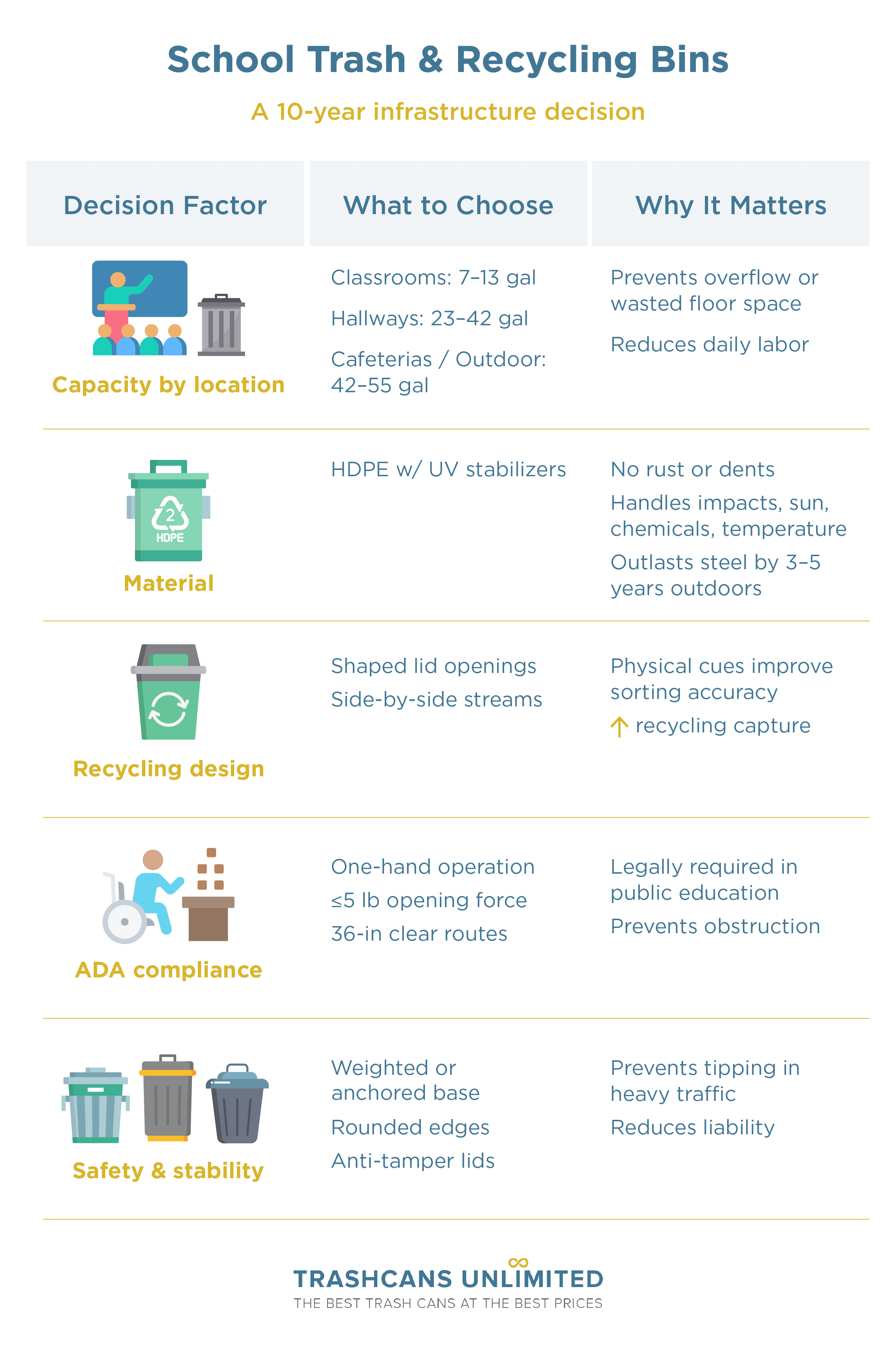
- Size by location: Elementary classrooms need 7–13 gallons; cafeterias and outdoor areas require 42–55 gallons; hallways fall in between at 23–42 gallons depending on grade level.
- Material matters most: Heavy-duty polyethylene (HDPE) with UV stabilizers outlasts painted steel by 3–5 years outdoors and resists the impacts, temperature swings, and chemical exposure common in schools.
- Multi-stream recycling requires design support: Specialized container lids with shaped openings increase recycling compliance by 34%. Pairing recycling bins directly adjacent to trash reduces contamination by 15% and increases recyclable capture rates by 30%.
- ADA compliance is mandatory: Opening mechanisms must require no more than 5 pounds of force and be operable with one hand; bins cannot obstruct the required 36-inch minimum clear width for accessible routes.
- Total cost of ownership beats purchase price: A durable $150 HDPE bin lasting 12 years costs $12.50 annually versus a $75 bin replaced every 4 years at $18.75 annually—50% more over the lifecycle.
Quick-Reference Selection Guide: Trash Cans for Schools by Location
Before the details, here's the practical overview. Match your location to these specifications, then adjust based on your actual traffic patterns.
|
Campus Location |
Recommended Capacity |
Key Features |
Typical Application |
|
Elementary classrooms |
7–13 gallons |
Rounded edges, easy-clean surfaces, bright colors |
Low-volume, safety-first environments |
|
High school hallways |
23–32 gallons |
Secure lids, slim wall-hugging profile, reinforced base |
High-traffic corridors with limited floor space |
|
Cafeterias (all levels) |
32–55 gallons |
Multi-stream capability, swing/push doors, quick liner access |
High-volume food waste with recycling needs |
|
Outdoor courtyards |
32–55 gallons |
Weather-resistant, anchored base, pest-resistant lids |
Unsupervised areas with weather exposure |
|
Stadiums/athletic fields |
42–55 gallons |
Maximum capacity, color-coded streams, rapid liner changes |
Event-driven volume surges |
|
Playgrounds |
32–42 gallons |
Bright visibility, stable weighted base, no pinch points |
Child-safe outdoor environments |
For stadium and athletic facilities, stadium recycling bins handle event-day volume while maintaining clear waste stream separation.
Key Factors for Selecting School and Campus Bins
Durability and Material Quality for High-Traffic Schools
Picture a bin after three years in a middle school hallway: daily impacts from backpacks, rolling carts clipping corners, cleaning chemicals splashed during floor care, temperature swings between August and January. Material choice determines whether that bin is still functional—or cracked, rusted, and scheduled for replacement.
- Heavy-duty polyethylene (HDPE) has become the default recommendation for good reason. It won't dent, rust, or corrode. It handles freezing winters and scorching summers without cracking. UV-stabilized formulations resist the sun damage that destroys cheaper plastics within 2-3 outdoor seasons. In practice, HDPE bins outlast painted steel outdoors by 3–5 years—steel's protective coating fails the moment it gets scratched, and corrosion follows.
- Stainless steel remains the premium choice where appearance matters most: administrative lobbies, libraries, main entryways. The trade-off is fingerprint maintenance and vulnerability to outdoor conditions. Steel also conducts temperature—uncomfortable to touch in extreme weather.
- Fiberglass excels in coastal schools or humid climates where salt air accelerates metal degradation.
- Concrete and aggregate provide maximum vandal resistance for high-risk outdoor areas. Once placed, they're permanent—and effectively immune to the abuse that defeats lighter materials.
When evaluating materials, look for reinforced bases and stress points, UV stabilizers for outdoor use, and impact ratings designed for institutional environments. The Kolorcans outdoor collection exemplifies these durability characteristics.
Trash Can Size and Capacity by School Location
An undersized bin overflows into a maintenance emergency. An oversized bin wastes budget and floor space. The goal is matching capacity to location type and student age.
|
Location |
Elementary (K–5) |
Middle/High School |
College/University |
|
Classroom |
7–13 gal |
13–23 gal |
13–23 gal |
|
Hallway |
23–32 gal |
32–42 gal |
42–55 gal |
|
Cafeteria |
32–42 gal |
42–55 gal |
55+ gal (or multiple) |
|
Restroom |
7–13 gal |
13–23 gal |
13–23 gal |
|
Outdoor common |
32–42 gal |
42–55 gal |
55 gal |
|
Stadium/event |
42–55 gal |
55 gal |
55 gal (high density) |
Why the grade-level differences? Elementary students generate less waste and discard smaller items. High schoolers and college students throw away larger food containers, beverage cups, and project materials.
The 55-gallon drum trap: Many schools buy cheap 55-gallon drums—big capacity, small price. In practice, they create problems. Their height and narrow base make them tip when partially full. They lack liner retention, so bags slip and create messes. Their industrial look undermines campus aesthetics. Modern 42-gallon alternatives like the Kolor Can series offer comparable effective capacity with better stability, integrated liner systems, and professional appearance. For cleaner sightlines in lobbies or administrative areas, the 42-gallon flat top configuration provides a streamlined aesthetic.
Indoor vs. Outdoor Trash Cans for Schools
Indoor and outdoor bins face completely different abuse patterns. Treating them as interchangeable leads to premature failure.
Indoor priorities:
Quiet operation matters in classrooms and libraries—a slamming lid disrupts learning. Soft-close mechanisms solve this. Aesthetic integration affects how spaces feel. Easy liner access impacts custodial efficiency directly: bins that require wrestling to service add labor minutes on every round. Compact footprints preserve hallway traffic flow. Fire-resistant options are recommended near labs, kitchens, and workshops as an industry best practice.
Outdoor priorities:
Weather resistance addresses rain, UV degradation, and temperature extremes. Anchoring prevents bins from tipping in wind or being moved by vandals. Pest-resistant design means sealed lids without gaps. Corrosion resistance is essential for any metal components. High visibility aids wayfinding.
Placement principles (both):
Keep America Beautiful research found that littering occurs when receptacles average 29 feet away, with compliance improving significantly when bins are within 10 feet. Place recycling directly adjacent to trash, not across walkways. Anchor outdoor bins; even heavy HDPE becomes unstable in wind when partially full. High-traffic transitions (building entrances, stairwells) need more capacity than floor area suggests.
ADA compliance is legally required, not optional. Bins cannot obstruct accessible routes (36-inch minimum clear width per ADA Standards). Lid mechanisms must work with one hand and require no more than 5 pounds of force.
For playground needs, playground-specific bins combine outdoor durability with child-safety design.
Hygiene and Odor Control in School Trash Cans
Walk into a school cafeteria on a warm May afternoon. You'll immediately understand why hygiene features matter—and why they're requirements, not luxuries, in spaces serving hundreds of daily users.
Essential features:
Tight-fitting lids contain odors and block pests. The difference between a loose lid and a sealed one becomes obvious during the first warm week of spring.
Hands-free operation via foot pedals or sensors reduces germ transmission. Post-pandemic, this shifted from "nice to have" to expected. Parents notice when bins require hand contact.
Smooth, non-porous surfaces resist bacterial buildup and make sanitization effective. Textured surfaces that trap residue can't be truly cleaned.
Removable inner liners allow thorough washing without moving the entire unit.
For high-traffic areas where touchless disposal matters, automated sensor bins eliminate contact entirely.
Cafeteria specifics:
Swing-door or push-flap lids stay closed but allow easy tray scraping. Liquid-solid separation, where feasible, reduces weight and mess. Proximity to handwashing stations reinforces good habits.
The real odor solution? Frequency. Liner changes twice daily during warm months matter more than any bin feature. The bin's job is containment between services.
Recycling Bins for Schools: Multi-Stream Configuration
Your recycling bin design directly determines contamination rates—and whether recyclables actually get recycled. Municipal contracts increasingly impose fees when contamination exceeds a certain level, with steeper penalties as contamination level increases. Every pizza box in the paper stream, every half-full drink in the bottles bin, threatens your entire program.
What drives compliance:
Color coding leverages learned associations. Blue for recycling, green for compost, and gray or black for landfill have become standard in most jurisdictions, though some regional variation exists—California mandates gray for landfill waste under SB 1383. Deviate from local norms, and users must read and think instead of acting on habit.
Shaped openings provide physical sorting cues. A study found that specialized recycling container lids increased beverage-recycling rates by 34%, demonstrating that perceptual affordances of physical openings improve compliance even when users aren't paying full attention. Round holes sized for bottles physically prevent paper or food waste from entering. Narrow slots accept paper but reject three-dimensional objects.
Pictorial signage outperforms text. A bottle image communicates instantly across language barriers and reading levels. Small-font labels are effectively invisible to rushed users.
Side-by-side placement is essential. According to a recent Keep America Beautiful study, pairing recycling bins with trash bins reduces contamination by 15% and increases recyclable capture rates by 30%. When someone holds trash in one hand and a recyclable in the other, they need both options within reach.
Common mistakes:
Recycling bins without adjacent trash (forces users to contaminate or hold waste). Identical openings for all streams (eliminates visual cues). Text-only labels in small fonts (useless for anyone moving quickly).
For deeper program guidance, our recycling at universities guide covers implementation beyond bin selection.
Custom Logo Trash Cans for Campus Branding
Branded bins work double duty: they reinforce school identity while providing practical benefits that justify the customization cost.
Options available:
School colors match bins to official palettes. Logo application includes laser-etching (durable), screen-printing (vibrant), and vinyl (cost-effective). Custom messaging can incorporate recycling instructions, school mottos, or sustainability pledges. Color-coding can assign specific hues to buildings or waste streams.
Practical benefits:
Branded bins are harder to steal and easier to recover. A bin marked with school identification can't be quietly repurposed. Consistent appearance improves wayfinding. Custom signage addresses your specific recycling requirements.
Custom logo trash cans are available with multiple branding methods and color options.
Safety and Security Features for School Bins
A five-year-old bumps into a bin in the hallway. Does it tip? Does it have sharp edges? In high-traffic environments with young users, safety features prevent accidents and liability.
Key features:
Weighted or anchored bases prevent tipping—critical where smaller children may lean on or bump bins. Rounded edges eliminate cut hazards in crowded hallways. Anti-tamper lids deter unauthorized access. Fire-resistant materials are recommended near labs, kitchens, and workshops as an industry best practice. Locking mechanisms secure sensitive documents or controlled areas.
Vandalism resistance:
Concrete or steel for high-risk outdoor locations. Tamper-resistant hardware. Designs without removable components that invite casual destruction.
Budget Planning and Long-Term Value
The cheapest bin upfront is rarely cheapest over ten years. The math is worth making explicit.
Total cost of ownership:
Purchase price is the number on the budget request—and often dominates decisions. Replacement cycle determines actual cost: a bin needing replacement every four years requires 2-3 purchases over a durable alternative's single lifespan. Maintenance labor accumulates invisibly: liner-change time, cleaning requirements, awkward servicing procedures. These minutes multiply across every bin, every day. Repair costs and parts availability matter when components fail; bins without replacement parts become complete replacements.
The framework: A $150 HDPE bin lasting 12 years costs $12.50 annually. A $75 bin replaced every 4 years costs $18.75 annually—50% more. Add purchasing labor, delivery, installation, and disposal across three cycles, and the premium option becomes obviously economical.
Optimization strategies:
Cooperative purchasing programs and district-wide contracts often eliminate minimum order requirements while providing volume discounts. Warranty coverage should extend 5+ years on structural components. Standardization using 2-3 models campus-wide simplifies parts, training, and reordering. Phased replacement spreads budget impact: high-traffic areas first, lower-priority locations later.
Sustainability and Eco-Friendly Campus Bins
Schools face growing mandates and community expectations around sustainability. Parents, students, and visitors notice environmental choices—including bins.
Sustainability factors:
Recycled-content bins use post-consumer HDPE. End-of-life recyclability ensures metal and some plastics can be recycled when eventually replaced. Durability is sustainability: longer-lasting bins mean less manufacturing, less shipping, less landfill waste. Often, the most sustainable bin is simply one that doesn't need replacement.
Well-designed multi-stream bins improve diversion rates continuously—ongoing impact that compounds over their service life.
The Kolorcan collection combines recycled content with durability that extends useful life.
Accessibility and ADA Compliance
A bin users can't reach or understand gets ignored. The waste ends up on the ground next to it.
Legal requirements for public educational facilities per ADA:
- Height: Operable parts must be within the 15–48 inch reach range for unobstructed forward access.
- Opening mechanisms: Operable with one hand, maximum 5 pounds of force.
- Pathway clearance: Bins cannot obstruct accessible routes; minimum 36-inch clear width required.
- Visual contrast: Bins distinguishable from surroundings for users with low vision.
Beyond compliance:
Eye-level placement in direct traffic paths maximizes use. Bins tucked into corners see dramatically lower compliance. Pictograms and large text serve diverse populations. Consistent locations build habits; unpredictable placement forces active searching.
Recommended School Trash Cans by Campus Zone
Classroom Bins
Classrooms demand quiet operation, compact footprint, and clean aesthetics. Small-to-medium HDPE bins with soft-close lids fit these spaces. The Tuffy Plastic Cans collection offers the durability and easy cleaning classroom use demands.
Cafeteria Stations
Cafeterias need high capacity, multi-stream capability, and liner systems allowing rapid service during lunch rushes. 42–55 gallon bins with swing or push doors minimize contact while enabling tray scraping. Adjacent recycling captures significant cafeteria waste volume. The 42-gallon Kolor Can push door and swing top options handle these demands.
Hallway and Common Areas
Hallways require durability, slim profiles preserving traffic flow, and secure lids preventing tampering. 23–42 gallon slim bins with locking or weighted bases provide stability without consuming floor space. Our school trash cans collection includes hallway-optimized configurations.
Outdoor Courtyards and Quads
Outdoor installations face weather, reduced supervision, and food waste from outdoor dining. Weather-resistant HDPE or concrete with secure mounting and pest-resistant lids address these challenges. The Kolorcans outdoor collection provides appropriate durability and aesthetics for both college campus bins and K-12 outdoor areas.
Playgrounds
Playgrounds require child-safe designs without pinch points or sharp edges, bright visibility colors, and stable bases resisting tipping during child interaction. Playground trash cans address these requirements specifically.
Stadiums and Event Spaces
Event spaces experience surge demand—low use most days, intense activity during games. Maximum capacity, clear color-coding, and rapid liner-change systems matter most. Stadium recycling bins are engineered for this pattern.
Proven Practices for School Waste Management
Conducting a Campus Waste Audit
Before purchasing, understand your current reality. Walk every building and outdoor space—floor plans miss ground-level truth. Document current inventory: condition, capacity, placement. Identify problems: overflow locations, contaminated recycling, vandalism patterns. Map traffic and high-use zones needing extra capacity.
Standardizing Your Campus Bin System
Standardization reduces long-term complexity and cost. Select 2–3 models covering all use cases. Establish consistent color and labeling standards campus-wide. Create replacement and maintenance schedules for predictable budgeting. Train custodial staff—they maintain these bins daily, and their practical input matters.
Measuring Waste Management Success
Track recycling diversion rates before and after implementation. Monitor custodial time on waste management. Survey students and staff on ease of use. Document maintenance and replacement costs to support future budget requests.
Frequently Asked Questions About School Trash Cans
Q: What size trash can works well for school classrooms?
A: Elementary classrooms typically need 7–13 gallon bins. Middle and high school classrooms work well with 13–23 gallon capacity.
Q: How do you prevent trash cans from being vandalized on campus?
A: Use anchored or weighted bases, tamper-resistant lids, and durable materials like heavy-duty HDPE or concrete for unsupervised outdoor areas. Branded bins with school logos are less attractive targets.
Q: What's a strong material choice for outdoor school trash cans?
A: Heavy-duty polyethylene (HDPE) offers the strongest all-around outdoor performance—UV-resistant, won't rust or dent, handles temperature extremes.
Q: Can school trash cans be customized with logos?
A: Yes. Options include laser etching, screen printing, and vinyl application. Beyond aesthetics, branding reduces theft and aids identification.
Q: What's the most durable option for high school hallways?
A: Heavy-duty HDPE bins in 32–42 gallon capacity with reinforced bases and secure lids. Look for UV stabilizers and institutional impact ratings.
Choosing the Right Trash Cans for Your School
Selecting school trash cans and recycling bins is a strategic infrastructure decision affecting maintenance efficiency, recycling success, campus aesthetics, and long-term budgets. The bins installed today will serve—or fail—for the next decade.
The decision framework comes down to matching capacity to location, prioritizing material durability over purchase price, and designing for the behaviors you want to encourage. A 7–13 gallon bin fits an elementary classroom; a 55-gallon unit handles cafeteria volume. HDPE outlasts steel outdoors. Paired recycling stations with shaped openings and pictorial signage reduce contamination and boost compliance. Custom branding deters theft while reinforcing institutional identity.
The lifecycle math consistently favors quality. When you factor in replacement cycles, maintenance labor, and disposal costs, durable bins prove more economical than their cheaper alternatives—and they look better doing it.
Explore premium school and campus trash cans engineered for educational environments. For campuses reinforcing identity while solving waste challenges, custom logo trash cans are available in school colors with multiple branding options.
Need bins for your entire district? Contact our team for volume pricing and recommendations based on your specific campus requirements.