
You've just trimmed a chicken breast. Your fingers are slick, the plastic tray is dripping onto the counter, and the bin lid is right there, waiting to be touched. So you lift it with two fingers, wince, and wash twice.
That small moment is the best argument for thinking about kitchen trash can lid types before size, finish or price. The lid's mechanism decides how often you touch the bin, how much smell escapes, what breaks first and whether the can fits your floor. Pick the lid first, and the can almost chooses itself.
By the end of this guide, you'll know:
- Which lid type fits the way you cook
- What wears out first on each one, and how to spot it early
- Which type fits your kitchen's layout
Kitchen Trash Can Lid Types at a Glance
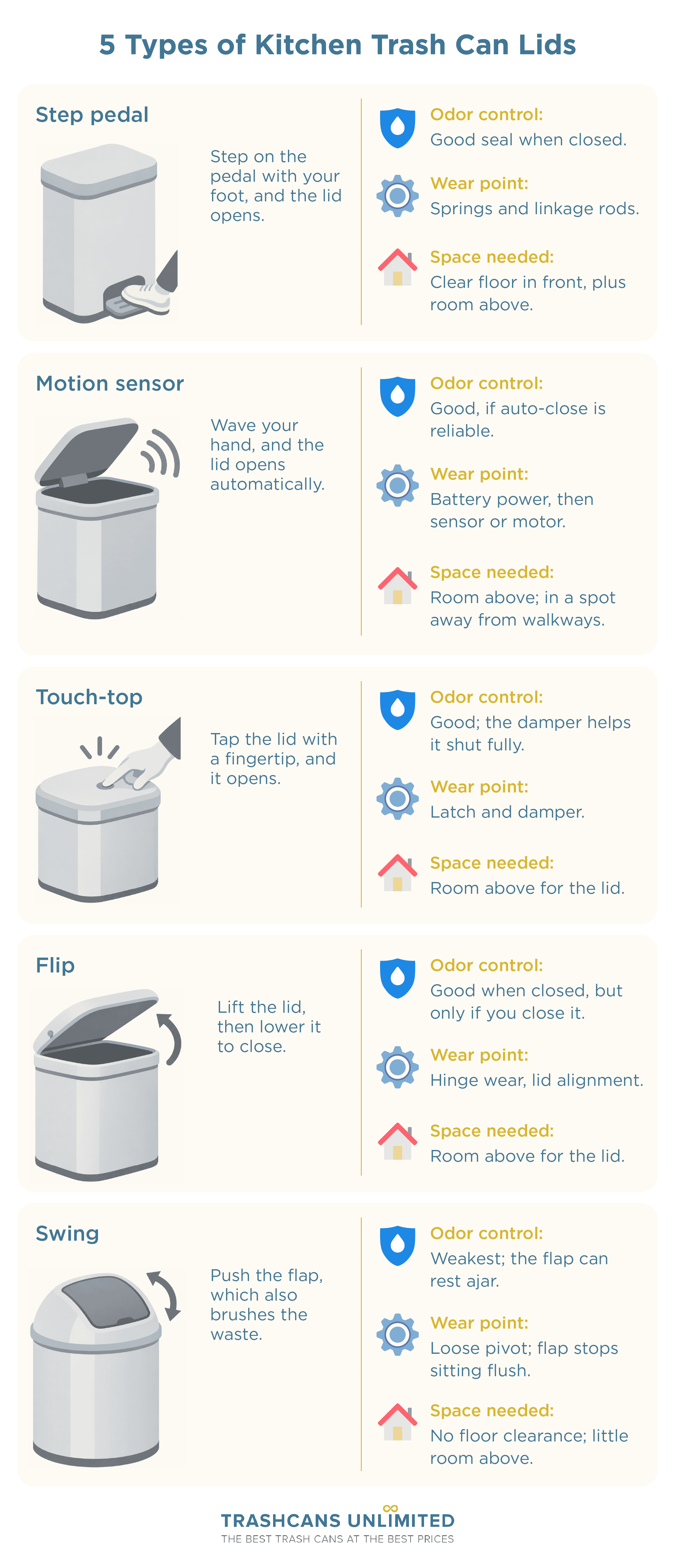
- Best all-rounder for most cooks: Step pedal. You never touch the lid, it needs no batteries, and it drops shut when you lift your foot.
- Best for maximum hands-free use and limited mobility: Motion sensor. It needs the least hand contact of any lid type, but it costs more up front and runs on batteries or charging.
- Best simple, battery-free upgrade: Touch-top. It closes softly and consistently, but it still needs a fingertip tap.
- Best for budget and small kitchens: Flip lid. It has the fewest parts and seals well when closed, but you have to lift and lower it.
- Best only for fast, low-odor waste: Swing lid. It's the quickest to use, and the weakest for odor and hygiene.
|
Lid type |
Hand contact per use |
Odor seal |
What wears out first |
Space needed |
|
Step pedal |
None by hand; your foot works the pedal. |
Good: closes onto the rim when you release the pedal. |
Springs, linkage rods, plastic pedals. |
Clear floor in front, plus room above. |
|
Motion sensor |
None while it's working. |
Good, if auto-close is reliable and the bag fits. |
Battery power, then sensor or motor. |
Room above; a spot away from walkways. |
|
Touch-top |
One fingertip tap; some models need a push to close. |
Good: the damper helps it shut fully. |
Latch and damper. |
Room above for the lid. |
|
Flip |
Lift to open, lower to close. |
Good when closed, but only if you close it. |
Hinge wear, lid alignment. |
Room above for the lid. |
|
Swing |
You push the flap, which also brushes the waste. |
Weakest: the flap can rest ajar. |
Loose pivot; flap stops sitting flush. |
No floor clearance; little room above. |
Ready to compare models? Browse kitchen trash cans by lid type.
The rest of this guide explains why the lid matters this much, and how each type earns its place.
Why Your Kitchen Trash Can Lid Mechanism Matters More Than You Think
The Hygiene Problem on Your Bin Lid
The bin lid is often the one surface you touch between handling raw meat and washing your hands.
Every trip to a hand-operated lid adds a touch point while your fingers may still carry raw-meat juice, dough or oil. Whatever is on your hands can end up on the lid, and from there back on your clean hands later. In a USDA-commissioned study, researchers added a harmless tracer to raw ground turkey and swabbed test kitchens after 371 adults cooked a meal; trash can lids were the third most contaminated surface, behind spice containers and cutting boards. Every surface you touch before you wash joins the chain.
That's why the mechanism, not the material, is the hygiene decision. A hands-free trash can won't make a kitchen safe on its own. It simply means one less surface touched before you wash.
How the Wrong Lid Type Disrupts Your Kitchen Routine
A mismatched lid costs you a little every day.
- Odor escapes from lids that rest ajar or that someone forgets to close.
- Mechanisms fail at the worst moment: a pedal stops lifting the lid, or a sensor stops responding mid-cook.
- Layouts fight back: a pedal juts into a galley walkway, or a lid that lifts hits a counter overhang.
To see how fast it adds up, take one weeknight dinner for example:
- Trimmings and packaging from the raw protein
- Vegetable peelings and ends
- Empty cans, jars or cartons
- Plate scrapings after the meal
That's four or more trips to the bin for one meal, several with messy hands.
Those problems look different for each mechanism. Here's how the five lid types work, from the one you touch most to the one you never touch.
The Five Kitchen Trash Can Lid Types Explained: Mechanisms, Strengths, and Weaknesses
Each type is covered in the same order, so you can compare like for like.
Swing Lids: Fastest Access, Weakest Seal
A swing lid is the quickest lid to use and the poorest at keeping smells in.
- How it works: A flap sits on a central pivot. Push it and it swings in, then rocks back on its own.
- Hand contact: You push the flap, and it brushes whatever goes in, so the one surface you touch is also the dirtiest.
- Odor seal: The flap settles near-closed but often rests slightly ajar, which makes this the weakest option for odor control.
- Durability: Little to break, but the pivot loosens and the flap stops sitting flush.
- Space: Needs no floor clearance and very little room above, so it tucks under a counter.
- Best for: Paper, dry packaging and other low-odor waste.
In a kitchen that sees raw chicken, a swing lid trash can is the wrong tool. For fast, low-odor disposal, browse swing top trash cans.
Flip Lids: Simple, Manual, and Underrated
A flip lid seals well with almost nothing to go wrong, as long as you remember to close it.
- How it works: A single hinge at the back. Lift the lid and it stays open until you lower it.
- Hand contact: Two touches per use, though a wrist or forearm can do the job.
- Odor seal: Closed, the lid forms a perimeter seal (it meets the rim all the way round), which beats any swing flap. Left open, it seals nothing.
- Durability: Few parts, few failures. On cheaper models the hinge wears and the lid drifts out of line.
- Space: No pedal to clear, but the lid needs room above.
- Best for: Small kitchens, tight budgets and anyone who prefers low-tech reliability.
The flip top trash can gets little attention, but it earns its place in rentals and compact kitchens.
Touch-Top Lids: One Tap, Minimal Contact
A touch-top lid cuts contact to a fingertip and needs no batteries, but it's still a touch. Don't confuse it with a touchless lid:
|
Type |
You… |
What happens |
|
Touch-top |
Tap the lid |
A latch releases, a spring lifts the lid, and a damper slows it. |
|
Touchless (sensor) |
Wave near the lid |
A sensor detects your hand, and a small motor lifts the lid. |
- How it works: A spring opens the lid once the latch releases, and a damper (a part that slows the lid as it moves) stops it snapping or slamming.
- Hand contact: One tap to open, and on many models a push to close. A touch-top trash can reduces contact but doesn't eliminate it, which matters most when your hands are dirty.
- Odor seal: The damped close stops the lid bouncing back up, so it shuts fully and consistently. That's the appeal of any soft-close trash can, at the cost of a slightly slower close.
- Durability: The latch and damper wear. A lid that starts slamming or popping back up usually means the damper is going.
- Space: Room above for the lid.
- Best for: Moderate cooking and anyone who values simplicity over automation.
Step Pedal Lids: Foot-Operated and Hands-Free
For most cooks handling raw ingredients, a step trash can is the hands-free option to beat: no batteries and no hand contact.
- How it works: Press the foot pedal and a lever-and-rod linkage lifts the lid. Lift your foot and the lid comes down.
- Hand contact: None. Your hands stay on the cutting board.
- Odor seal: Most close snugly onto the rim when you release the pedal. How well they seal depends on the close type:
- Gravity-close: the lid falls under its own weight. It's simple, but it can bang and bounce.
- Soft-close damper (sometimes sold as slow-close): the lid lowers slowly and quietly and seats fully.
- Spring-assisted: a spring pulls the lid firmly shut.
- Durability: Springs lose tension, rods bend, and plastic pedals can crack with heavy use. Stainless steel pedals and linkages generally outlast plastic ones.
- Space: Clear floor in front for the pedal, plus room above.
- Best for: Daily cooks who handle raw meat, dough or oil.
Pedals rarely snap without warning. They get lazy first: the lid stops opening fully, or the pedal feels loose. Catch that early and a lid or linkage fix can sometimes save the can.
To compare step pedal designs, browse kitchen step on cans.
Motion Sensor Lids: Fully Automatic and Hands-Free
A motion sensor lid needs the least hand contact of any lid type, at the cost of power, price and the odd opening you didn't ask for. A "touchless trash can" almost always means this type.
- How it works: An infrared sensor (one that detects your hand when it comes close to the lid) sends out invisible light and watches for it to bounce back. When your hand enters that zone, a small motor lifts the lid. It stays open while it senses movement, then closes after a short delay. Some models add a manual override or an open-and-hold mode.
- Hand contact: None while it's working.
- Odor seal: It closes itself, so it can't be left open. But it needs a clear rim: a bunched bag or waste piled above the edge can stop it from shutting.
- Durability: Power runs out first; a sluggish or half-opening lid usually needs fresh batteries or a charge. After that, the sensor window and motor are what fail.
- Space: Room above, and a spot away from traffic. Passing movement, direct sun or a counter overhang right above the sensor can trigger some models.
- Best for: Anyone who wants the fewest touch points, and anyone for whom balancing on one foot or gripping a lid is hard.
Sensor lids run on AA batteries or a USB-rechargeable battery. Either way:
- Keep spare batteries or a charging routine, so the lid doesn't stall mid-week.
- Check the product page for a manual opening method.
- Weigh the tradeoff: rechargeables need regular charging; disposables add ongoing cost and waste.
- Recycle spent batteries: EPA says rechargeables don't belong in the trash.
A motion sensor trash can costs more up front than a pedal model; it's worth it if never touching the bin matters most. Compare motion sensor trash cans by size and power type.
Knowing how each lid works is half the decision. The other half is how they compare on the things you'll notice every day.
Head-to-Head Comparison: Choosing the Right Lid Mechanism for Your Kitchen
Hygiene: Hand Contact Ranked Across All Five Lid Types
Only sensor and step pedal lids keep your hands off the bin entirely. Ranked by hand contact per use, least to most:
- Motion sensor: No contact while it's working.
- Step pedal: No hand contact. Your foot does the work.
- Touch-top: One fingertip tap, and sometimes a second to close.
- Flip: Two touches, to open and close, though a wrist or forearm helps.
- Swing: One push, but on the flap that also brushes the waste.
With raw chicken, dough or oil on your hands, a sensor or pedal lid lets you finish and wash once. The other three mean touching the lid or stopping to wash first.
Odor Control: Seal Quality Compared by Lid Mechanism
Odor control comes down to one question: does the lid close fully every time, without anyone having to remember?
A swing flap tends to rest ajar, and a flip lid seals only when someone shuts it. Step lids close on release, with damper and spring-assisted versions seating more reliably than bouncy gravity-close lids. Sensor lids solve the forgotten-lid problem, though the lid stays open for a short delay after each use.
The seal matters most where waste breaks down fastest. Food waste spoils faster in warmth, as its pH fell faster when stored warmer, so a warm kitchen full of food scraps punishes a weak seal.
A bag bunched over the rim stops any lid from sealing, so liner size matters as much as the mechanism. Carbon filters adsorb (trap) odor molecules and gradually saturate, but no filter fixes a lid that sits open.
|
Lid type |
Resting position |
Close type |
Seal consistency |
|
Swing |
Near-closed, often slightly ajar |
Pivot swings back on its own |
Low |
|
Flip |
Closed only if you close it |
Manual |
Good when closed, but depends on you |
|
Touch-top |
Closed |
Damped close (some need a push) |
High |
|
Step pedal |
Closed |
Gravity, soft-close damper or spring-assisted |
High when the lid sits square on the rim |
|
Motion sensor |
Closed |
Motorized auto-close after a short delay |
High, if the bag fits and the can isn't overfilled |
For the most consistent everyday barrier, pick a touch-top, a sensor lid, or a step lid with soft-close or spring-assisted closing.
Durability: What Wears Out First in Each Lid Type
Fewer moving parts means fewer things to fail. That's why simple flip lids tend to outlast complex sensor systems, though every type has a predictable weak point.
Step pedal wear is mechanical: springs, rods and pedals. Sensor wear is mostly electrical: power, the sensor window and the motor. Stainless steel parts generally outlast plastic.
|
Lid type |
Weak point |
Warning sign |
What to do |
|
Swing |
Pivot and flap |
Flap sticks open or flops loosely |
Replace the lid. |
|
Flip |
Hinge |
Lid no longer lines up or won't stay open |
Tighten the hinge if you can; otherwise replace the lid. |
|
Touch-top |
Latch and damper |
Lid won't latch, or slams or pops back up |
Replace the lid if one fits your can. |
|
Step pedal |
Springs, rods, plastic pedals |
Lid opens only partway, pedal feels loose or cracked |
Check whether the lid or linkage can be replaced; if not, replace the can. |
|
Motion sensor |
Batteries, sensor window, motor |
Sluggish or partial opening, opening when nobody's there |
Fit fresh batteries or recharge, and wipe the sensor window; then consider a new lid or can. |
If the can body is still solid and only the lid has failed, a trash can lid replacement is usually the simplest fix. Just match the shape and size to your can first.
Space: Clearance and Kitchen Layout Fit
Check two clearances, not one: the floor in front of the can, and the space above it.
- Swing lids need no floor clearance, and the flap swings within the lid, so they fit under a counter.
- Lifting lids (flip, touch-top, step and sensor) need headroom to open fully. Under a counter overhang or a low shelf, check the open height on the product page. A lid that hits the counter never opens fully and never quite shuts.
- Step pedals jut forward, so allow pedal clearance in front of the can. In a galley kitchen, the pedal becomes a toe-stubber in the main walkway. NKBA guidelines recommend a work aisle of at least 42 inches for one cook, and every inch of pedal eats into it.
- Sensor lids need a spot away from foot traffic to avoid false triggers.
|
Lid type |
Front clearance |
Overhead or under-counter room |
Galley-kitchen fit |
|
Swing |
None |
Minimal: the flap swings within the lid. |
Good |
|
Flip |
None |
Needs room for the lid to open fully. |
Good, if there's headroom |
|
Touch-top |
None |
Needs room for the lid to open fully. |
Good in slim models |
|
Step pedal |
Clear floor for the pedal and your foot |
Needs room for the lid to open fully. |
Fair: the pedal juts into the walkway |
|
Motion sensor |
None |
Needs room to open; avoid an overhang right above the sensor. |
Fair: passing traffic can trigger it |
With the tradeoffs laid out, here's the short version for your household.
Matching a Lid Type to Your Household
Busy Home Cooks: Step Pedal or Motion Sensor
Default to a step pedal. If you handle raw meat, dough or oil most days, a step on trash can keeps your hands off the bin with no batteries to manage. Choose a sensor lid instead if balancing on one foot is uncomfortable, there's no room for a pedal, or you'd rather the lid did everything.
Odor-Sensitive Households: Touch-Top or Motion Sensor
Choose a touch-top or a motion sensor lid. Both close fully and consistently: the touch-top with a damper and no batteries, the sensor lid with no touch at all. A step lid with soft-close or spring-assisted closing is a strong alternative. In a warm kitchen, pair any of them with a correctly sized liner, and empty food scraps often, since fruit flies breed in trash containers.
Budget-Focused Apartment Dwellers: Flip Lid
Choose a flip lid. It has the fewest parts, a good seal when closed, no pedal sticking into the walkway and no batteries to buy. Check the headroom, and make closing it a habit. If the budget stretches a little further, a slim touch-top adds a softer, more consistent close.
Households with Limited Mobility: Motion Sensor
Choose a motion sensor lid. It opens and closes with no grip, no reaching for a pedal and no shifting your weight onto one foot. Keep the can within easy reach but out of the main walkway, and consider a rechargeable model if changing batteries is awkward.
Match the Lid to Your Need, Kitchen, and Budget
- If you handle raw meat most days and have floor space, choose a step pedal.
- If you want zero hand contact or find balancing on one foot hard, choose a motion sensor.
- If smell is your biggest complaint and you'd rather skip batteries, choose a touch-top or a soft-close step lid.
- If you're in a galley or rental kitchen on a budget, choose a flip lid or a slim touch-top.
- If the bin only takes dry, low-odor waste, choose a swing lid.
- If pets get into your bin, see our guide to the best dog-proof trash cans for your kitchen.
Once you know your lid type, choosing the can itself gets much easier.
Choose the Mechanism, Then the Can
Back to that chicken-slick moment over the bin. For most cooks, a step pedal turns it into a non-event: the lid opens under your foot and drops shut when you're done. If you want the least contact of all, or a pedal isn't practical, a motion sensor lid does the same job without a touch.
Whichever type you choose, the test is the same: fewer touches, a lid that closes fully every time, and a fit that suits your floor. Size, finish and capacity are easier to settle once you've chosen between the kitchen trash can lid types.
Your next step depends on where you're starting:
- Shopping for a new bin? Browse kitchen trash cans by lid type.
- Happy with your can but not its lid? Look through our trash can lids for a replacement.