
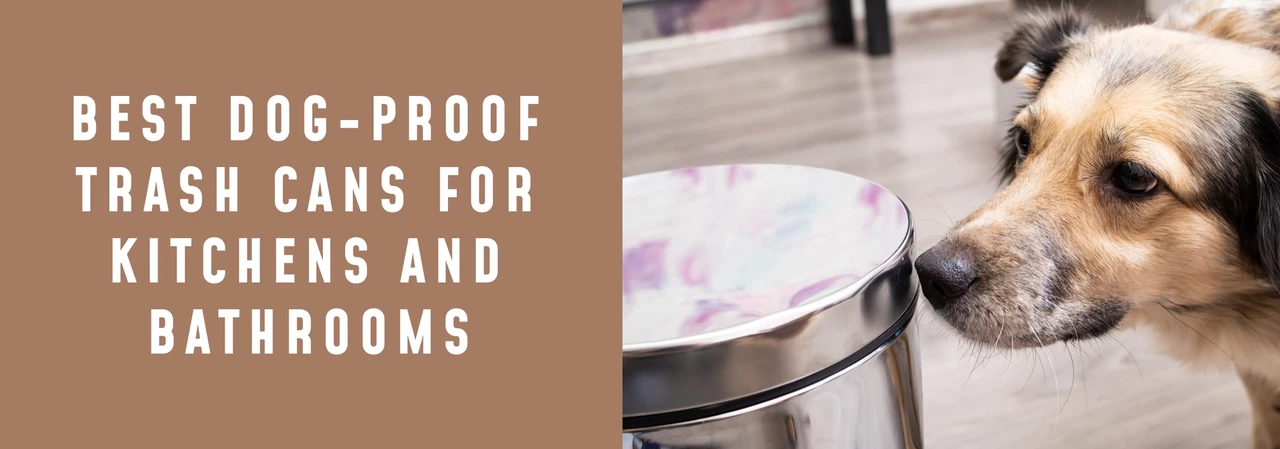
You come home, open the door, and there it is: coffee grounds across the tile, a shredded bag, and a dog who won't meet your eyes. The mess is the easy part. The hard part is wondering what he swallowed.
The best dog-proof trash cans keep the bag fully enclosed and use an opening a dog's nose or paw can't work. Lightweight cans with open swing lids, step pedals or motion sensors are the most common failures. The most reliable designs are heavy steel push-door cans and enclosed wood cabinet bins (tilt-out, hinge-top or flip-top).
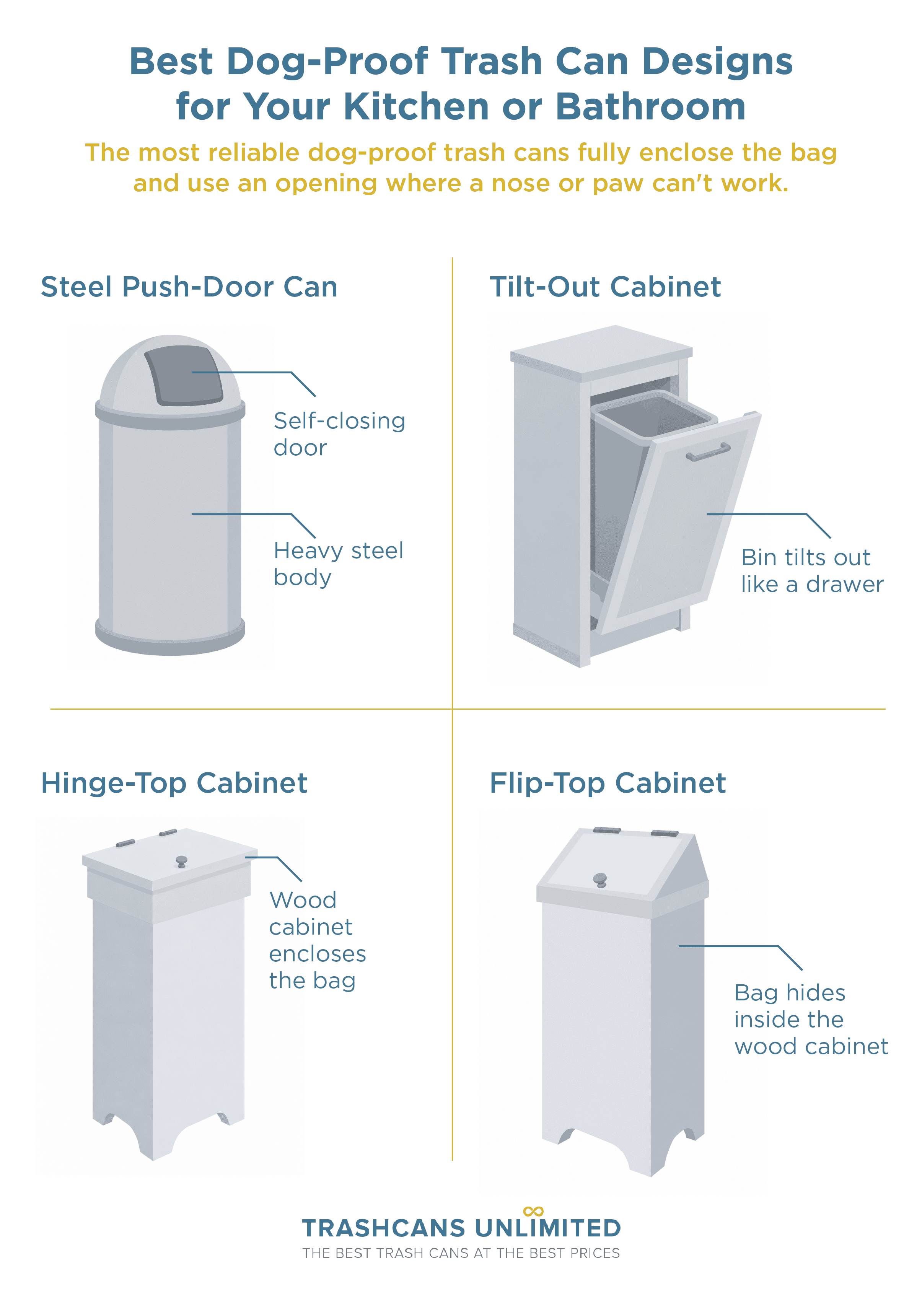
Ready to shop now? Browse our dog-proof trash cans. Every pick below works on the same principle: the bag is fully enclosed, and the opening can't be nosed or pawed open.
|
Pick |
Best For |
Why It Stops Dogs |
|
Large, persistent scavengers |
Steel shell, steel inner liner, self-closing door. |
|
|
Small kitchens, primary bathrooms |
No top opening; the bin tilts out like a drawer. |
|
|
Kitchens that sort recycling |
Both bins sit inside a closed wood cabinet. |
|
|
Easy one-hand access with a cabinet look |
A wood cabinet encloses the bag. |
|
|
A furniture look in open-plan kitchens |
The bag hides inside the wood cabinet. |
To see why these designs work when others fail, it helps to understand how dogs get into trash in the first place.
Why Dogs Raid the Trash and What's at Stake
How Dogs Find, Open, and Tip Trash Cans
Most trash raids follow the same three steps:
- They smell it. The can advertises what's inside long before your dog gets close.
- They open it. A nose under a lid, a paw on a pedal, or a body walking past a sensor.
- They tip it. Paws on the rim or a shoulder bump, and the contents spill across the floor.
Smell is the step owners underestimate. Humans have about 5 to 6 million scent receptors, while dogs have 100 million or more, according to the American Kennel Club. A lid that leaks odor at the seams still tells your dog exactly where dinner went.
Persistence does the rest. Food-motivated breeds like Labs, Beagles and Huskies learn by repetition, and in Labs the drive may be partly genetic: University of Cambridge researchers found that about one in four carries a gene variant linked to appetite and obesity. A can that fails only sometimes is the worst kind: occasional wins build the most stubborn habits. The goal isn't to make trash harder to reach. It's to keep dogs out of the trash entirely.
What Dogs Can Swallow From Kitchen and Bathroom Trash
|
Kitchen Hazards |
Bathroom Hazards |
|
Cooked bones |
Disposable razors |
|
Corn cobs |
Medication packaging and pills |
|
Grapes and raisins |
Dental floss |
|
Onions and garlic |
Cotton swabs |
|
Xylitol gum and baked goods |
Feminine hygiene products |
|
Foil and plastic wrap |
Xylitol toothpaste, mouthwash or gum |
|
Moldy or spoiled food |
Household cleaners |
These aren't rare accidents. In 2025, ASPCA Poison Control took calls on more than 376,000 pet exposures. Food and drink ranked second at 16.4%, led by grapes, raisins, xylitol gum, onions and garlic, and over-the-counter medications and supplements ranked first.
Some are toxic: the ASPCA warns that grapes and raisins can damage a dog's kidneys, and onions and garlic can lead to anemia. Others get stuck. Bones and trash that won't pass can lodge in the stomach or intestines, according to the American College of Veterinary Surgeons, and string-like items such as dental floss are especially risky because they can perforate the gut. Swallowed corn cobs often cause a life-threatening blockage that usually needs surgery, a Kansas State University veterinarian warns, and moldy food waste can carry toxins that trigger vomiting, tremors and seizures, according to the Merck Veterinary Manual.
Xylitol turns up in both rooms. The FDA reports that this sweetener, found in sugar-free gum, baked goods, toothpaste and mouthwash, can drop a dog's blood sugar dangerously within 10 to 60 minutes. Some effects take 12 to 24 hours to appear, so a dog who seems fine isn't necessarily in the clear.
Each of those three behaviors (smelling, opening, tipping) points to a specific feature to look for in a can.
What Makes a Trash Can Dog-Proof: The Features That Matter
A dog-proof can has to stop all three: the smell, the opening and the tip-over. Most shoppers focus only on the lid, which is how they end up with a can that stays shut but still gets knocked over.
|
Opening Type |
How a Dog Beats It |
Dog Resistance |
Notes |
|
Open or swing-top plastic lid |
Pushes through the flap with a nose |
Low |
Built to yield to light pressure |
|
Lightweight plastic flip lid |
Noses up the edge |
Low |
The weakness is the light material |
|
Step pedal |
Steps or leans on the pedal |
Low–Medium |
A pedal can't tell a paw from a foot |
|
Motion sensor |
Walks past or sniffs near it |
Low, unless it locks |
Responds to anything nearby |
|
Manual locking lid |
Paws at the latch until it gives |
Medium–High |
Only as good as the latch |
|
Self-closing push door on a heavy steel can |
Rarely succeeds |
High |
Tall, heavy and self-closing |
|
Enclosed wood cabinet (flip, hinge or tilt-out) |
Rarely succeeds |
High |
The bag is fully hidden |
Ratings are general guidance based on how each design works, not lab test results.
Opening Mechanism: Locks, Push Doors, and Enclosed Lids
The weakest designs are built to open easily. A step pedal is just a lever: it can't tell a foot from a paw, and a 70-pound dog leaning on it supplies all the force it needs. Pedal and push-button locks help. Dual-action latches that need a squeeze-and-lift (the kind that call for opposable thumbs) help more.
Enclosed designs remove the problem instead of guarding it. A tilt-out front has to be pulled outward, so a dog nosing it pushes it shut. A solid wood flip-top or hinge-top cabinet needs a deliberate pull or lift, and a steel push door sits high on a heavy body and swings closed the moment a dog backs off. That's the goal: a trash can dogs can't open, not one they simply have to work harder at.
Lid material matters as much as design. Lightweight plastic swing and flip lids fail against Labs, Beagles and Huskies because they're light and flexible, with an edge a nose can get under. A flip or hinge lid on a heavy pine cabinet is a different thing: solid wood over a closed box.
A secure opening greatly reduces the chance your dog reaches anything in the hazard table. A trash can with a locking lid for dogs is only as strong as its weakest part, so check:
- Self-closing: The door or lid returns to closed on its own.
- No nose edge: There's no lip a snout can get under.
- Solid parts: The latch or door is metal or solid wood, not thin plastic.
- Firm hinges: The lid sits firm, with no side-to-side play.
- Human-only motion: Opening takes a pull, lift or press that a paw can't reproduce.
For a self-closing door on a heavy steel body, see the push-door can profiled below.
Construction and Stability: Materials, Weight, and Anti-Tip Design
|
Material |
Chew Resistance |
Weight and Stability |
Look |
|
Steel |
Highest; teeth can't get purchase. |
Heavy, hard to tip |
Clean and classic |
|
Solid wood (pine) |
Moderate; a softwood, so puppies can mark edges. |
Heavy, square base, very hard to tip |
Furniture, painted or stained |
|
Plastic |
Lowest; chews, cracks and scratches. |
Light, tips easily |
Budget and utilitarian |
A wide, weighted base and a low center of gravity are essential in a busy kitchen. The detail most owners miss: a can is least stable right after you empty it, because the trash that acted as ballast is gone. The can's own weight matters more than how full it is.
Bathroom cans face the same physics with smaller footprints and lighter builds, which is why placement matters so much there (more below). And build quality ties it together: a can that wobbles under repeated bumps from a large dog doesn't just wear out faster. It rewards the next attempt.
Odor Containment: Seals, Filters, and Enclosures
Less smell means less temptation. Airtight gasket seals (a rubber strip that closes the gap around the lid) and carbon filter lids trap the odors that set off a dog's scavenging instinct. Self-closing doors and enclosed cabinets work as odor barriers too. Remember that nose: a gap you can't smell is still a signal to your dog.
Materials matter over time. Steel doesn't absorb odors, sensor cans vent a puff of smell every time they open, and budget plastic soaks up odor and often has a loose lid. Good odor control cuts trash-diving without extra training sessions. It won't replace training for a dedicated scavenger, but it makes that training far easier to hold.
Sensor and Hands-Free Opening: Convenience Versus Security
Automatic sensor lids open for anything that comes close, including a curious nose. And the kitchen is where your dog passes and investigates most, so the lid opens for exactly the visitor you're trying to keep out.
If you love hands-free, look for a manual lock mode that holds the lid shut and survives a battery change. Better still, a push door or tilt-out keeps most of the convenience without the sensor risk. For a dog-resistant trash can that still works one-handed, those two designs are the most practical pet-proof trash can options for a busy kitchen.
With those features in mind, here's how the best options line up for each room and each kind of dog.
The Best Dog-Proof Trash Cans by Room and Dog
Best Dog-Proof Kitchen Trash Cans
A dog-proof kitchen trash can needs room for real food waste. Most households need at least 10 to 13 gallons, and 13 to 15 is the sweet spot. Size up rather than down: an overfilled can won't close.
Where the can will sit shapes the best design:
- Freestanding in the open: a push-door can or a flip-top or hinge-top cabinet
- Against a wall or in a corner: a tilt-out, whose flat top doubles as counter space
- In a kitchen that sorts recycling: a double tilt-out
Best Dog-Proof Bathroom Trash Cans
A dog-proof bathroom trash can has a tougher job than it looks. It holds razors, medication packaging, dental floss, feminine hygiene products and, as the hazard table showed, xylitol toothpaste and mouthwash.
Look for:
- A secure, enclosed opening: a lid that closes fully, with no swinging flap
- A stable base: weighted or wide, or small enough to stand inside a vanity cabinet (If your dog opens cabinets, add a simple childproof latch.)
- Rigid construction: metal or sturdy material, not thin plastic
- A tight fit: a sealed or snug lid to hold in odor
- The right look: a finish that suits the room
Best Picks by Dog and Home Type
|
If You Have... |
Choose... |
Why |
|
A large, food-obsessed dog |
Push-door can |
Steel, heavy and self-closing |
|
A small dog that jumps and climbs |
An enclosed cabinet (flip, hinge, or tilt-out) |
No pedal to trigger, and the bag is out of reach |
|
A puppy in the chewing stage |
Steel for heavy chewers, a wood cabinet once chewing is under control |
Pine is a softwood, so teeth can mark the edges |
|
Several dogs |
A heavy steel can or a wide cabinet |
Hard to tip even when dogs team up |
|
A small kitchen or apartment |
Tilt-out cabinet |
Compact, with a top that works as counter space |
|
A kitchen that sorts recycling |
Double tilt-out |
Both streams enclosed in one piece |
Every design below comes in several finishes. See the full collection to match your kitchen or bathroom.
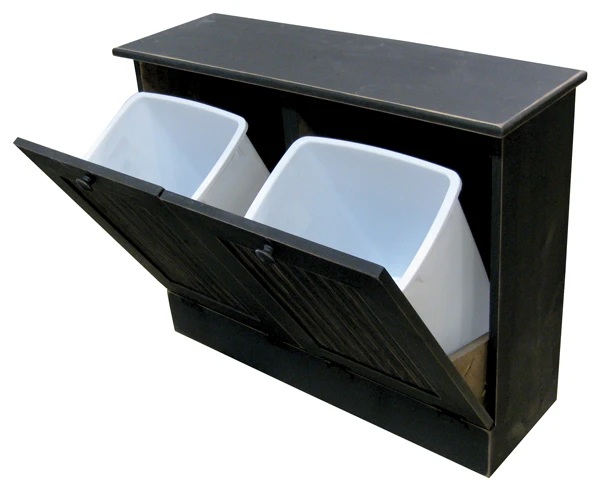
Double Tilt-Out Cabinet Bins
The double tilt out dog-proof trash can and recycling bin puts trash and recycling behind two closed tilt-out fronts in one handmade pine cabinet. The small size holds two 9-gallon bins. The large holds two 13-gallon bins plus an interior shelf for spare bags.
Best for: kitchens that sort recycling and want one piece of furniture instead of two open bins. It comes in 11 colors and is made in the USA.
Why it works against dogs:
- There's no top opening to nose.
- Both bins sit fully enclosed.
- At about 39 to 44 inches wide, the cabinet is very hard to tip.
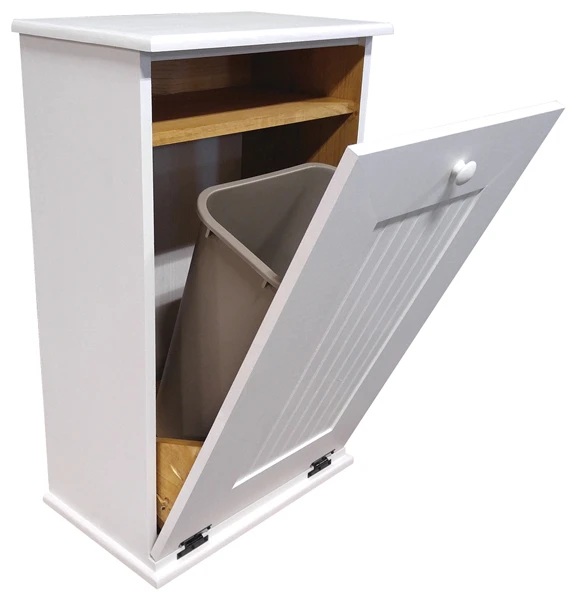
Tilt-Out Cabinet Bin
The tilt out dog-proof trash can is a handmade solid pine tilt out trash can cabinet, 20 inches wide and about 30 inches tall. Its 9-gallon bin swings out like a drawer and takes standard 13-gallon bags, and the flat top works as extra counter space.
Best for: small kitchens and primary bathrooms. It comes in 15 color choices and is made in the USA.
Why it works against dogs:
- There's no top opening at all.
- A dog nosing the front pushes it shut, not open.
- The square, solid base resists tipping.
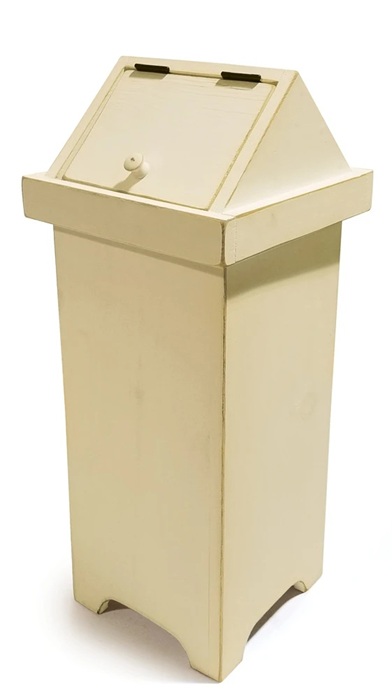
Flip-Top Cabinet Bin
The flip top dog-proof trash can hides a standard 13-gallon bag inside a solid knotty pine cabinet. The body is about 10 inches square and 23 inches tall, under a 12-by-12-inch top. It reads as furniture first and a trash can second.
Best for: open-plan kitchens where the can is on display. With 15 color choices, from stained wood to painted and distressed finishes, it can match almost any cabinetry. It's made in the USA.
Why it works against dogs:
- The bag is fully enclosed, with no exposed rim.
- The top is solid wood, not light plastic.
- The cabinet body hides every edge a dog could grab.
Hinge-Top Cabinet Bin
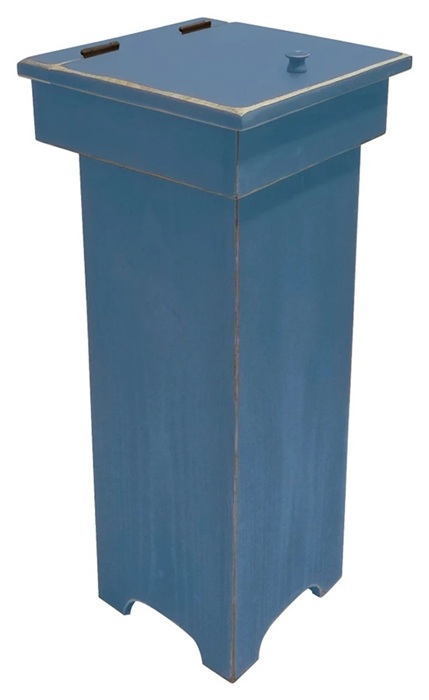
The hinge top dog-proof trash can is a wooden trash can cabinet with a lid that lifts on hinges. The body is 12 inches square and 30 inches tall with the lid, and it takes standard 13-gallon bags.
Best for: one-hand access, with a cabinet look. It comes in 15 color choices and is handmade in the USA.
Why it works against dogs:
- The bag is fully enclosed.
- The solid wood lid needs a deliberate lift.
- The square base resists tipping.
Steel Push-Door Can
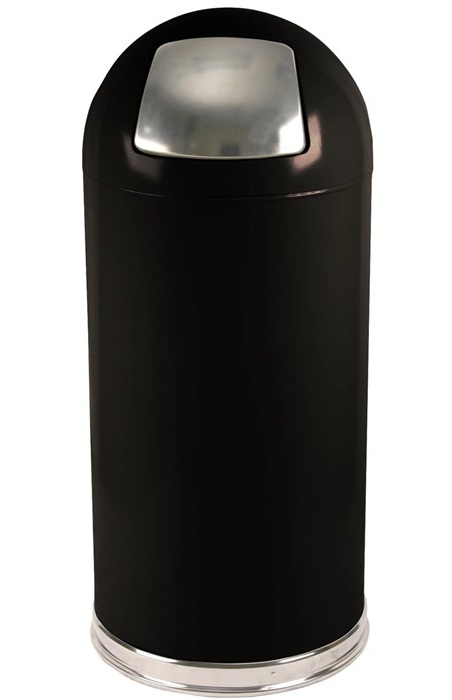
The push door dog-proof trash can is built for the dog that has beaten other cans. A steel shell sits over a steel inner liner, and a rolled stainless steel bottom edge protects your floors. This push door trash can holds 15 gallons and stands 35 inches tall. A 12-gallon version is also available.
Best for: large, food-obsessed dogs. It comes in 6 colors.
Why it works against dogs:
- There's nothing to chew; it's steel inside and out.
- The door swings shut on its own and helps contain odor.
- The heavy steel body resists tipping.
Choosing the right can is most of the battle. Keeping it dog-proof for years comes down to build quality and a few habits.
How to Keep Your Trash Can Dog-Proof Long Term
Durability: What Separates Cans That Last
Big scavengers apply force: they lean, tip and pry. Small, agile dogs apply access: they climb, jump and squeeze into gaps. A can that survives a quick test can still fail against a food-motivated dog left alone for hours, because every empty afternoon is practice time.
Signs a can will last:
- Metal or solid-wood hinges with no wobble
- Doors and lids that still close fully on their own after months of use
- A base or bottom edge that resists scratches and dents
- Replaceable parts, such as a replacement liner
- No thin panels that flex under a paw
Cleaning, Liners, and Hygiene Maintenance
Clean cans attract fewer noses. Residue and bacteria build odor, so easy interior access matters: the push-door can's steel inner liner lifts out for washing. Steel also resists odor and stains better than plastic. In a wood cabinet, the bag and bin do the containing, so the exterior only needs a wipe.
Watch the bag edge. A loose or overhanging trash can liner is an easy handle for a determined dog. An enclosed trash can cabinet hides it entirely.
A simple routine keeps any can working:
- Weekly: Wipe the lid, door edges and handle, where food residue and scent collect.
- Weekly: Check that the bag isn't hanging over the rim.
- Monthly: Wash the inner liner or bin and let it dry fully before rebagging.
- Monthly: Test that hinges, doors and lids still close on their own.
Household Habits That Back Up Your Can
- Take food waste out nightly. Nothing left overnight means nothing to hunt.
- Never overfill. A lid that can't close isn't a lid.
- Move high-risk items outside. Bones, meat wrappers and corn cobs go straight to the outdoor bin. For that, see our guide to outdoor trash cans with locking lids.
- Close bathroom doors. It's one of the cheapest forms of dog-proofing there is.
- Never leave a tied bag on the floor, even for a minute.
- Read labels for xylitol. It may be listed as "birch sugar" or "wood sugar" in sugar-free gum, mints, peanut butter and dental products, according to the FDA. Wrap those items before they go in any can.
Still have questions? Here are the ones dog owners ask most.
Common Questions About Keeping Dogs Out of the Trash
Are wooden trash cans dog-proof?
Solid wood cabinet cans are among the most dog-resistant designs, because the bag is fully enclosed and the lid or door needs a deliberate human motion to open. They're also heavy and square-based, so they're hard to tip. For a puppy that still chews everything, a steel can is the safer pick until that stage passes.
Can dogs open step-on trash cans?
Yes. A step pedal can't tell a foot from a paw, so a dog that steps or leans on it can open the lid. If you want hands-free convenience, a self-closing push door or a tilt-out cabinet is much harder for a dog to work.
Are motion sensor trash cans safe for homes with dogs?
Not on their own. Sensors open for anything that comes close, including a curious nose. If you use one, choose a model with a lock or off mode that holds the lid shut.
How can I stop my dog from knocking over the trash can?
Choose a heavy can with a wide base, such as a steel push-door can or a wood cabinet, because light plastic cans tip easily. Cans are most likely to go over right after they're emptied, when there's no weight inside, so the can's own weight matters most. Taking food waste out nightly also removes the reason to try.
What should I do if my dog ate something from the trash?
Call your veterinarian or the ASPCA Animal Poison Control Center at (888) 426-4435 right away (a consultation fee may apply), even if your dog seems fine. Many poisons, xylitol among them, have a delayed effect, so don't wait for symptoms. Note what was eaten and roughly how much, and don't try to treat it at home.
Choose the Right Can and End Trash Raids for Good
Trash raids stop when the can stops all three things dogs rely on: the smell, the opening and the tip-over. The right dog-proof trash can does that by design, so you're not relying on luck, a bungee cord or a dog's self-control.
- Large scavenger: a steel push-door can
- Furniture look: a flip-top or hinge-top cabinet
- Compact spaces and recycling: a tilt-out or double tilt-out
Browse our full range of dog-proof trash cans and pick the right one for every room in your house.