
The best ultra-slim trash cans for narrow spaces are the ones whose widest point measures less than the gap you actually have. In this guide, you will learn how to measure your own gap in a way that accounts for the protrusions manufacturers rarely list, and the odor and liner details that decide whether a narrow bin is workable or merely narrow.
Key Takeaways
- Check the widest point of the slim trash can, not just its listed width. Lid overhangs, side handles, step pedals, and hinge housings can all add extra clearance requirements. Recessed handles and flush designs are the best choice for the tightest spaces.
- True 6-inch slim trash cans are a niche option. Their narrow footprint limits capacity, stability, and liner fit, making wall- or cabinet-mounted models the better choice for extremely tight spaces. Most homes benefit more from moving up to an 8-inch bin.
- An 8-inch slim trash can is where the category becomes practical. It delivers usable capacity in a footprint that fits narrow kitchen gaps, balancing space savings with everyday features such as hands-free operation, secure liner retention, and effective odor control.
- A slim 13-gallon trash can keeps full-size capacity without taking more floor space. Choose one with a secure liner ring, recessed handles, a stable weighted base, and a lid mechanism that fits your space, because the details that matter most come after the bin fits.
- The best lid for a slim trash can depends on where it will be used. Step-pedal and soft-close lids work best in kitchens, while open-top slim bins are the better choice for bathrooms and offices, where dry waste makes odor control less important.
How to Measure Your Narrow Space: The Widest-Point Method
You will need a tape measure, a pencil, and somewhere to write one number down.
- Measure the gap at its narrowest point, not its average. Run the tape across the opening at floor level, again at knee height, and again at the top. Walls bow, cabinets are rarely square, and older apartments are rarely either. Record the smallest of the three readings. That is your gap.
- Subtract a working tolerance of one inch. This covers the baseboard you measured above rather than behind, the out-of-square wall that closes the gap toward the back, and the plain fact that you will eventually want to lift the bin out and clean behind it. A bin that fits only when shoved is a bin you will stop moving.
- Measure the depth of the gap, front to back. A bin can clear the width and still stand proud of the cabinet line. Slim bins are usually deeper than they are wide, because depth is where the volume goes.
- Measure the height available above the floor. If a countertop, floating shelf, or upper cabinet overhangs the space, measure from the floor to the underside of it. An under-counter trash can lives or dies on that figure.
- Add the lid's travel to that height figure. A swing-top rotates up and back. A flip lid needs clearance above the rim. A step pedal drives the lid upward from below. A bin that fits with the lid closed and cannot open in place is the wrong bin.
- Check the swing arc at floor level. A step pedal travels forward and down as you press it. Make sure nothing occupies the space it moves through or the space a cabinet door needs to swing past it.
The five mistakes that most often cause returns:
- Measuring the cabinet opening instead of the true gap
- Ignoring the baseboard
- Measuring at eye level rather than floor level
- Trusting a product photo's proportions
- Forgetting the door or drawer that has to open beside the bin
|
Protrusion |
Where it adds width |
What to check |
|
Lid overhang |
Both sides, at the rim. |
Whether the listed width is body or rim. |
|
Side handles |
Both sides, mid-body. |
Whether they are molded or applied. |
|
Recessed handles |
Nowhere — flush to the body. |
Nothing. This is the narrow-gap solution. |
|
Step pedal |
Front, increasing through travel. |
Projection at full press, not at rest. |
|
Hinge housing |
Rear, at the lid line. |
Whether the bin can sit flush to the wall. |
Once you have your number, note it down and browse slim trash cans by width.
The Truth About 6-Inch Slim Trash Cans
Below about eight inches, the geometry starts working against itself.
Narrow the footprint and you lose volume, so height has to compensate. But a bin six inches wide and thirty inches tall stands on a base with an aspect ratio approaching five to one, and a front-mounted pedal applies downward force at the front edge, which is also the tipping edge. Physics does the rest.
Liners stop cooperating too. Household bags are cut for rounder openings, and a bag sized by gallon rating bunches badly in a six-inch throat. Bunched liner means folds, and folds are where residue collects, in the part of the bin you can least easily reach.
None of this makes a genuinely six-inch bin impossible. It does explain why so few exist, why most that do are open-top, and why the honest recommendation for a true six-inch gap is often a wall-mounted or cabinet-mounted unit rather than a freestanding can.
Most apartment kitchens, though, have more room than their owners assume. Two more inches changes the arithmetic considerably.
Best 8-Inch Slim Trash Cans: Slim Profile with Usable Capacity
Eight inches is where the category stops compromising.
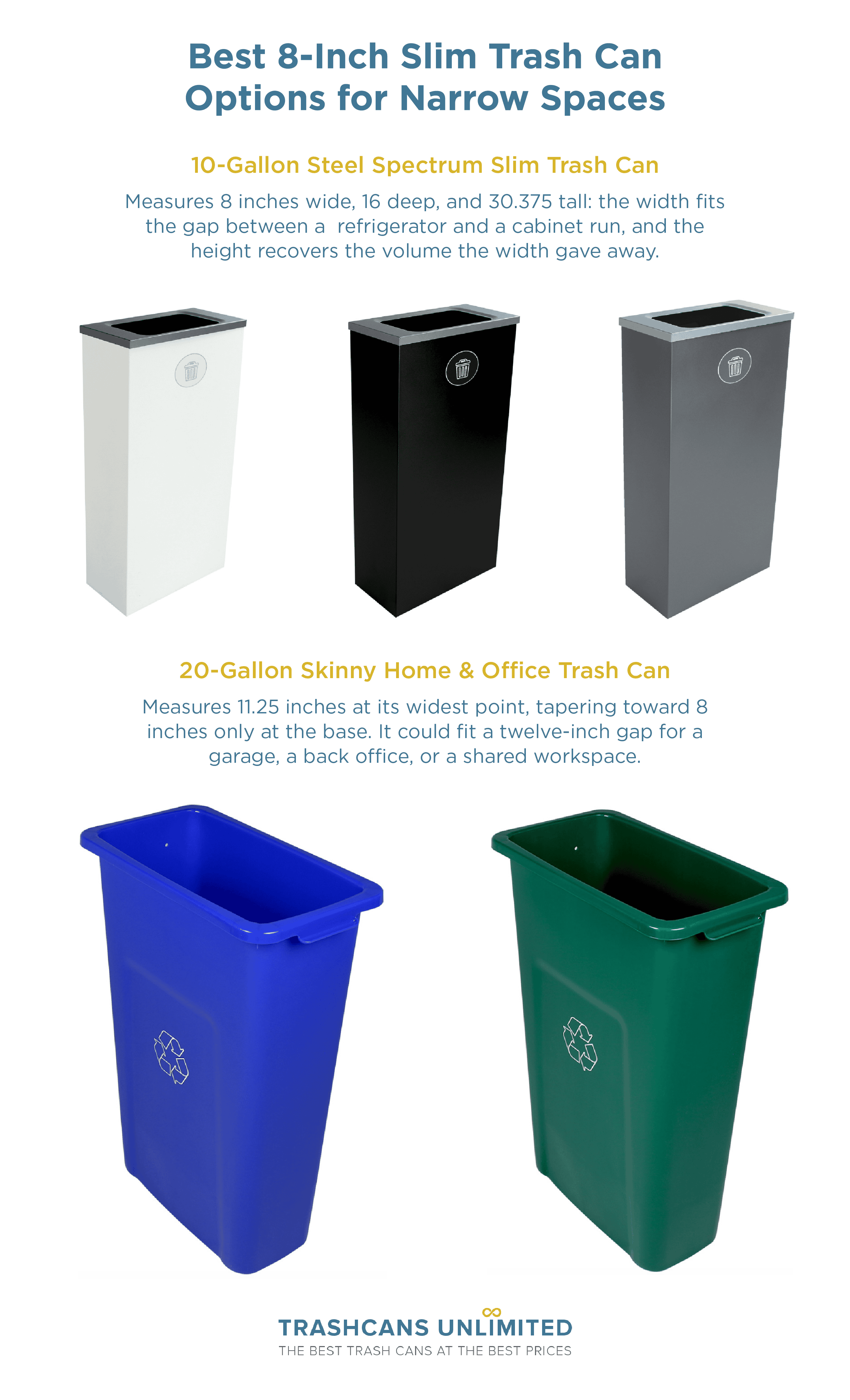
The 10 Gallon Steel Spectrum Slim Trash Can measures 8 inches wide, 16 deep, and 30.375 tall. That is the shape that makes the tier work: the width fits the gap between a refrigerator and a cabinet run, and the height recovers the volume the width gave away.
As a narrow kitchen trash can it sits beside a cabinet run without breaking the line; it also works in a utility alcove, under an office desk, or in a dorm room where floor space is the scarcest resource in the building.
Ten gallons is roughly three-quarters of a standard 13-gallon kitchen bin. So take how often you empty your bin now and add about a third more trips. For scale, the EPA measures US waste generation at 4.9 pounds per person per day — a whole-stream figure counting yard trimmings and bulky goods, so only a share reaches a kitchen bin, but it is why ten gallons fills faster than expected. For one or two people that is usually the right trade for two inches of floor. For a household that cooks daily, it usually isn't.
Standard 13-gallon liners fit a 10-gallon slim bin with room to fold, provided you buy the taller cut. For odor control, a liner ring grips the bag's folded edge and holds it against the rim. It is a small inner collar part doing outsized work: a bag that sags away from the rim leaves a gap where residue collects, and no lid seals against a gap.
Wider, but still narrow: A 20-gallon slim trash can option for utility and office spaces measures 11.25 inches at its widest point, tapering toward eight inches only at the base. It will fit a twelve-inch gap, and for a garage, a back office, or a shared workspace, twenty gallons in a footprint that narrow is a genuinely useful shape.
Best 13-Gallon Slim Trash Cans: Full Capacity, Narrow Footprint
A 13-gallon bin does not need a wide footprint. It needs a tall one.
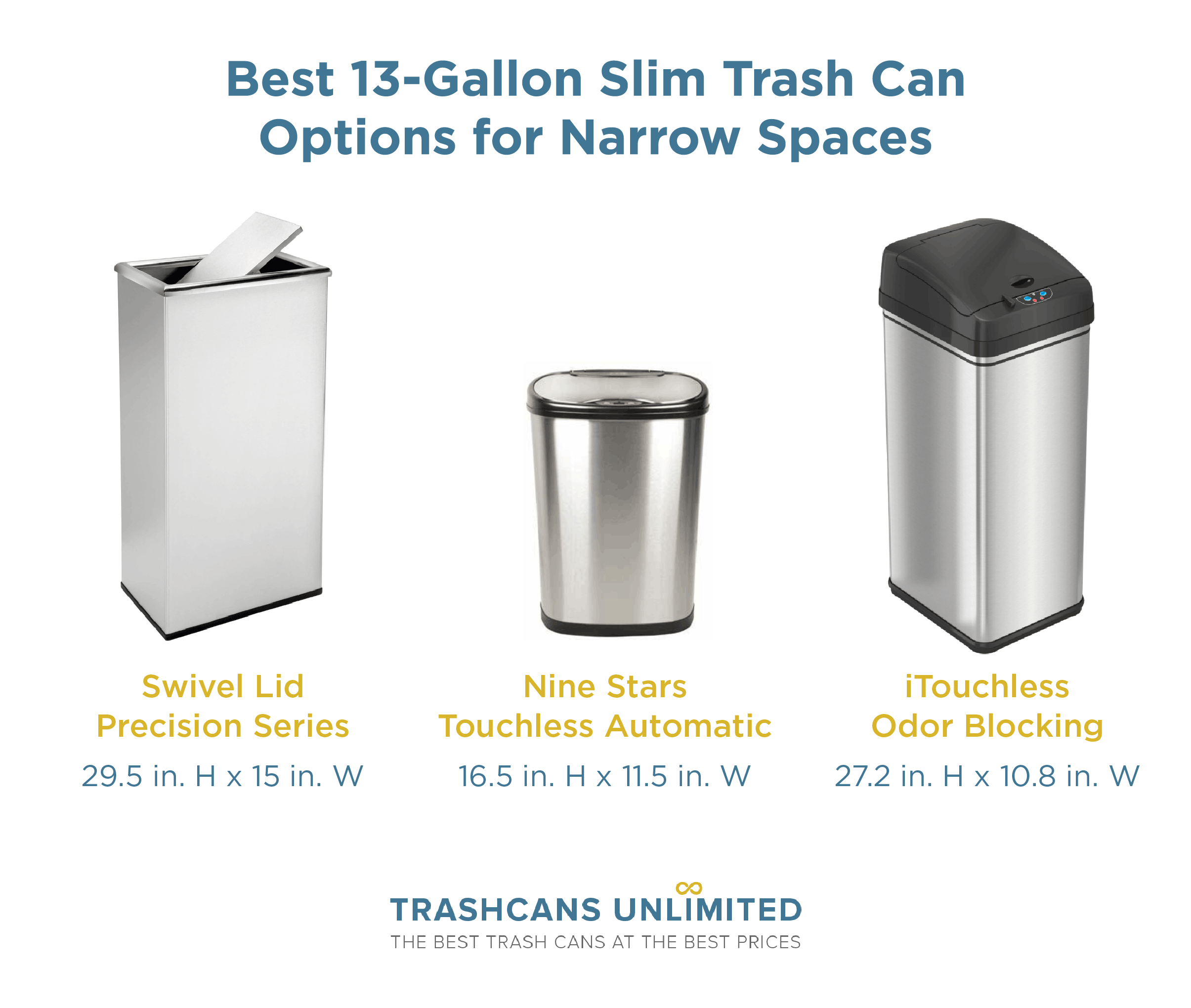
Compare these slim 13-gallon trash can options:
Lid mechanisms: A soft-close hinge is damped so the lid settles rather than drops, which matters in an open-plan apartment where the kitchen is also the living room. A gasket — the compressible seal running around the lid's underside — is what turns a closed lid into a closed bin. Without one, "closed" just means "resting on top."
Handles, which are not a minor detail: Recessed handles add zero width. Side handles add measurable width. In a gap that clears by half an inch, that difference decides whether you can lift the bin out to clean behind it, and a bin you cannot lift out is a bin you will clean around instead of behind.
If you are considering touchless: A touchless trash can trades a mechanical problem for an electrical one, and in a narrow gap the trade is usually worth it — no pedal means no forward projection, which is the one protrusion tight spaces punish hardest. Ask three things before buying. How is it powered — disposable cells or a rechargeable pack? Where does the sensor sit and how far does it reach, given that a wide-tuned sensor will fire every time you open the cabinet next to it? And what happens when the power dies — does the lid still open by hand?
Stability: A 13-gallon bin this narrow is a tall thin trash can by definition, and tall narrow objects tip. A weighted base keeps the trash can in place.
Liner fit: Standard 13-gallon liners, tall cut. A secure liner ring matters more here than anywhere else in the guide, because a bag sagging inside a thirty-inch bin is difficult to reach and easy to ignore.
How to Choose the Right Ultra-Slim Trash Can for Your Space
Choosing a Lid: Step Pedal, Soft-Close, Swing-Top, or Open-Top
The right lid depends on the room, and for one room the right lid is no lid at all.
|
Mechanism |
Added footprint |
Noise |
Best narrow-space use |
|
Step pedal |
Forward projection, growing through travel |
Sharp drop without a damper |
Kitchen, hands full |
|
Soft-close |
None beyond the lid line, needs headroom |
Quietest |
Open-plan, shared living |
|
Swing-top |
None at floor level, needs room above and behind |
Light knock each swing |
Frequent use, dry waste |
|
Open-top |
None |
Silent |
Bathroom, office, bedside |
A bathroom bin emptied every couple of days holds tissue and packaging. Sealing it accomplishes nothing except adding a step between you and the bin, and a bin with friction is a bin that collects things on top of it instead of inside it. Open-top is the solution there.
Odor Control Technology in Ultra-Slim Trash Cans: What Actually Works
Odor is a concentration problem. The same peel releases the same compounds into a 10-gallon bin as a 13-gallon one, but in the smaller volume those compounds sit more concentrated, and every lid opening displaces a share of that concentrated air into the room. In a galley kitchen, the room receiving it is small too. The effect compounds at both ends, which is why the seal matters more on a narrow bin, not less.
What a carbon filter does: Odor molecules stick to the surface of activated carbon rather than soaking into it — physical adsorption, the dominant mechanism for volatile compounds on beaded carbon. And that surface is enormous: one commercial beaded activated carbon measures 1,278 square meters per gram. So a small pad does real work.
What follows from that: Filters saturate. Every molecule that sticks occupies a site that cannot be reused, so a filter in a busy kitchen bin is spent sooner than the same pad in a bathroom. Check the manufacturer's stated replacement interval — commonly three to six months, at the short end under heavy use. And they cannot be revived at home. The barrier is not heat — the study above regenerates at 120 to 160°C — but the controlled nitrogen purge and dedicated apparatus it needs, and the carbon degrades anyway: micropores clog with coke and efficiency falls toward 50 to 60 percent by the sixth cycle. Rinsing or drying a saturated pad achieves nothing.
What it does not do is close a gap: A filter treats the air already inside the bin. If the lid does not seat, or the liner sags away from the rim, odor leaves through the opening regardless of what is mounted under the lid.
Buy the seal first. Treat the filter as a supplement. And before you buy, check whether the pad is a standard size or proprietary to that model. It sets what you pay for the life of the bin, and it is rarely stated where you would look for it.
Materials and Finishes: Stainless Steel, Matte, and Plastic
Steel is the default for a kitchen because the bin is a visible object there and steel reads as intentional. Matte black and white finishes carry their color in a coating and hide oils better than bare steel does, which is why they work in bathrooms where the bin is touched with wet hands. In an office, a dorm, or a garage, plastic is lighter to move, cheaper to replace, and because the color runs through the material rather than sitting on top of it, scratches largely disappear.
Four things any buyer can check without special knowledge:
- Material type, which the listing should state outright.
- Wall thickness, judged by flexing the rim between thumb and finger.
- Base weight, which in a tall narrow bin matters disproportionately.
- A means of securing the liner, whether a ring, a groove, or a clip.
Garbage Bag Compatibility: Matching Liner Size to Capacity
Here is the part nobody warns you about. The bag aisle has exactly the same problem as the bin aisle.
A 13-gallon bags ship in two materially different cuts. The shorter runs roughly 24 by 27 inches flat. The taller "tall kitchen" cut runs roughly 24 by 33. Only one will line a thirty-inch slim bin.
Buy the short cut for a tall narrow can and the bag will not reach the rim with enough left to fold. It slips inside on the first use, the contents settle against bare bin wall, and residue collects where you cannot easily reach it.
A gallon rating told you nothing about whether the bin would fit. It tells you just as little about whether the bag will.
How to size a liner for a rectangular slim bin: Flat bag width should be roughly the interior width plus the interior depth, plus a few inches of slack to stretch over the rim — for an 8-inch-wide, 16-inch-deep bin, about 24 inches plus slack, so 26 to 28. Bag length should be the interior height plus four to six inches of overhang to fold and tie, more if the waste is regularly wet.
Measure the interior, not the exterior. Wall thickness, base molding, and lid housing can overstate the opening by an inch or more.
|
Bin capacity |
Recommended liner |
Watch for |
|
6–8 gal slim |
8–10 gal, or a 13 gal short cut |
Small liners are often too short for slim height |
|
10 gal slim (8" x 16") |
13 gal, check box dimensions |
Gallon rating alone will mislead you |
|
13 gal slim |
13 gal tall kitchen cut |
A short-cut 13 gal will slip on a tall bin |
|
20 gal slim |
20–30 gal, thicker mil |
Heavier fill needs a stronger bag |
One more cost worth checking before you commit: whether the bin takes standard liners at all. Proprietary bag systems are priced per bin, not per aisle, and you are buying them for as long as you own it. Our guide to measuring garbage bags has the full method.
Placement Strategies for Ultra-Slim Trash Cans Across Every Room
Two bins in a small kitchen sounds like a space problem. It is the reason slim bins exist.
The NKBA's planning guidelines recommend at least two waste receptacles — one near each cleanup and prep sink, and a second for recycling either in the kitchen or nearby. In a large kitchen, that is trivial. In a 700-square-foot apartment, it is the entire difficulty — and the point where a narrow footprint stops being a compromise: two eight-inch bins take up less floor than one standard sixteen-inch can.
From there the logic runs through the rest of the home. A sealed bin where food waste is generated. An open-top in the bathroom, where waste is dry and the bin is emptied often enough that a lid is friction rather than protection. A small bin beside the desk, so paper never migrates to the kitchen. In a bedroom, beside the nightstand or in a closet corner. And every one of those decisions comes back to a single number: the widest point of the gap. So go and measure the gap, then shop to that number.