
Originally posted on 15th Nov 2024
Learning how to measure garbage bags takes about 60 seconds, a tape measure, and one of two simple formulas: one for rectangular bins, one for round. This guide gives you both formulas upfront, explains every dimension on the packaging, walks you through thickness and material selection, and flags the sizing mistakes that waste the most money. Measure once, buy right every time.
Key Takeaways
- Two formulas solve every bin. Rectangular: Bag Width = Bin Width + Bin Depth. Round: Bag Width = (Bin Diameter × 3.14) ÷ 2. Add 3–4 inches to bin height for overhang.
- Always measure from the inside. Exterior dimensions include wall thickness and molded features that don't affect bag fit — interior measurements are what matter.
- Gallon labels can mislead. A "13-gallon kitchen bin" may actually hold 17+ gallons. Calculate volume in cubic inches and divide by 231 to get true gallons, then round up to the nearest standard bag size.
- Thickness determines success under load. One mil equals one-thousandth of an inch (0.001″), and 1 mil ≈ 25.4 microns. Match mil rating to waste type: 0.9 mil for standard kitchen, 1.5+ mil for sharp or heavy loads, 3.0+ mil for contractor-grade work.
- Material matters as much as thickness. HDPE bags handle paper and dry waste cheaply but puncture easily. LDPE/LLDPE bags resist tears, punctures, and stretch — the right choice for anything sharp, heavy, or wet.
- Gusseted bags are wider than they appear. The width on the packaging is the flat measurement. True expanded width = Flat Width + Gusset Depth.
- Measure once, buy right for years. Record each bin's dimensions and corresponding bag size. For facilities, build a standardized spec sheet and distribute to custodial staff and procurement.
The Two Formulas You Need (60-Second Answer)
Grab a tape measure, identify whether your bin is rectangular or round, and plug in three numbers. That's the whole process.
Formula 1: Rectangular and Square Bins
Bag Width = Bin Width + Bin Depth
Bag Height = Bin Height + 4 inches (overhang for tying or draping over the rim)
Worked Example: A typical kitchen bin might measure 11 inches wide × 15 inches deep × 24 inches tall. Bag Width = 11 + 15 = 26 inches. Bag Height = 24 + 4 = 28 inches. You need a bag at least 26" × 28".
Why Width + Depth? When you open a flat bag and drape it into a rectangular bin, one side of the bag covers the width and the other covers the depth. Adding those two dimensions gives you the minimum bag width that lines the interior without gaps or bunching.
Formula 2: Round and Cylindrical Bins
Bag Width = (Bin Diameter × 3.14) ÷ 2
Bag Height = Bin Height + 4 inches
Worked Example: A round outdoor bin has a 22-inch diameter and is 30 inches tall. Circumference = 22 × 3.14 = 69.08 inches. Bag Width = 69.08 ÷ 2 ≈ 34.5 inches. Bag Height = 30 + 4 = 34 inches. You need a bag at least 35" × 34".
A flat bag folded in half needs to wrap all the way around the inside of the bin. Half the circumference gives you the required bag width.
These two formulas cover the vast majority of household and commercial bins. The sections below break down each dimension, walk through the measuring process step by step, and help you choose the right bag thickness for your waste type.
Understanding Garbage Bag Dimensions
Width, height, gusset, circumference — these are the trash bag dimensions that determine whether a liner fits your bin or collapses into it. Knowing what each term means on the packaging keeps you from buying blind. For a full reference, see our garbage bag size chart.
Width, Height, and What They Mean on the Package
Width is the measurement across the bag's open mouth when it's laid flat. It tells you whether the liner can wrap all the way around the inside perimeter of your bin. Too narrow, and the bag pulls away from the walls and collapses inward under the weight of trash.
Height is the measurement from the sealed bottom to the open top. It determines whether the bag reaches the floor of the bin with enough material left over to drape over the rim or tie off. Too short, and the bag slides down into the can the moment you drop something in.
Width = wrap. Height = reach plus anchor.
What Is a Gusset and How It Affects Sizing
A gusset is a folded side panel sealed into the bag that lets it expand into a box-like shape. Gusseted bags are built for rectangular and square bins, where a standard flat bag would bunch in the corners instead of conforming to the geometry.
The detail most people miss: the width printed on the packaging is the flat width — measured with the gusset folded in. The bag's true functional width is larger.
Gusset Formula: True Expanded Width = Flat Width + Gusset Depth (one side)
Worked Example: A bag labeled 24 inches wide with a 6-inch gusset actually opens to 30 inches across when the panels unfold. If you're matching it to a rectangular bin, 30 inches is the number that matters — not the 24 on the box.
When to choose gusseted vs. flat: Gusseted bags conform to corners in rectangular bins without excess material. Flat bags work better for round bins, where there are no corners to fill.
Circumference and Diameter: Measuring Round Bins
For round bins, two measurements matter: diameter (the straight-line distance across the widest point of the opening) and circumference (the total distance around the rim).
Circumference = Diameter × π (3.14)
Since a flat bag folded in half needs to wrap around the full interior:
Bag Width = Circumference ÷ 2
Practical tip: If you don't have a rigid ruler long enough to span the opening, wrap a flexible tape or string around the rim for circumference directly, then divide by two. On larger commercial bins, this is often faster and more accurate than trying to eyeball the center for a diameter measurement.
If you're unsure of your bin's exact dimensions, our guide on how to determine what size your trash can is walks through the full identification process.
Step-by-Step: How to Measure Your Bin and Find the Right Bag
Grab your tape measure, pick a bin, and follow the steps for its shape. One rule applies to every bin: measure from the inside, not the outside. Exterior dimensions include wall thickness and molded features that don't affect bag fit.
What You Need Before You Start
- A tape measure (flexible for round bins, rigid for rectangular)
- A calculator or phone
- A pen and paper or notes app to record measurements
- Optionally, a garbage bag size chart for cross-referencing
Under two minutes per bin. That's the full commitment.
Measuring Rectangular and Square Bins
Step 1: Measure the bin's width — the shorter side of the top opening — in inches. Place the tape inside the bin, wall to wall.
Step 2: Measure the bin's depth — the longer side of the top opening — in inches.
Step 3: Add Width + Depth = your required bag width.
Step 4: Measure the bin's height from the bottom interior to the top rim.
Step 5: Add 3 to 4 inches for overhang = your required bag height. That extra material is what lets you fold the bag over the rim or tie it off when full.
Worked Example:
A typical kitchen bin might measure 11" wide × 15" deep × 24" tall.
- Bag Width = 11 + 15 = 26 inches
- Bag Height = 24 + 4 = 28 inches
- You need a bag at least 26" × 28"
Tapered bins — wider at the top, narrower at the bottom — always get measured at the widest point: the top rim. The bag needs to fit the opening; gravity handles the rest.
Measuring Round and Cylindrical Bins
Step 1: Measure the diameter across the widest point of the interior opening. Alternatively, wrap a flexible tape or string around the inside rim to get the circumference directly.
Step 2: If you measured diameter, multiply by 3.14 to get circumference. Divide circumference by 2 = your required bag width.
Step 3: Measure the height from the bottom interior to the top rim.
Step 4: Add 3 to 4 inches for overhang = your required bag height.
Worked Example:
A round outdoor bin has a 22-inch diameter and stands 30 inches tall.
- Circumference = 22 × 3.14 = 69.08 inches
- Bag Width = 69.08 ÷ 2 ≈ 34.5 inches
- Bag Height = 30 + 4 = 34 inches
- You need a bag at least 35" × 34" (round up to the nearest standard size)
For large commercial garbage can sizes, the formula scales linearly — a 44-inch diameter drum just means bigger numbers, not a different process.
Cross-Referencing Your Measurements with Gallon Capacity
Gallon capacity is where most sizing mistakes happen. Garbage bags are sold by gallon capacity, but your tape measure gives you inches. Here's how to convert.
Volume formula for rectangular bins:
Volume (cubic inches) = Width × Depth × Height
Convert to gallons: 1 gallon = 231 cubic inches
Volume formula for round bins:
Volume (cubic inches) = π × (Radius²) × Height
(Radius = Diameter ÷ 2)
Worked Example: That 11" × 15" × 24" kitchen bin: 11 × 15 × 24 = 3,960 cubic inches. 3,960 ÷ 231 = 17.1 gallons. A 13-gallon bag would be too small — you'd need a 20-gallon bag at minimum.
This catches people off guard. "Kitchen bin" doesn't automatically mean "13-gallon bag." Actual volumes vary widely by manufacturer, and the only way to know is to calculate.
Your calculated gallon capacity is the floor. Never go smaller. If your number falls between two standard sizes, round up — a slightly oversized bag folds over the rim and works fine. An undersized bag fails immediately.
|
Gallon Capacity |
Typical Bin Type |
Common Bag Dimensions (W × H) |
|
4–7 gal |
Small wastebasket (bathroom, desk) |
17" × 18" to 20" × 22" |
|
8–10 gal |
Medium office, bedroom |
22" × 24" to 24" × 24" |
|
12–16 gal |
Standard kitchen (rectangular) |
24" × 28" to 27" × 30" |
|
20–30 gal |
Tall kitchen, step-on, medium outdoor |
30" × 33" to 33" × 40" |
|
32–44 gal |
Round outdoor, commercial |
33" × 40" to 38" × 46" |
|
55–65 gal |
Large round, drum, industrial |
38" × 58" to 43" × 48" |
|
95–96 gal |
Wheeled tote, curbside |
46" × 50" to 50" × 52" |
These are standard ranges. Always measure your specific bin using the formulas above for the most accurate fit.
For detailed breakdowns, see our guides on garbage bag sizes in gallons and garbage bag sizes in liters.
Choosing the Right Bag Thickness and Material
Getting the right size is half the equation. The other half is selecting a bag thick enough to handle what you're actually throwing away.
A perfectly sized bag in the wrong material still punctures, stretches out, or splits at the seam. Understanding thickness ratings and polymer types takes less than a minute, and prevents the most expensive kind of failure: the one that happens after you've already lifted the bag out of the bin.
Mil vs. Micron: How Bag Thickness Is Measured
Mil is the standard U.S. thickness unit for garbage bags. One mil = one-thousandth of an inch (0.001″). Micron is the international metric equivalent — one-thousandth of a millimeter (0.001 mm). The conversion: 1 mil = 25.4 microns (an exact value per NIST standards).
The two units are not interchangeable. A bag rated at 1 mil is roughly 25 microns — a number that sounds much larger but represents the same physical thickness. When comparing domestic and imported bags, convert to a single unit first.
The rule is simple: higher mil = thicker and more puncture-resistant.
|
Thickness (Mil) |
Thickness (Micron) |
Application |
|
0.5–0.7 mil |
~12–18 µm |
Light-duty: office, bathroom (paper, tissues only) |
|
0.9–1.1 mil |
~23–28 µm |
Standard household: general mixed waste |
|
1.2–1.5 mil |
~30–38 µm |
Kitchen-grade: food scraps, moderate liquids |
|
1.5–2.0 mil |
~38–51 µm |
Heavy-duty: wet kitchen waste, heavier loads |
|
2.0–3.0 mil |
~51–76 µm |
Yard waste: branches, dense clippings |
|
3.0+ mil |
76+ µm |
Contractor-grade: construction debris, demolition |
A 0.5-mil bag is cheaper on the shelf. It's far more expensive when it tears halfway to the dumpster and you're scraping food waste off the hallway floor.
High-Density vs. Low-Density Polyethylene: Which Do You Need?
Beyond thickness, the polymer type determines how a bag handles stress. Two categories cover nearly every bag on the market: HDPE (high-density polyethylene) and LDPE/LLDPE (low-density and linear low-density polyethylene).
HDPE bags feel stiff and crinkly — almost papery. The high-density polymer structure packs more strength per mil, making them efficient for lightweight, non-sharp waste: office paper, bathroom tissues, dry recyclables. The tradeoff is puncture resistance. One sharp edge — a broken pen, a can lid — and the bag is compromised.
LDPE and LLDPE bags feel thicker, stretchier, and quieter in your hands. The lower-density structure gives them superior tear resistance, puncture resistance, and elasticity — the right choice any time your waste includes sharp objects, heavy items, or significant moisture. LLDPE, the linear variant, offers the strongest balance of stretch and durability and is the most common material in quality kitchen and commercial bags.
|
Property |
HDPE |
LDPE / LLDPE |
|
Feel |
Stiff, crinkly |
Soft, stretchy |
|
Puncture resistance |
Low |
High |
|
Tear resistance |
Low |
High |
|
Stretch |
Minimal |
Significant |
|
Typical mil range |
0.31–0.51 mil (8–13 µm) |
0.7–3.0+ mil (18–76+ µm) |
|
Best for |
Paper, dry waste, light loads |
Kitchen waste, sharp items, heavy loads |
|
Cost |
Lower per bag |
Higher per bag, lower cost per successful use |
The shortcut: anything sharp or heavy → LDPE or LLDPE. Paper and dry waste only → HDPE saves money without risk.
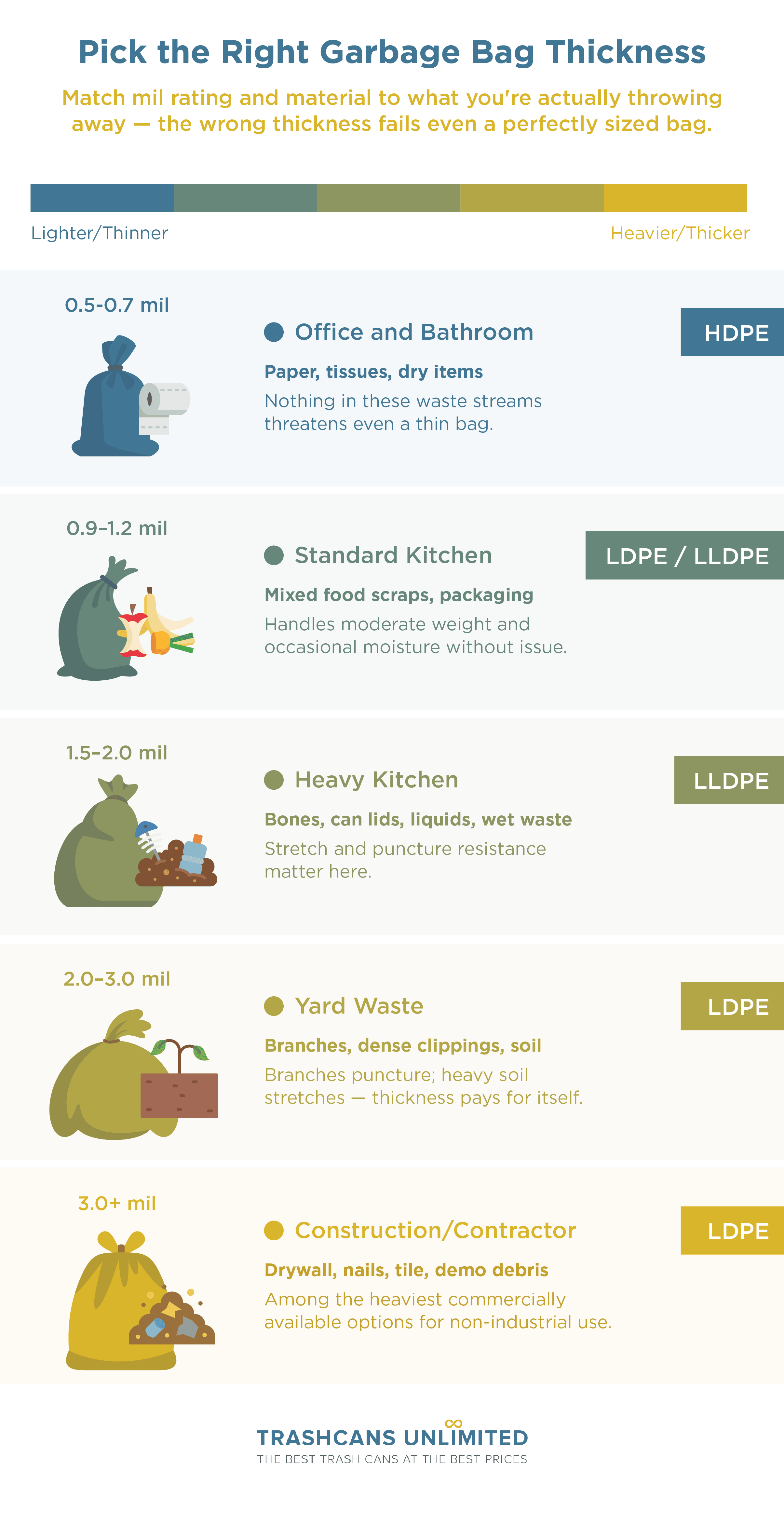
Matching Thickness to Your Waste Type
Skip the mil chart memorization. Match the bag to what's going in it:
- Office and bathroom (paper, tissues, dry items): 0.5–0.7 mil HDPE. Nothing in these waste streams threatens even a thin bag.
- Standard household kitchen (mixed food scraps, packaging): 0.9–1.2 mil LDPE or LLDPE. The everyday workhorse — handles moderate weight and occasional moisture without issue.
- Heavy kitchen (food scraps, liquids, bones, cans): 1.5–2.0 mil LLDPE. Sharp-edged items like bones and can lids are among the most common causes of kitchen bag punctures. Stretch and puncture resistance matter here.
- Yard waste (branches, dense clippings, soil): 2.0–3.0 mil LDPE. Branches puncture; heavy soil stretches. Thickness pays for itself.
- Construction and renovation debris (drywall, nails, tile): 3.0+ mil contractor-grade LDPE. Among the heaviest commercially available options for non-industrial use.
- Commercial and facility (mixed heavy, multi-source): 1.5–2.0 mil LLDPE minimum. For facility managers ordering across unpredictable waste streams, LLDPE at 1.5 mil is the safest default — it handles what you can't predict in shared bins.
Common Mistakes and Pro Tips for a Perfect Fit
The right formulas and the right thickness get you 90% of the way. These mistakes and shortcuts cover the last 10%.
Five Sizing Mistakes That Waste Money
- Measuring the outside of the bin instead of the inside. Interior dimensions are what the bag needs to fit. The exterior includes wall thickness, textured surfaces, and molded ribs. On heavy-duty commercial bins, the difference can be a full inch or more per side — enough to throw your bag width calculation off by two inches.
- Forgetting to add overhang. Without 3 to 4 extra inches of height, the bag can't fold over the rim to stay put or tie off when full. This is the most common reason bags slide into the can — they reach the bottom but have nothing left at the top to anchor.
- Confusing flat width with expanded width on gusseted bags. The width on the packaging is the folded-flat measurement. If the bag has gussets, the true functional width is larger. Buying on flat width alone consistently results in bags too narrow for rectangular bins.
- Choosing thickness based on price alone. A 0.5-mil bag is cheaper per unit. A single failure — leaking onto flooring, re-cleaning a bin, a custodial callback — costs multiples of the savings. For facility managers, one ruptured bag during transport can mean stained carpet or a slip-and-fall incident. Match thickness to waste type, not to the lowest line item.
- Using the wrong formula for the bin shape. The rectangular and round formulas are not interchangeable. Applying Width + Depth to a round bin produces a meaningless number. Always identify the shape first.
Pro Tips for Optimizing Fit and Reducing Waste
- Test before you bulk-order. Buy a single box to confirm fit before committing to hundreds or thousands of bags. A test box costs a fraction of a mismatched bulk shipment — especially critical for commercial and facility purchasing.
- Between two standard sizes? Round up. A slightly oversized bag folds over the rim for a snug fit. An undersized bag fails immediately and can't be made to work.
- Account for stretch. LDPE and LLDPE bags give you some additional margin on width because they conform rather than resist. This isn't a reason to deliberately undersize, but an LDPE bag at the exact calculated width will perform better than an HDPE bag at the same width.
- Tapered bins: measure the top rim. The bag needs to fit the widest point — the opening. Gravity and trash weight push it into the narrower base naturally.
- Tape a measurement cheat sheet inside a cabinet door. Record each bin's dimensions and corresponding bag size once. Never re-measure.
- Facilities: build a standardized spec sheet. List each bin model, its interior dimensions, and the corresponding bag size and thickness. Distribute to custodial staff and procurement. This turns bag purchasing from a guessing game into a repeatable system across every property.
Quick-Reference: Garbage Bag Size Chart by Bin Type
Here's a chart mapping common bin types to recommended bag dimensions and thickness.
|
Bin Type / Common Use |
Typical Bin Dimensions (Interior) |
Recommended Bag Width × Height |
Gallon Capacity |
Recommended Thickness |
|
Small wastebasket (bathroom, desk) |
~9" × 6" × 12" or ~10" dia × 12" |
17" × 18" to 20" × 22" |
4–7 gal |
0.5–0.7 mil HDPE |
|
Medium rectangular (bedroom, office) |
~11" × 8" × 18" |
22" × 22" to 24" × 24" |
8–10 gal |
0.7–1.0 mil LDPE |
|
Standard kitchen (13 gal, rectangular) |
~11" × 15" × 24" |
24" × 28" to 27" × 30" |
12–16 gal |
0.9–1.5 mil LLDPE |
|
Tall kitchen (step-on) |
~12" × 14" × 26" |
26" × 30" to 28" × 33" |
13–16 gal |
1.0–1.5 mil LLDPE |
|
Round outdoor (32 gal) |
~22" dia × 27" |
35" × 33" |
32 gal |
1.5–2.0 mil LLDPE |
|
Large round (44 gal) |
~24" dia × 32" |
38" × 38" to 40" × 46" |
44 gal |
1.5–2.0 mil LLDPE |
|
Wheeled tote (65–96 gal) |
~24" × 28" × 40" to 27" × 34" × 44" |
46" × 50" to 50" × 52" |
65–96 gal |
2.0–3.0 mil LDPE |
|
Commercial Slim Jim (rectangular) |
~11" × 22" × 30" |
31" × 36" to 33" × 40" |
23–30 gal |
1.2–1.5 mil LLDPE |
These are standard ranges. Always measure your specific bin using the formulas above for the most accurate fit.
For comprehensive sizing data, see our garbage bag size chart and garbage bag sizes in gallons.
Stop Guessing, Start Measuring
Two formulas and a tape measure — that's all it takes to permanently solve the wrong-bag problem. Rectangular bins: Bag Width = Width + Depth. Round bins: Bag Width = (Diameter × 3.14) ÷ 2. Add 3 to 4 inches to bin height for overhang. Done.
Pair the right size with the right thickness — mil rating and material matched to your waste type — and bag collapses, leaks, and tears stop being part of your routine. For homeowners, that means measuring once and buying confidently for years. For facility managers, it means a spec sheet that systematizes purchasing and drops liner-related maintenance to near zero.
Ready to find the right bags for your bins? Browse our full selection of trash bags, lids, and liners to find the exact size and strength you need.