
When choosing stainless steel kitchen trash cans, the lid mechanism matters as much as material quality since it determines how tightly the can seals, how often the lid actually stays closed, and whether you can reach and clean the surfaces where odor‑causing residue builds up. If you’re under a low overhang, near heavy traffic, or cooking with raw meat often, that can rule out certain lid mechanisms regardless of how good the stainless shell is.
To buy a 13‑gallon trash can that will actually work in your kitchen space long term, start by measuring three things: the floor footprint where the base will sit, the vertical clearance from floor to the lowest obstruction (counter, cabinet lip, or sink basin), and the forward/vertical clearance needed for the specific lid type you’re considering (pedal reach, lid arc, or sensor travel).
Key Takeaways
- Step cans are popular for hands‑free use, but their pedal assemblies are common wear points that can compromise odor control and usability over time. They also need forward floor clearance for foot access, which tight galley layouts may not provide.
- Sensor (touchless) trash cans are especially efficient at odor control. By keeping the lid closed between uses and opening only when needed, they limit air exchange and, with a gasketed lid and carbon filter, can significantly reduce VOCs and peak odor spikes. They require vertical lid travel plus a clear detection zone.
- Swing‑top stainless steel trash cans are best used as secondary bins in a kitchen setting for recycling stations or low‑odor dry waste where fast, one‑handed access matters more than a tight seal. They need vertical arc for the flap.
Top 3 Best 13-Gallon Stainless Steel Kitchen Trash Cans
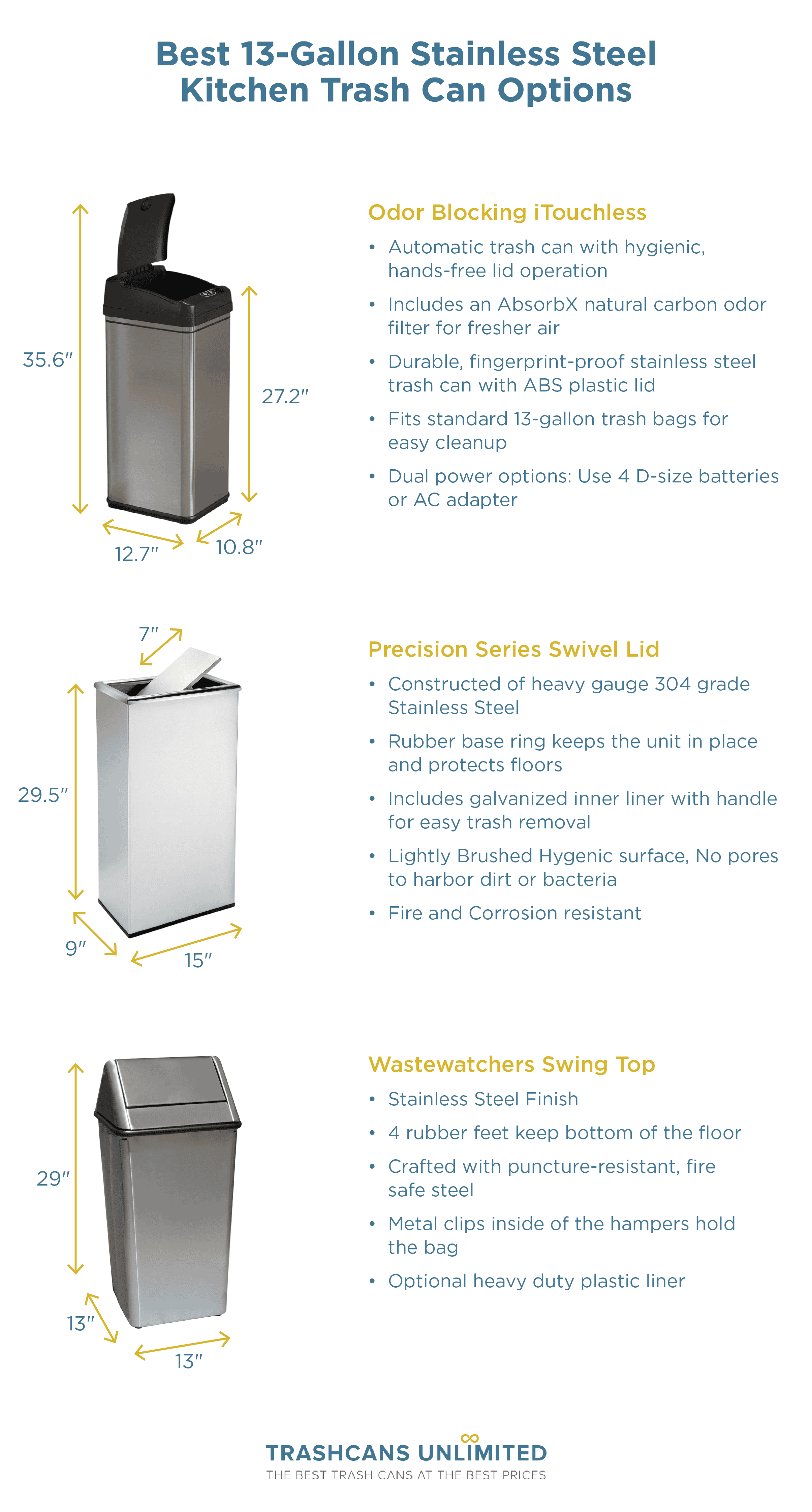
Best for odor control: Get a 13-gallon stainless steel odor blocking kitchen trash can that pairs an automatic touchless lid with a carbon odor filter, sits in a fingerprint-proof stainless shell under an ABS lid, and takes standard 13-gallon liners. It runs 12.7" x 10.8" x 27.2" (35.6" with lid open) on four D-size batteries or an AC adapter.
Best slim-profile pick: Choose a slender 13-gallon rectangular stainless steel trash can that trades a square footprint for a narrow one, which is what a galley kitchen or a gap between appliances needs. It measures 15" x 9" x 29.5", includes a galvanized inner liner, and is rated at 13.5 gallons rather than a flat 13. A swivel lid needs vertical room, so measure up as well as across.
Best swing-top: A 13-gallon stainless steel swing top trash can suits high-volume waste that does not smell much, which in practice means paper, packaging, and a utility corner. It stands 13" x 13" x 29" on four rubber feet that keep the base off the floor, and the shell is puncture-resistant steel.
Lid Types, Bag Fit, and Performance in a 13-Gallon Stainless Steel Kitchen Trash Can
Why 13-Gallon Stainless Steel Became the Default for Kitchen Waste
Thirteen gallons is not a measurement of how much garbage a household produces. It is a measurement of a bag. In practice, tall kitchen liners cluster around a common flat size, and cans in this class are built around it. So capacity and bag compatibility are not two criteria you weigh against each other. They are one criterion seen from two ends, which is why a can that gets the number right and the rim wrong will still fail you.
For a household of two to five, that bag size also lands where it should. Against an EPA national figure of 4.9 pounds of waste per person per day, thirteen gallons is large enough to avoid emptying daily and small enough that the full bag is still liftable.
Stainless earns its place for a different reason. It is non-porous and carries no applied coating that can wear off, so there is no scratched, absorbent surface for odor-causing residue to settle into. That absence is the mechanism behind every plastic can that started to smell faintly no matter how often you emptied it. That is also the replacement-cost argument in one line: a steel shell does not scratch, absorb, or crack the way a plastic one does.
With capacity and material settled, the lid is the only decision left.
Step Can vs. Sensor Can vs. Swing-Top: Which Lid Type Wins in a Working Kitchen
Three mechanisms dominate the 13 gallon stainless steel trash can market. A step trash can 13 gallon in size gives you hands-free access with no power source, and its pedal assembly is the part that wears. A motion sensor trash can removes contact entirely, which matters most when your hands are the contamination risk. A swing-top is the fast option: no pedal, no power, a flap that pushes open and falls back.
|
Mechanisms |
Step / Pedal |
Sensor / Touchless |
Swing-Top |
|
Hands-free |
Yes |
Yes |
No |
|
Odor containment |
Strong |
Strong |
Partial |
|
Power required |
None |
Batteries or AC |
None |
|
Moving parts |
Pedal, rod, hinge, spring |
Sensor, motor, hinge |
Flap pivot |
|
Clearance needed |
Forward floor space |
Vertical travel plus detection zone |
Vertical arc |
|
Cleaning effort |
Low with inner bucket |
Moderate, sensor housing needs care |
Low |
The best lid in the world still fails you if the bag will not stay where you put it.
The Bag Fit Test: Why Liner Compatibility Makes or Breaks a 13-Gallon Can
A liner draped over a smooth steel rim is held up by friction, and friction needs something pressing the two surfaces together. A hanging cuff presses on almost nothing. Meanwhile the load inside pulls straight down, all day, getting heavier.
That gap is the entire failure. It is why bags slip, why the cuff disappears into the can halfway through the week, and why no amount of careful tucking fixes it.
A retention ring does not improve the grip. It changes the problem, clamping the cuff so the bag is mechanically captured rather than held by friction it never had. A kitchen trash can with inner bucket reaches the same result by a different route, trapping the cuff between the bucket wall and the shell.
So the first thing to check on any product page is whether a retention system exists at all. Rim geometry, a bag ring, and an inner bucket are all visible in product photography, which means you can verify this before you order rather than after. If you want the liner side of the equation, our guide on how to measure garbage bags covers the sizing.
One caution that cuts the other way. A can rated at 13 gallons assumes a liner seated cleanly to the rim, and an inner bucket loses some of that to the bucket wall and seating depth. If your household sits at the top of the two-to-five range, plan around that gap instead of discovering it on a Sunday night.
The five-point bag fit test:
- Does the can include a bag ring, inner bucket, or retention notches?
- Is the rim smooth-rolled, or does it have exposed edges that tear liners?
- Does the listed capacity correspond to the flat dimensions of standard 13 gallon trash bags?
- Does the inner bucket lift out with the bag in place?
- Is there a bag overhang channel, or will excess liner be visible?
A well-seated liner solves one problem completely and another one not at all, which brings us to smell.
Odor Containment: What Separates a Well-Sealed Can From a Marketing Claim
Odor moves the way everything moves: from where there is more of it to where there is less, through whatever gap it can find. A gasketed lid works by shrinking that gap. Hinge tolerance matters for the same reason, because a hinge is a gap with a name.
An activated carbon filter catches some of what still escapes. It is worth having and it is worth understanding: filters saturate, which makes them a consumable you replace, not a feature you buy once. A filter supplements a good seal. It does not substitute for one.
Now the part that explains the smell you cannot find. Phantom odor is usually not escaping the can, because it is already outside it.
Residue films the underside of the lid. Grease works into the hinge pivot. Liquid pools in a base seam and stays there. All three sit on the wrong side of whatever seal you paid for, which is why a fresh bag changes nothing.
That reframes what to look for. A removable inner bucket, a smooth-weld or seamless interior, and hinge geometry you can actually reach are odor features, because the real fix is cleaning access rather than sealing. This is where an odor blocking trash can earns the name, and you can see all three for the odor blocking iTouchless trash can, which pairs the seal with a replaceable carbon filter.
Dimensions, Footprint, and Placement: Fitting a 13-Gallon Can Into Your Actual Kitchen Layout
Footprint is the measurement everyone takes. Clearance is the measurement that defeats them.
Take three measurements, not one. Floor footprint, so the can fits the gap. Forward clearance, because a pedal can needs room for a foot in front of it, and because a cabinet door that swings into that space will make the can unusable without ever touching it. And vertical travel, because a swing-top needs room for the flap to rotate and a sensor lid needs room to open.
Sensor cans need a fourth consideration, which is where the detection zone points. Aim it at a walkway and the can will open for everyone who passes.
The 13-gallon stainless steel Precision Series rectangular swivel lid trash can and iTouchless kitchen trash can options solve the galley problem without giving up capacity, since the footprint narrows on one axis and lengthens on the other. That fits a gap a square can cannot.
Where the can sits is settled. How it looks sitting there, after three years of hands and steam and cooking oil, is a different question.
Finish Durability, Smudge Resistance, and How Stainless Ages
Stainless resists corrosion for one reason: chromium in the alloy reacts with oxygen to form a thin oxide film across the surface, and that film regenerates when it is damaged. Every finish problem you will have is a version of the same problem: something interfering with that layer faster than it can reform.
That gives you four things to plan for:
- Grease film. Airborne cooking oil settling on vertical surfaces near the range. Brushed stainless hides it best; wipe along the polish grain rather than across it, weekly.
- Water spotting. Mineral deposits on a can beside the sink or dishwasher. Dry it after splashes rather than letting droplets evaporate in place.
- Cleaner-induced hazing. Abrasives, bleach, and chloride-based cleaners attack the coating and the oxide layer underneath; if the label carries the symbol Cl, treat it as a risk. A fingerprint resistant stainless steel trash can has a coating worth protecting, so mild soap and water beats a specialty spray.
- Contact wear. The pedal face, the lid edge, and anywhere a hand or shoe lands daily. Matte and brushed finishes wear gracefully. Mirror-polished does not, which is why it is the wrong choice for a high-contact placement.
Choose brushed for anything in the sightline, and never put mirror-polish where hands land.
How to Choose the Best 13-Gallon Stainless Steel Kitchen Trash Can for Your Household
Match your household first, then verify the specifics.
|
Your Household |
Recommended Lid Type |
Recommended Profile |
Why |
|
Household of 2, small galley kitchen |
Step or swivel lid |
Capacity moves into depth, not width; forward clearance stays manageable. |
|
|
Household of 4–5, heavy food prep |
Standard |
Hands stay off the lid mid-prep; note that an inner bucket costs some usable volume at this load. |
|
|
Low-odor, high-volume waste |
Standard |
Fast disposal, no mechanism to wear, containment matters less here. |
Checklist before you order:
- Lid type matches household use pattern.
- Bag retention system present (ring, inner bucket, or notches).
- Dimensions verified against measured space, including clearance.
- Finish appropriate to placement (near range, near sink, or in sightline).
- Odor containment features present and, where applicable, filters replaceable.
- Warranty terms and return policy confirmed before ordering.
Avoid these common mistakes:
- Buying on capacity alone without checking bag retention.
- Measuring the footprint but not the clearance.
- Choosing a sensor can for a household that will not maintain batteries.
- Selecting a mirror-polished finish for a high-contact placement.
- Treating a swing-top as a primary kitchen bin in an odor-sensitive household.
On warranty and returns, coverage varies by manufacturer and by product line, terms differ on structural failure versus surface finish, and the return window on a large kitchen accessory is worth checking before it ships.
See about other kitchen trash cans or stainless steel trash cans for your kitchen at Trashcans Unlimited.