
Originally posted on 9th Dec 2024
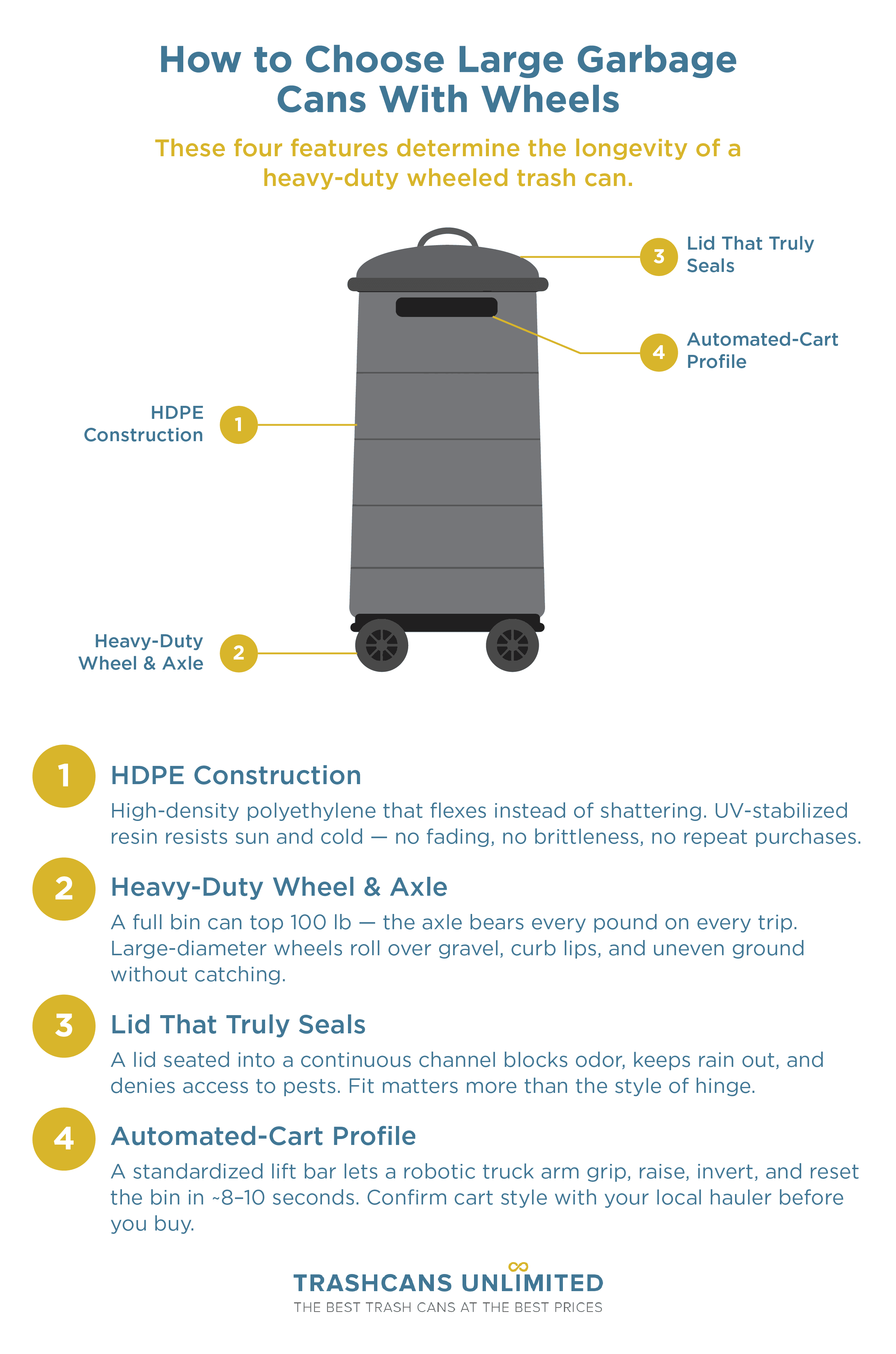
A large garbage can with wheels is a heavy-duty bin molded from HDPE plastic, usually somewhere between 32 and 96 gallons, built to roll to the curb instead of being carried there. The right size comes down to how much waste you throw out in a week. Features that determine whether it lasts are HDPE construction, a lid that truly seals, a heavy-duty wheel-and-axle system, and a shape that works with automated collection trucks. Get those right and the payoff is simple: fewer trips to the curb, no more hauling dead weight, and a bin you buy once and roll for years instead of replacing every season.
This guide walks through where large garbage cans with wheels earn their keep at home and on a worksite, how to pick a size, and how to compare models before you buy.
|
Capacity |
Best for |
Roughly replaces |
Typical use case |
|
1–2 people |
A pair of kitchen bins |
Apartments, single occupants, light weekly waste |
|
|
Tight spaces |
A standard bin in half the footprint |
Side yards, alleys, galley areas |
|
|
Small households |
One small curbside bin, upgraded |
Couples, smaller homes |
|
|
Growing households |
Two smaller bins |
3-person homes, light recycling overflow |
|
|
Mid-size families |
Multiple small bins |
The common "right size" for a family of three to four |
|
|
High volume, tight space |
A 64–72 gal bin in a narrow footprint |
Townhomes, restaurants with limited back-of-house room |
|
|
Large households / light commercial |
Several small bins |
Big families, small offices |
|
|
High-volume homes / facilities |
A cluster of small cans |
Large households, retail, break rooms |
|
|
Maximum capacity |
An entire collection of small bins |
Big families, facilities, construction sites |
Key Takeaways
- How to size one: Match capacity to weekly volume; 32 to 48 gallons for one or two people, 64 to 96 gallons for a family of three to five or a light-commercial space, with skinny 46- and 69-gallon models for tight footprints.
- Why wheels matter: A full large bin can top 100 pounds, so real wheels turn a back-straining lift into a push almost anyone can manage.
- Before you buy: Confirm the cart style that your local hauler services; accepted profiles vary by municipality. Add a trash can dolly only if a heavy bin mostly stays put and travels occasionally.
Why Homeowners and Facility Managers Are Ditching Small Bins for Heavy-Duty Large Garbage Cans With Wheels
The break point usually arrives on a single morning. The bin is full by Wednesday, the lid won't close, and when you finally tip it to wheel it out, a wheel cracks off in the driveway. That moment is what sends most people looking for something built to a different standard.
The Real Cost of Undersized, Flimsy Trash Bins
A small bin doesn't fail because you did anything wrong. It fails because it was never sized for the job. The EPA estimates the average American throws out about 4.9 pounds of waste a day, which works out to roughly 137 pounds a week for a household of four before a single recyclable is pulled out. A 20- or 30-gallon bin runs out of room against that number fast, and the result is predictable: a second bag set beside the can, an extra trip down the driveway, a lid propped open in the rain.
For a homeowner, the cost is measured in repeated effort: multiple curb trips, a sore back from dragging an overstuffed can, and the slow accumulation of broken parts. Cheap bins almost always give out in the same three places: the joint where the wheel meets the axle, the anchor where the handle attaches, and the hinge on the lid. Those are the spots that take the most repeated stress, so those are the spots that snap first.
For a facility manager, the real expense isn't the bin at all — it's labor. When undersized containers fill before pickup day, staff start improvising: consolidating bins, double-bagging, hand-carrying overflow across a lot. Every one of those workarounds is paid time, week after week, spent solving a problem a properly sized bin would have prevented.
How Large Garbage Cans With Wheels Solve the Everyday Waste Management Problem
A large wheeled bin fixes the problem at its root by changing the physical task. A full large bin packed with wet or dense waste can easily top 100 pounds — more than anyone should be lifting or dragging on repeat. Put that same load on a set of real wheels and the job stops being a back-straining lift and becomes a push almost anyone can manage. That single change is why a heavy-duty wheeled bin reads as a long-term investment rather than a recurring expense: you're not buying a bigger container so much as buying your way out of the weekly fight with it.
Choosing the Right Large Garbage Can With Wheels: Sizes, Materials, and Features
This is the heart of the decision. Size first, because it's the question everyone asks; then the materials and features that determine whether the bin you choose is still doing its job in five years.
Understanding Capacity Options: Matching Bin Size to Your Waste Volume
Capacity is where most buyers either overthink it or undershoot it. The simplest approach is to tie the size to your weekly output rather than guessing.
- One or two people usually fit comfortably in a 32- to 48-gallon bin.
- A family of three to five is best served by 64 to 96 gallons.
- Light commercial spaces — offices, small retail, break rooms — generally start at 64 to 96 gallons and scale by adding bins rather than stretching one container past the point where a person can move it.
Going too small is the obvious mistake, and it leads straight back to overflow. Oversizing is rarely a real disadvantage, with one honest exception: an extra-large 96-gallon bin is genuinely harder to maneuver in a cramped space than a smaller one. That's exactly why the skinny 46- and 69-gallon models exist; they hold serious volume in a tall, narrow footprint that slips into a side yard, an alley, or a galley kitchen where a wide bin simply won't fit.
|
Your situation |
Recommended range |
|
1–2 people, light waste |
32–48 gallon |
|
Small household, some recycling |
48–56 gallon |
|
Family of 3–5 |
64–96 gallon |
|
Tight side yard or alley |
46 or 69 gallon (skinny) |
|
Office / small retail |
64–96 gallon, add bins to scale |
|
Construction site / high-volume facility |
96 gallon, multiples |
HDPE Construction: Why Material Quality Determines Longevity
When a bin survives a decade of sun, frost, and rough handling, the reason is almost always the plastic it's made from. Trashcans Unlimited bins are built from HDPE (high-density polyethylene) and the difference between HDPE and generic plastic is the difference between a bin that lasts and one that goes brittle and cracks.
HDPE earns its reputation on three properties. It has a high strength-to-density ratio, so it's rigid and tough without being heavy. It barely absorbs moisture, so it won't waterlog, swell, rust, or hold odor the way porous materials do. And it's impact-resistant; it flexes and absorbs a blow rather than shattering, which matters most in cold weather, when cheaper plastics turn brittle and split.
All of which is why HDPE construction quietly lowers your cost over time: a bin that doesn't crack, warp, or fade is a bin you aren't replacing.
Wheel and Mobility Systems: Where Cheap Bins Break First
Wheels are the whole point, and yet they're where buyers pay the least attention. There's a real gap between basic fixed wheels and a heavy-duty caster system built for maneuvering a loaded bin around corners and over obstacles.
The spec most people overlook is wheel diameter. Large-diameter wheels roll over gravel, cracked pavement, a lawn edge, or a curb lip with far less force, while small hard wheels catch on every seam and stop you cold. Underneath, the axle is the part that actually carries the load. Remember that a full large bin can exceed 100 pounds, and the axle bears all of it every time the bin moves. That's the engineering reason "the wheels snapped" tops every list of cheap-bin complaints: the axle was never built for the weight. For bins that sit on a slope or face stiff wind, locking wheels add a simple, welcome bit of stability.
Lid Design and Odor Control: Keeping Waste Contained Between Collections
A lid's job isn't to sit on top of the bin — it's to seal it. The difference between snap-lock and hinged designs matters less than how tightly the lid mates to the rim.
A lid that seats into a continuous channel, or carries a gasket-style edge, is what actually blocks the scent trail that draws raccoons, rodents, and flies. The same tight fit keeps rain out, which matters more than it sounds: a load that stays dry stays lighter and doesn't ferment into a leaking, reeking mess between collections. When you shop, judge the lid on fit, not just presence.
Handle Ergonomics and Automated Garbage Truck Lifter Compatibility
Handle placement sounds like a minor detail until you're guiding a heavy bin down a driveway. Grips set where your hands naturally fall, on a handle anchored to take repeated force, are what make the trip to the curb safe and strain-free instead of a daily wrestling match.
The bigger consideration for curbside collection is whether the bin works with an automated truck. Here's how that system actually works: on an automated route, a robotic arm reaches out from the truck, grips the bin at a standardized lift bar or pocket near the top, raises it overhead, inverts it to empty into the hopper, and sets it back down. The whole cycle takes only about 8 to 10 seconds, and the driver never leaves the cab. It works because the bin conforms to a recognized industry cart profile that the arm is built to grab. A non-standard shape can be mis-grabbed or skipped entirely.
A bin built to the common automated-cart profile will work with most automated and semi-automated systems, but collection setups vary from town to town. Confirm the cart style that your local hauler services before you buy. It's a quick call to your provider, and it saves a headache on collection morning.
Adding a Trash Can Dolly for Easier Heavy-Load Mobility
A dolly solves a different problem than capacity does. It's the answer when a heavy bin lives in one spot most of the week — a garage, a basement, a back lot — and only needs to travel now and then, or when staff have to move several bins at once.
A trash can dolly with wheels adds maneuverability to a bin that would otherwise be a chore to reposition, and it pairs especially well with the 72- to 96-gallon range, where loaded weight is highest. Think of it as a mobility multiplier for the bins that need it most.
Where and How Large Garbage Cans With Wheels Deliver Maximum Value
The same bin earns its keep differently at home than it does on a worksite. Here's how each plays out.
Residential Applications: Simplifying Curbside Collection for Homeowners
At home, the win is consolidation. A single 96-gallon wheeled bin can absorb what used to take several smaller containers, which means one trip to the curb instead of three. Between collection days, a tall bin tucks into a side yard or garage corner and stays out of sight. Many households run two large bins side by side — one for general waste, one for recycling — and keep both streams contained instead of letting overflow pile up. The neighborhood-facing benefit is real too: a sealed, lidded bin reads as tidy, where a cluster of overflowing small cans reads as an eyesore.
Commercial and Facility Applications: Scaling Waste Management Without Scaling Labor
For a facility, the bin is a labor tool. The fewer minutes staff spend handling waste, the more the bin pays for itself, and commercial trash cans with wheels cut that time sharply in high-traffic settings: office complexes, retail floors, construction sites, outdoor venues. Standardizing on one or two sizes across a site makes routing predictable and stops staff from improvising around mismatched containers. HDPE matters here for a maintenance reason as much as a durability one: because it's non-porous and chemical-resistant, a bin can be pressure-rinsed and sanitized without absorbing odor or staining, which is what keeps a commercial-grade can hygienic through years of heavy use.
Choosing Your Large Wheeled Garbage Can: Next Steps
It comes down to three moves. First, pick a capacity that matches your weekly volume — smaller for one or two people, 64 to 96 gallons for a family or a facility. Second, confirm the build: HDPE, a sealed lid, and heavy-duty wheels on a reinforced axle. Third, verify the bin works with your local automated collection before you buy.
When you're ready, browse our full range of trash cans with wheels and find the size that fits your week. Choose well once, and trash day stops being a chore you manage and becomes one you barely notice.