
Originally posted on 9th May 2025
You keep finding roaches in your bathroom because it offers exactly what cockroaches need to survive: consistent moisture, stable warmth, and concealed entry points through plumbing infrastructure. This has nothing to do with how clean your home is. A spotless bathroom can still be a cockroach magnet because the room itself functions as a habitat — humidity from daily showers, residual heat from hot water, and organic residue like soap scum and shed hair create conditions that rival the tropical environments these insects evolved in. Understanding what actually causes a roach infestation starts with recognizing that your bathroom's design, not your housekeeping, is the problem.
This guide covers what draws cockroaches to bathrooms, how to identify which species you're dealing with (and what that tells you about where they're coming from), and how to get rid of roaches in your bathroom using a proven 4-phase protocol so they don't come back.
Key Takeaways
- Species identification is diagnostic. German cockroaches indicate an indoor colony; American cockroaches point to a sewer or exterior access problem; Oriental cockroaches signal a serious moisture issue.
- The fix is a 4-phase protocol: Inspect → Seal → Dry → Maintain. Sealing entry points (cracks as narrow as 1/16 inch) and reducing humidity are higher-impact than any spray or trap.
- A sealed, lidded trash can completes the roach habitat disruption. Open bathroom waste is one of the last reliable food sources in an otherwise inhospitable bathroom.
What Attracts Roaches to Bathrooms
Before reaching for a can of spray, it helps to understand what you're actually dealing with. Cockroaches in your bathroom aren't random visitors — they're responding to specific environmental signals that tell them they've found a viable habitat. Once you understand those signals, you can systematically dismantle them.
The Bathroom Ecosystem: Why Moisture and Warmth Matter More Than Cleanliness
A clean bathroom can absolutely still attract roaches. Cockroaches are driven by moisture and temperature, not filth. Your bathroom delivers both in abundance, reliably, day after day — which is exactly what a colony needs to establish itself.
Humidity is the primary draw. A standard hot shower pushes bathroom humidity far above normal indoor levels — and without adequate exhaust ventilation, that moisture lingers for hours. German cockroaches, the species most likely to colonize indoor spaces, thrive in moderate-to-high humidity. Your post-shower bathroom doesn't just meet that threshold; it blows past it for extended periods, creating exactly the conditions these insects seek out. The relationship between moisture and cockroach behavior runs deeper than most people realize.
Warmth seals the deal. Residual heat from hot water keeps bathroom temperatures in the range cockroaches prefer — roughly 77°F to 86°F (25–30°C) for German cockroaches, according to NC State University's entomology department. Even after you've toweled off and left, the tile, grout, and enclosed space retain heat far longer than other rooms in the house. Bathrooms in interior locations — those without exterior walls — hold this warmth even more effectively.
Water sources are everywhere. Beyond shower humidity, your bathroom offers cockroaches a buffet of accessible water: the sink basin, the toilet bowl and tank, condensation forming on cold-water supply pipes, residual water pooled on shower floors, and the standing water inside P-traps. For a cockroach, any one of these is sufficient for survival. American cockroaches, in particular, can survive two to three months without food but only about a month without water — which tells you everything about why they prioritize your bathroom over your living room.
Then there's the food — and yes, your bathroom has plenty of it. Cockroaches are omnivorous scavengers with a particular affinity for starches and fats. The University of Kentucky's entomology department notes that cockroaches will consume everyday household materials including soap, toothpaste, glue, hair, and filth. In your bathroom, that translates to specific, invisible food sources most people never consider:
Soap scum on shower walls and tub edges contains fats from the saponification process. Toothpaste residue around sinks provides glycerin — an organic compound cockroaches readily metabolize. Shed skin cells and hair accumulated in drains and on floors supply protein. And the organic waste sitting in your bathroom trash can — tissues, cotton swabs, dental floss, personal care product residue — rounds out the menu.
Cockroaches don't need much. German cockroaches can survive on remarkably low-quality diets, completing nymphal development on the trace organic residues common in bathroom environments. The microscopic film of organic material that accumulates on bathroom surfaces between cleanings is more than enough to sustain a population.
How Roaches Actually Get Into Your Bathroom
Most people overlook this part: your bathroom was probably always attractive to cockroaches. What changed is that something opened a door. Most bathroom roach problems are access problems, not attraction problems — and the plumbing infrastructure that makes your bathroom function is also what makes it vulnerable.
Plumbing penetrations are the most common entry point. Every pipe that passes through a wall or floor creates a hole, and unless that hole was sealed with precision during construction (or resealed since), there's a gap. Adult cockroaches can compress their bodies to fit through cracks as narrow as 1/16 of an inch — just 1.6 millimeters, as documented by UC IPM. That's roughly the thickness of a credit card. Nymphs, which can be as small as 1/8 inch at their earliest stage according to Rutgers University, need even less space. The gaps around your sink drain pipe, toilet supply line, and shower valve are prime candidates.
Drain lines function as highways. Cockroaches — especially American cockroaches — are well-adapted sewer dwellers. They travel through municipal sewer systems and enter homes through floor drains, shower drains, and overflow drains. The P-trap (that curved section of pipe beneath every drain) is designed to hold a water seal that blocks sewer gases and, incidentally, crawling insects. But P-traps in guest bathrooms, basement drains, or other infrequently used fixtures can dry out, eliminating the only barrier between your bathroom and the sewer system. If you've noticed roaches coming from the drain, a dry P-trap is one of the first things to investigate.
Wall voids connect rooms you'd never expect. The cavity behind your bathroom wall doesn't stop at the bathroom. It connects to adjacent rooms, the kitchen, utility closets, and — in multi-unit buildings — neighboring apartments. Cockroaches exploit these voids as protected travel corridors, moving freely between spaces without ever exposing themselves to open air. In apartments and condominiums, shared plumbing chases (the vertical shafts that carry water and drain lines between floors) are notorious migration pathways.
Deterioration creates new openings over time. Grout cracks. Caulk shrinks and peels, particularly the latex-based caulk commonly used in bathrooms that degrades faster in high-humidity environments. Gaps form between baseboards and flooring as materials expand and contract seasonally. Tile cracks expose sub-floor voids. Even your bathroom exhaust vent — if the ductwork lacks proper screening — can serve as a migration route from the attic or between-floor spaces. Understanding whether roaches can eat through caulk matters when choosing sealant materials — not all products hold up equally in wet environments.
Which Cockroach Are You Dealing With?
Species identification isn't academic trivia — it's diagnostic. The species you're finding tells you where they're coming from, how they got in, and how concerned you should be about an established colony. A single American cockroach that wandered up from the sewer requires a different response than a cluster of German cockroach nymphs living inside your vanity cabinet.
German cockroach (Blattella germanica): The one you don't want to find. Adults measure ½ to ⅝ inch long, are tan to light brown, and carry two distinctive dark parallel stripes just behind the head. German cockroaches are exclusively indoor insects — they don't survive in the wild and depend entirely on human environments. If you're finding them in your bathroom, particularly small nymphs or egg cases (oothecae — small brown capsules about ⅓ inch long), you're likely dealing with an established colony.
They are overwhelmingly nocturnal; if you're spotting roaches in the bathroom at night when you flip on the light, this is your most likely suspect. They're also the fastest reproducers among common household species — a single female can produce five to eight egg cases containing approximately 40 eggs each, yielding 200 to 250 total offspring, according to NC State University.
American cockroach (Periplaneta americana): The large one. Adults reach 1.5 to 2 inches long, are reddish-brown, and have a distinctive yellowish figure-8 pattern on the back of the head. Despite the name, they originated in tropical Africa and were introduced to North America as early as 1625, according to the University of Florida's entomology department. American cockroaches are primarily sewer and storm drain dwellers. Finding one in your bathroom usually means it entered through drain lines, plumbing voids, or an exterior gap — not that it's nesting inside your walls. Their presence is often seasonal or weather-driven (heavy rain can flood sewer systems, pushing roaches upward into homes). A single American cockroach is an access problem. Multiple sightings over weeks suggest a persistent entry point that needs to be sealed.
Oriental cockroach (Blatta orientalis): Sometimes called the "water bug" for good reason. Adults are about 1 inch long, dark brown to black, and have a glossy, almost lacquered appearance. They strongly prefer cool, damp environments and are most commonly found near floor drains, in basement-level bathrooms, and around areas with significant moisture issues. They favor cool, damp conditions that other species avoid, and they require high ambient humidity. Finding Oriental cockroaches in your bathroom signals a moisture problem beyond normal shower use. It likely indicates persistent leaks, poor ventilation, or chronic dampness that needs to be addressed at its source.
|
Species |
Size |
Color / ID Marks |
Preferred Environment |
Likely Entry Point |
What Their Presence Indicates |
|
German cockroach |
½–⅝ inch |
Tan/light brown, two dark stripes behind head |
Warm, humid indoor spaces (77–86°F) |
Carried in on goods, through shared walls in multi-unit buildings |
Established indoor colony — likely breeding inside cabinets or wall voids |
|
American cockroach |
1.5–2 inches |
Reddish-brown, yellow figure-8 on head |
Sewers, storm drains, warm moist spaces |
Drain lines, plumbing voids, exterior gaps |
Sewer/exterior access problem — seal drains and plumbing penetrations |
|
Oriental cockroach |
~1 inch |
Dark brown/black, glossy |
Cool, damp environments |
Floor drains, foundation cracks, damp crawl spaces |
Significant moisture issue — address leaks and ventilation |
You now know what draws cockroaches to your bathroom and how they're getting in. The next step is shutting down every entry point and making the space permanently inhospitable.
How to Get Rid of Roaches in Your Bathroom
This is a sequential, 4-phase protocol. Each phase builds on the one before it, and skipping steps undermines the entire system. Think of it as habitat disruption: you're not just killing roaches — you're eliminating the conditions that allow them to survive. Executed fully, this protocol makes your bathroom a place cockroaches can't live in, not just a place they happen to die in.
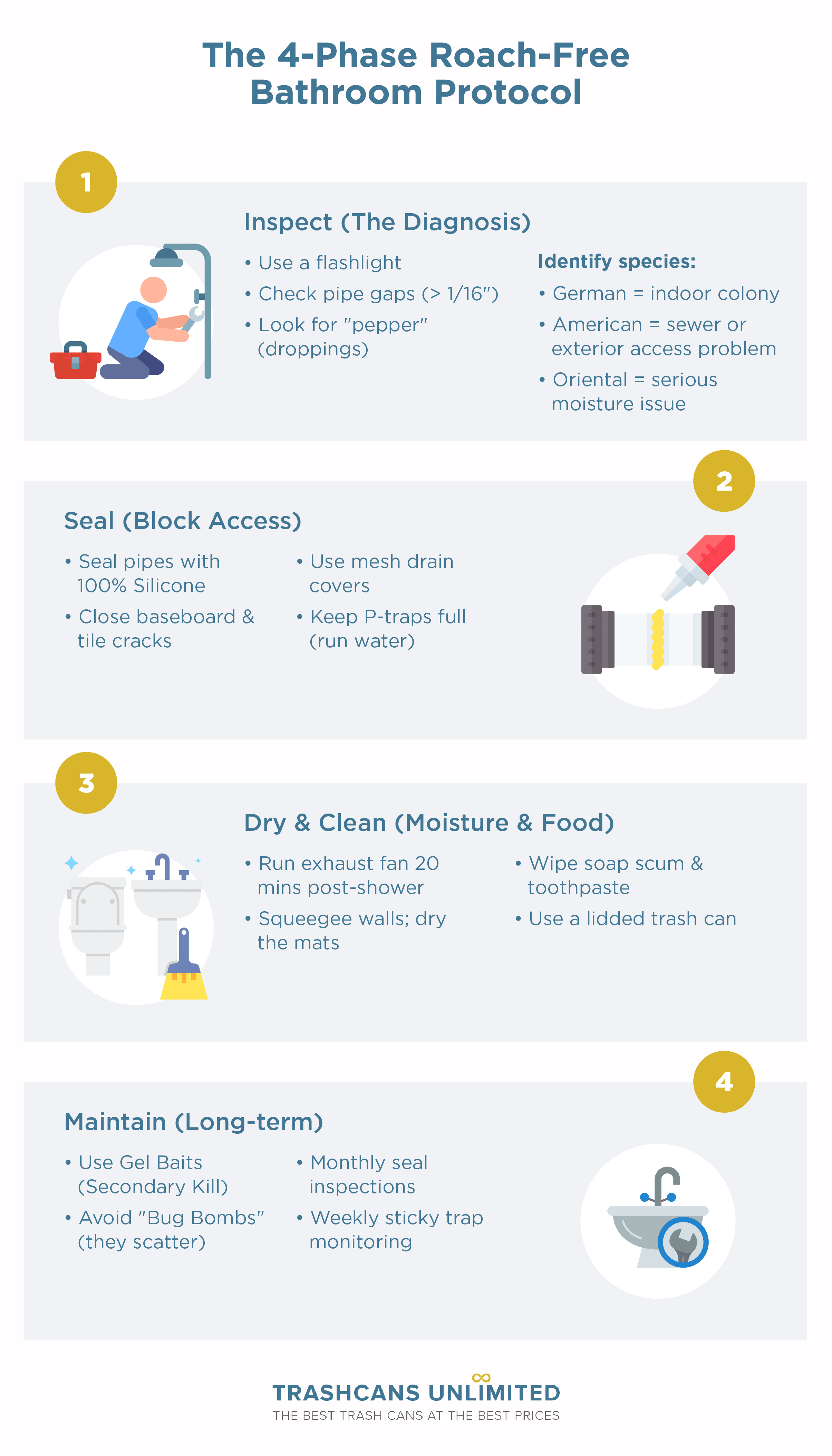
Phase 1: Inspect and Identify Entry Points
Before you seal, spray, or scrub anything, you need to know where they're getting in. This is the diagnostic phase — fifteen minutes with a flashlight will tell you more than a month of reactive spraying.
Work through this inspection checklist systematically:
- Check all pipe penetrations — under the sink, behind the toilet, and around shower supply lines — for gaps between the pipe and the wall or floor. Remember: a gap as narrow as 1/16 inch is wide enough for an adult cockroach to squeeze through.
- Run water in every drain and check for slow drainage or gurgling sounds. Slow drains may indicate compromised or dry P-traps — the water seal that blocks sewer access. If a drain is in a guest bath or rarely used fixture, the P-trap may have evaporated entirely.
- Inspect caulk seams around the tub, shower enclosure, and sink for cracking, peeling, or shrinkage. Press along seams with your finger — if caulk compresses or lifts, it's no longer sealing.
- Look inside vanity cabinets with a flashlight for signs of cockroach activity: small dark specks (droppings), brown capsules about ⅓ inch long (egg cases, called oothecae), or translucent, papery shed skins.
- Check the bathroom exhaust vent cover for gaps around the housing or missing screening that could allow insects to enter from ductwork.
- In multi-unit buildings, inspect shared walls for gaps around plumbing chases — the vertical pipe runs that connect floors. These are high-traffic cockroach corridors and a common reason why there are roaches in your bathroom even when your own unit is well-maintained.
Document what you find. Photograph gaps, cracks, and evidence of activity. This becomes your work order for Phase 2.
Phase 2: Seal Entry Points and Block Access
Now that you've mapped the gaps, close them. This is the single highest-impact step in the entire protocol. A bathroom with sealed entry points and intact P-traps is exponentially harder for cockroaches to colonize, regardless of humidity or food availability.
Pipe penetrations: Fill gaps around pipes where they pass through walls or floors using 100% silicone caulk. This matters — standard latex or acrylic caulk deteriorates significantly faster in the high-humidity environment of a bathroom. Silicone remains flexible, waterproof, and intact for years. For gaps larger than ¼ inch, use expanding foam first to fill the void, then cap the surface with silicone caulk for a clean, durable seal. The goal is a continuous barrier with no gaps visible to the eye. When you seal pipes to prevent roaches, the material choice is critical — silicone-based sealants resist the moisture-driven degradation that eventually gives cockroaches an opening.
Drain protection: Install fine-mesh drain covers over shower drains and floor drains. Look for mesh with openings smaller than 1/16 inch to block even nymph-stage cockroaches. For infrequently used floor drains (common in basements and guest baths), run water for 15–20 seconds weekly to maintain the P-trap water seal. This single habit eliminates one of the most common sewer-to-bathroom pathways.
Grout and tile: Re-grout any cracked, crumbling, or missing grout lines along floors and tub surrounds. Replace deteriorating caulk around the tub-to-wall and shower-to-wall perimeters. Again, choose 100% silicone-based products for longevity in wet environments.
Baseboards and trim: Caulk any visible gaps between baseboards and flooring, paying particular attention to corners and the wall sections closest to plumbing. These gaps often connect to wall voids that serve as cockroach harborage.
Ventilation screening: Inspect the exhaust fan housing and ensure the vent duct is screened where it exits the building or enters shared attic space. Replace damaged or missing screening.
With entry points sealed and drains protected, you've closed the doors. The next phase makes sure any cockroaches already inside have nowhere comfortable to stay.
Phase 3: Eliminate Moisture and Remove Food Sources
This is habitat disruption — making your bathroom actively inhospitable to cockroaches that may already be present and eliminating the environmental signals that attract new ones.
Moisture reduction:
Fix any dripping faucets, running toilets, or leaking supply lines immediately. Even a slow drip produces enough water to sustain a cockroach population indefinitely.
Run the bathroom exhaust fan during every shower and for at least 20 minutes afterward — a duration recommended by the Home Ventilating Institute. This is one of the most effective humidity control measures available. The goal is to bring bathroom humidity below 60% within an hour of showering — well below the comfort zone for German cockroaches. If your bathroom lacks an exhaust fan (or the existing fan is undersized), a portable dehumidifier targeting below 60% relative humidity is a worthwhile alternative.
Wipe down shower walls and glass after use to remove standing water and condensation. A squeegee takes 30 seconds and removes a surprising volume of moisture from surfaces. Hang towels and bath mats to dry fully — ideally outside the bathroom. Damp textiles left on the floor serve as both water sources and harborage.
Food source elimination:
Clean soap scum from shower walls, tub edges, and sink basins weekly. What looks like a harmless film actually contains residual fats from the saponification process — and those fats are a preferred food source for cockroaches.
Remove hair from drains weekly using a drain brush or install a silicone hair catcher. Accumulated hair provides protein that sustains nymph development.
Wipe toothpaste residue from sinks and countertops nightly. The glycerin in toothpaste is an organic compound readily consumed by cockroaches.
Empty the bathroom trash frequently and use a bin with a tight-fitting, sealed lid. This matters more than most people realize. An open or lidless bathroom trash can exposes tissues, cotton swabs, dental floss, adhesive bandage strips, and personal care product residue — all organic materials cockroaches exploit as food. Cockroaches sustain themselves on remarkably small quantities of organic matter, and an open bathroom bin concentrates exactly the kind of waste they target. Switching to a sealed, lidded bathroom trash can eliminates this food source entirely. For a hands-free option that maintains the seal without requiring you to touch the lid, a touchless trash can reduces both pest access and cross-contamination.
Deep clean under-sink cabinets and shelving quarterly. Remove all stored items, wipe down surfaces, and check for any signs of cockroach activity (droppings, egg cases, shed skins). These dark, enclosed spaces are preferred harborage areas.
You've now blocked access and disrupted the habitat. The final phase ensures the protocol holds over time.
Phase 4: Treat, Monitor, and Maintain Long-Term
The first three phases handle root causes. This phase addresses any cockroaches still active in the space and establishes the ongoing maintenance that makes everything permanent. A bathroom cockroach prevention plan only works when it's sustained.
Treatment (for active infestations):
For confirmed activity, apply gel bait in small dots near identified harborage areas — behind the toilet base, under the sink cabinet, along pipe penetrations where they meet the wall. Gel bait works through a mechanism called secondary kill: cockroaches consume the bait, return to their harborage, and die. Other cockroaches then consume the carcass or feces, receiving a lethal dose themselves. This cascading effect makes gel bait far more effective than surface sprays for established cockroach populations. Choose a gel bait product labeled for cockroach control and follow label directions precisely.
For households with small children or pets, enclosed bait stations provide the same active ingredients in a tamper-resistant housing. Place bait stations along walls, in corners, near drains, and inside vanity cabinets — cockroaches travel along edges and are more likely to encounter bait placed in their natural travel paths.
Do not use foggers or bug bombs. This is not a matter of preference — it's a matter of efficacy. UC IPM specifically warns that foggers and aerosol bombs "may repel and disperse cockroaches to other areas without actually killing them." In practice, foggers push cockroaches deeper into wall voids and adjacent rooms, fragmenting a localized problem into a building-wide one. They also contaminate surfaces, trigger health concerns, and provide a false sense of resolution.
For severe or persistent infestations — as a general benchmark, if you're seeing five or more cockroaches per week, finding egg cases, or if activity hasn't declined after 3–4 weeks of executing this protocol — contact a licensed pest management professional for bathroom pest control. An established German cockroach colony inside wall voids often requires professional-grade products and application techniques that go beyond what's available to homeowners.
Monitoring:
Place sticky monitoring traps near drain openings and inside under-sink cabinets. Check them weekly. Sticky traps serve two purposes: they catch roaches (reducing the active population incrementally) and they provide data. A declining trap count over 2–4 weeks confirms the protocol is working. A stable or rising count means you've missed an entry point or harborage area.
During regular cleaning, watch for fresh droppings (small dark specks that look like ground pepper), new egg cases, or shed skins. These are evidence of ongoing reproductive activity and indicate the problem isn't resolved yet.
Maintenance schedule:
- Daily: Run the exhaust fan for 20 minutes after every shower. Wipe counters and sinks. Empty the bathroom trash if it contains food-adjacent waste.
- Weekly: Clean drains with a brush. Scrub soap scum from shower walls and tub. Check sticky traps. Run water in infrequently used drains for 15–20 seconds to maintain P-trap seals.
- Monthly: Inspect caulk and grout seals for cracking or deterioration. Check under-sink cabinets for signs of activity. Verify exhaust fan is functioning properly.
- Quarterly: Deep clean cabinets and shelving. Replace sticky traps. Re-caulk any deteriorating seals. Inspect drain covers for damage.
Consistency is what separates a temporary fix from a permanent solution. The protocol works because it addresses every element of the cockroach survival equation — access, water, food, and harborage — simultaneously. Any single gap gives cockroaches a foothold. Close them all, and the space becomes permanently inhospitable.
Making Your Bathroom Permanently Inhospitable to Roaches
Cockroaches in your bathroom are a structural and environmental issue — not a reflection of how you keep your home. The moisture, warmth, and plumbing access that define every bathroom also define a cockroach habitat. Now you have the framework to dismantle it.
The protocol is straightforward: inspect to find entry points, seal every gap and protect every drain, eliminate the moisture and food sources that sustain roaches, then maintain the system with a consistent schedule. Each phase reinforces the others. Skip one, and you leave a survival pathway open. Execute all four, and you make the space permanently inhospitable.
The final link in the chain is often the simplest to overlook: your bathroom trash. Exposed waste provides one of the last reliable food sources in an otherwise sealed, dry bathroom. A sealed, lidded bathroom trash can removes that resource and completes the habitat disruption. For a hands-free option, a touchless trash can keeps the seal intact without requiring contact. The bathroom that once invited cockroaches in now has nothing left to offer them.