

Originally posted on 8th Apr 2025
The fastest way to get rid of fruit flies is a simple trap you can make in 30 seconds: apple cider vinegar with a few drops of dish soap. The vinegar's fermentation scent mimics ripening fruit—exactly what these pests are programmed to find. The soap breaks the surface tension, so instead of landing and flying away, they sink and drown. Place the trap near the infestation and you'll see results within hours.
But here's what most articles won't tell you: traps only kill adult flies. While you're catching the ones buzzing around your bananas, the next generation is already hatching somewhere in your kitchen. A single female can lay 400 to 500 eggs in her lifetime¹, and those eggs become breeding adults in just eight to ten days². The trap on your counter is bailing water while the faucet runs.
To actually solve the problem, you need to find and eliminate where they're breeding.
This guide covers both sides of that equation. We'll start with the trap that works, walk through where to look for breeding sites, and show you how to make your kitchen permanently inhospitable to fruit flies.
Key Takeaways
- The fastest solution: Apple cider vinegar + dish soap in a shallow bowl, placed within 2-3 feet of the infestation. Expect catches within hours.
- Traps alone won't solve the problem. A single female fruit fly can lay 400-500 eggs. Even while you're trapping adults, new generations are hatching.
- The real fix: Find and eliminate breeding sources—overripe fruit, drain buildup, trash can residue, recycling containers with liquid.
- The lifecycle is fast: Eggs hatch in 24-30 hours; the complete egg-to-adult cycle takes just 8-10 days at room temperature.
- Prevention beats trapping: Sealed trash cans, rinsing produce when you bring it home, flushing drains weekly, and removing overripe fruit eliminate the conditions fruit flies need.
The Fastest Way to Kill Fruit Flies (Your 60-Second Solution)
You don't need special equipment or a trip to the store. One of the most effective fruit fly traps uses two things already sitting in your kitchen cabinet.
The Apple Cider Vinegar and Dish Soap Trap
What you need:
- 1/2 cup apple cider vinegar
- 2-3 drops liquid dish soap
- A shallow bowl or jar
Setup (30 seconds):
- Pour the apple cider vinegar into your bowl or jar.
- Add 2-3 drops of dish soap.
- Stir gently—just enough to mix, not enough to create bubbles.
- Place the trap near where you've seen the most flies.
No plastic wrap to fuss with, no paper cones to construct. Just vinegar, soap, and a dish.
Why this combination works so well: Fruit flies navigate the world through smell. Their antennae carry olfactory receptors tuned to the alcohols and esters produced during fermentation—the same compounds that signal "ripe fruit, come eat." Apple cider vinegar emits acetic acid and ethanol in concentrations that read as irresistible to a fruit fly's sensory system.³ They would be compelled to investigate.
The dish soap is the lethal addition. Water and vinegar naturally have surface tension—a molecular "skin" strong enough that a light insect can land and take off again. You've seen this with water striders on a pond. Soap disrupts that tension, dropping it from roughly 73 dynes per centimeter to around 25.⁴ When a fruit fly lands expecting to float, it sinks. And it can't get back out.
Placement matters more than you'd think. Fruit flies rely primarily on olfactory cues rather than vision for navigation⁵—flying toward areas where attractant compounds grow more concentrated. A trap in the center of your kitchen might catch a few wanderers, but a trap placed within two or three feet of the actual infestation will catch dramatically more. Put it next to the fruit bowl. Set it beside the trash can. Position it near the sink if that's where you've noticed activity.
Expected results: You should see flies accumulating in the trap within two to four hours. Some people see catches within minutes if the infestation is severe. Replace the vinegar every two to three days, or sooner if it becomes cloudy with bodies.
A note on vinegar alternatives: If you don't have apple cider vinegar, any vinegar will attract fruit flies to some degree—but apple cider vinegar is generally considered the most effective option.³ The reason is chemistry: apple cider vinegar's fermentation profile more closely matches the volatile compounds of ripening fruit. Wine and beer also work well as alternatives.
Fruit Flies or Gnats? Identify the Pest First
Before you commit to traps, take five seconds to confirm you're dealing with the right insect. Fruit flies and fungus gnats look similar from across the room, but they breed in completely different places. Set a vinegar trap for gnats and you'll wonder why nothing's working.
Quick Fruit Fly Identification
Look for these characteristics:
- Size: About 1/8 inch⁶, roughly the size of a sesame seed. Small enough that you can't see detail without getting close.
- Color: Tan or brownish-yellow body—the color of a ripe banana peel, fittingly enough.
- Eyes: This is your tell. Fruit flies have bright red eyes, visible if you can get within a few inches. No other common household pest shares this feature.
- Behavior: They hover near fruit, kitchen drains, and garbage in a slow, looping flight pattern. They're not shy—they'll land on produce while you're standing right there.
How Gnats Differ
Fungus gnats are darker, almost black, with longer legs relative to their bodies. They're drawn to moisture and potted plants, not fruit. You'll see them hovering around houseplant soil, not your fruit bowl. Their flight pattern is faster and more erratic.
Most importantly: fungus gnats won't respond to vinegar traps.⁷ They need different solutions entirely.
Not sure which you have? Get close enough to check the eyes. Red means fruit fly, and the vinegar trap will work. For a detailed comparison with photos, see our complete guide to gnats vs. fruit flies.
Where Do Fruit Flies Come From?
Every fruit fly infestation has a source—a place where females are laying eggs and larvae are developing. Find that source, eliminate it, and the infestation collapses. Miss it, and you'll be refilling traps indefinitely while new generations keep emerging.
The fundamental truth: Fruit flies lay eggs on moist, fermenting organic matter. That's usually overripe fruit, but it could just as easily be the gunk in your drain, the residue in your trash can, a forgotten spill behind the coffee maker, or the dregs in your recycling bin. The eggs themselves are nearly invisible—about half a millimeter long, smaller than a grain of salt⁶. You'll never spot them. What you spot are the adults that emerged eight to ten days after those eggs were laid.
6 Common Breeding Grounds in Your Kitchen
- The fruit bowl is the obvious suspect. Fruit flies can detect volatile fermentation compounds—like ethanol and acetic acid released by ripening fruit—from surprising distances. A single bruised peach or overripe banana can host dozens of eggs laid in the tiny wounds and soft spots on its skin. The flies don't need the fruit to be rotten. Slightly overripe is enough.
- Trash cans rank as the second most common breeding site, especially open-top bins or cans with loose-fitting lids. Any organic residue creates potential habitat: banana peels, coffee grounds, meat wrappers with residual juice, vegetable scraps. The flies don't need much material to work with. A thin film of decomposing matter—invisible to you—can support an entire generation.
- Sink drains and garbage disposals accumulate a bacterial biofilm mixed with food particles that fruit flies find irresistible.⁸ If you lean close to your kitchen drain and catch even a hint of fermentation smell, you've likely found a breeding site. The disposal blades don't reach the sidewalls of the drain where this buildup accumulates.
- Recycling bins are sneaky culprits, particularly if they hold beer bottles, wine bottles, or soda cans. That quarter-inch of liquid at the bottom of a bottle? Prime egg-laying real estate. Multiply it by a dozen containers and you have a significant breeding operation.
- Damp sponges, mops, and cleaning rags left in warm areas can harbor eggs, especially if they've absorbed fruit juice, wine, or other organic liquids. The moisture and organic matter create perfect conditions.
- Under and behind appliances is where the mystery infestations hide. Pull out your refrigerator and check the floor beneath it. Look behind the stove. Examine the gap beside the dishwasher. Forgotten spills, dropped food, sticky residue—these hidden zones often harbor the source that people can't seem to locate.
For flying adults that you want to knock down immediately, a contact spray can provide instant results. See our guide to homemade fruit fly spray.
The 5-Minute Kitchen Inspection
When you're dealing with an active infestation, a systematic sweep beats random searching. Work through this checklist:
First, examine all fruit. Look for soft spots, bruises, or tiny punctures. Eggs may be laid inside wounds you can barely see. If anything's overripe or damaged, it goes—either into the trash you're about to take out, or into the refrigerator where the cold will halt any egg development.
Second, check your drains. Run the garbage disposal for a few seconds, then lean in and smell. A fermentation odor indicates organic buildup. Even if you don't smell anything, drains are worth treating as a precaution during an active infestation.
Third, inspect the trash can. Pull it out from the wall or cabinet. Look at the interior walls and the underside of the lid for sticky residue. Check the floor where the can usually sits.
Fourth, look under appliances. This is the step most people skip, and it's often where the source lives. Pull out the refrigerator, stove, and dishwasher if you can. A flashlight helps. You're looking for spills, crumbs, or any organic residue.
Fifth, examine the recycling. Check bottles and cans for residual liquid. Sugary residue at the bottom of containers is a magnet.
When you find the source—and you usually will—either remove it entirely or clean it thoroughly. No source means no new eggs. No new eggs means your traps can actually finish the job.
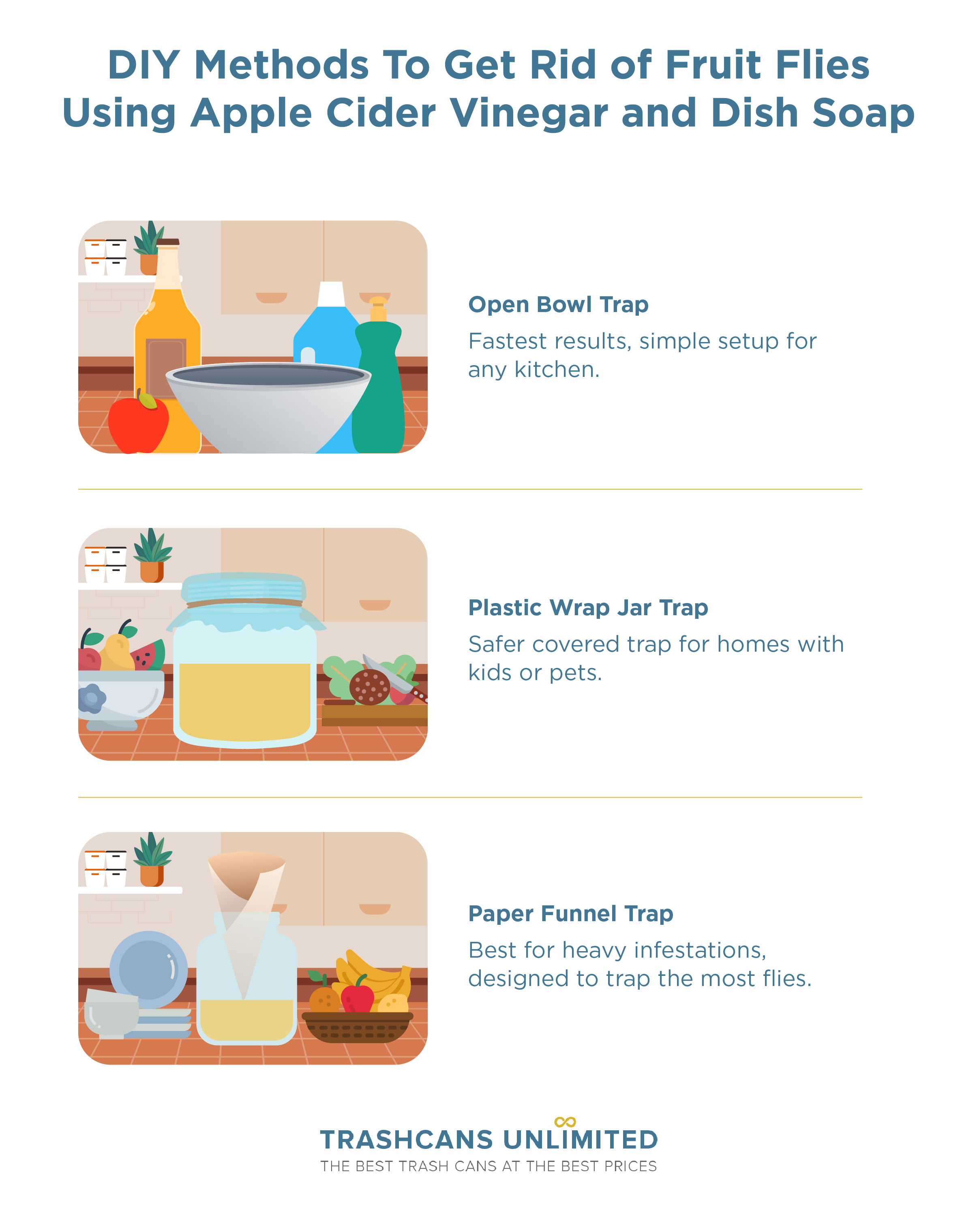
DIY Fruit Fly Traps: 3 Methods Tested and Compared
The open-bowl apple cider vinegar trap is the fastest and most effective option for most kitchens. But depending on your situation—pets, children, aesthetics, or the severity of your infestation—one of these variations might suit you better.
Trap Comparison at a Glance
|
Trap Type |
Setup Time |
Mess Level |
Best For |
|
Open Bowl Trap |
30 seconds |
Low |
Fast results, any kitchen |
|
Plastic Wrap Jar Trap |
2 minutes |
Medium |
Homes with pets or kids |
|
Paper Funnel Trap |
3 minutes |
Medium |
Heavy infestations |
The Open Bowl Method
Already covered in detail above. The open design allows maximum scent dispersal—more volatile compounds reaching more air space—which means flies find the trap faster. The trade-off is that it's uncovered, which some people find less appealing on a kitchen counter.
Plastic Wrap Jar Trap
When to choose this: You want the trap contained. Maybe you have cats who'd investigate an open bowl, or toddlers who'd tip it over. Maybe you just don't want an open dish of vinegar sitting on your counter for days.
Setup:
- Fill a mason jar or similar container about one-third full with apple cider vinegar.
- Add 2-3 drops of dish soap and stir gently.
- Stretch plastic wrap tightly across the top.
- Secure it with a rubber band so it stays taut.
- Poke 4-6 small holes through the plastic using a toothpick—each hole should be roughly pencil-lead width.
How it works: The flies enter through the holes, attracted by the vinegar scent escaping through the openings, but they can't easily find their way back out. The plastic wrap also reduces evaporation, so the trap stays potent longer without needing fresh vinegar.
The trade-off: This design catches flies more slowly than the open bowl. The plastic wrap restricts both scent dispersal and entry points. If speed matters most, go open. If containment matters, go covered.
Paper Funnel Trap
When to choose this: You're dealing with a serious infestation—enough flies that you want to maximize capture rate.
Setup:
- Roll a piece of paper into a cone shape with a narrow opening at the tip (about pencil width).
- The wide end should fit just inside the opening of a jar or glass.
- Fill the container with apple cider vinegar and a few drops of dish soap.
- Insert the paper cone point-down, with the tip hovering an inch or two above the liquid.
- Tape the cone's edges to the rim of the container to seal any gaps.
How it works: Flies navigate easily into the wide opening—it's a big, obvious entrance emitting attractive scent. Once inside, they can't figure out how to exit through the tiny hole at the bottom. This is the same principle behind commercial wasp traps and some professional fly control systems.
Construction note: Use stiff paper that holds its shape. Printer paper or cardstock works well. Tissue paper or napkins will collapse.
Why Traps Alone Won't Solve a Fruit Fly Problem
Here's the math that explains why infestations feel endless: a single female fruit fly can lay 400 to 500 eggs over her lifetime.¹ Even if your trap catches 50 adults today, the eggs those flies have already deposited are hatching into larvae right now. Those larvae will be breeding adults themselves within eight to ten days.²
Traps address the visible symptom—the adults flying around your kitchen. Eliminating breeding sites addresses the actual cause. You need both.
The Fruit Fly Life Cycle Explained
Understanding how quickly these insects reproduce explains why infestations seem to explode overnight.
- Eggs: A female lays her eggs directly on the surface of fermenting organic material—in the skin of a banana, in the gunk coating your drain, on the residue inside your trash can. She deposits them in small batches, typically around five at a time, but can produce 400 to 500 in her lifetime.¹ The eggs are almost invisible, about half a millimeter in length⁶. Under warm kitchen conditions, they hatch in just 24 to 30 hours.
- Larvae: The newly hatched larvae burrow into whatever organic material the eggs were laid on. They feed on the decaying matter and the yeasts and bacteria breaking it down. This larval stage lasts about five to six days. You won't see them—they're inside the food source, not crawling around your counter.
- Pupae: When larvae are ready to transform, they crawl to a drier location—often the edge of the food source or a nearby surface—to pupate. During this two-to-three-day stage, they're immobile and developing into adult form.
- Adults: Newly emerged adults can mate within hours of emergence. Females begin laying eggs within about 24 hours of mating.⁹ Adults typically live up to 2 months, producing eggs throughout.¹⁰
The bottom line: The complete cycle from egg to egg-laying adult takes just 8 to 10 days in a warm kitchen.² That's why an infestation that seems minor on Monday can feel overwhelming by the following weekend. It's not that more flies are arriving from outside—it's that the eggs laid last week are now flying around your kitchen, ready to lay eggs of their own.
What this means practically: Even if you eliminated every adult fruit fly in your kitchen right now, any eggs laid over the past week would continue developing. You'd see new adults emerging for the next 7 to 10 days. To fully break the cycle, you need to either remove all breeding material or maintain traps for at least two to three weeks—long enough to catch emerging generations before they can reproduce.
Long-Term Fruit Fly Prevention: Stop Infestations Before They Start
Once you've dealt with the current invasion, prevention is mostly a matter of removing the conditions fruit flies need. None of this requires significant effort—just awareness of what attracts them and small changes to daily routine.
Daily Habits That Prevent Fruit Flies
- Rinse produce when you bring it home. Fruit flies often enter kitchens as invisible eggs on the skin of fruit purchased at the grocery store.⁸ A quick rinse under cool running water removes surface contaminants—including any eggs that may be present—before they have a chance to develop. As a bonus, this also extends produce life by washing away some of the bacteria that accelerate spoilage.
- Wipe down counters after food prep. That sticky spot where you sliced a mango? The ring left by a juice glass? These small residues are exactly what a fruit fly female is looking for when she's ready to lay eggs. A quick wipe after cooking eliminates potential breeding sites.
- Take out trash containing food scraps before bed. Fruit flies are most active during warmer hours, but eggs hatch and larvae feed around the clock. Removing food waste before you sleep denies them an undisturbed overnight breeding window.
- Run the garbage disposal with cold water for 30 seconds after every use. This flushes food particles completely through the system rather than letting them settle in the drain, where they'd otherwise accumulate into the biofilm fruit flies love.
- Empty beverage glasses before bed. The dregs of wine, beer, juice, or soda are attractants. Rinse glasses before you sleep, or cover them if you want to finish that drink in the morning.
Weekly Kitchen Maintenance
- Flush drains with boiling water. A kettle of boiling water poured down each drain helps dissolve accumulated biofilm. For more stubborn buildup, pour half a cup of baking soda into the drain, follow with half a cup of white vinegar, let it fizz for 15 minutes, then flush with boiling water.
- Clean under appliances and along baseboards. A quick pass with a damp cloth picks up the crumbs, drips, and residue that accumulate in forgotten corners. These zones are easy to ignore and easy for fruit flies in your kitchen to find.
- Wash trash cans inside and out. Even sealed cans develop a film of residue on their interior surfaces. A monthly scrub with hot water and dish soap prevents the buildup that eventually attracts pests.
- Inspect the fruit bowl. Once a week, actually look at what's in there. Remove anything that's overripe, bruised, soft, or starting to turn. One piece of fermenting fruit can attract and breed an entire new generation.
- Empty and rinse the recycling bin. If you can smell something sweet when you lift the lid, fruit flies can detect it from across the room.
Equipment Upgrades That Eliminate Breeding Habitat
Sometimes the most effective prevention is simply eliminating the opportunity. Certain kitchen equipment makes it much harder for fruit flies to establish themselves in the first place.
- Sealed, step-on trash cans address the trash problem at both ends. They prevent flies from physically accessing the waste inside, and they contain the fermentation odors that attract flies from across the room. An open trash can is essentially a beacon signaling "breeding site here." A sealed can with a properly fitting lid eliminates both the access and the signal.
- Drain covers with fine mesh allow water to flow while physically blocking flies from accessing drain-based breeding sites. They won't eliminate existing drain buildup, but they prevent new infestations from starting there.
- Airtight produce storage lets fruit ripen without exposure to egg-laying females. Clear containers allow you to monitor ripeness without opening the lid. This is particularly useful for bananas, stone fruit, and tomatoes—the items most attractive to fruit flies.
- Compost bins with secure lids and carbon filters contain the fermentation odors that would otherwise spread through your kitchen. The filter absorbs volatile compounds; the sealed lid blocks physical access.
Of these upgrades, replacing an open or loose-lidded trash can with a sealed, step-on model offers the highest impact for the lowest effort. It eliminates what's often the largest breeding ground in a kitchen and removes the fermentation scent that draws fruit flies in the first place.
Browse Step-On Trash Cans for the Kitchen →
Your Complete Fruit Fly Action Plan
Everything above distills into three steps: immediate action, source elimination, and ongoing prevention.
Step 1: Set a Trap Immediately
Mix apple cider vinegar with a few drops of dish soap in a shallow bowl. Place it within two or three feet of wherever you've seen the most fly activity—beside the fruit bowl, next to the trash can, near the sink. Not in the center of the room. Next to the source.
Expect to see catches within hours. If you're seeing nothing after 24 hours, move the trap closer to where flies are congregating.
Step 2: Find and Eliminate the Source
Do a five-minute kitchen sweep. Check fruit for soft spots. Sniff your drains for fermentation. Inspect the trash can interior. Pull out appliances and look underneath. Examine recycling containers for residue.
When you find organic material in any stage of decay, remove it or clean it thoroughly. No breeding site means no new eggs. No new eggs means your trap can actually finish the job.
Step 3: Prevent Recurrence
Adopt the daily habits: rinse produce when you bring it home, wipe counters after cooking, take out food trash before bed. Weekly, flush drains and clean forgotten corners. Consider equipment upgrades—particularly a sealed trash can—that eliminate breeding habitat entirely.
The two-pronged approach in one sentence: Traps kill the adults you can see; eliminating breeding sites stops the ones you can't.
Why Prevention Beats Constant Trapping
Fruit flies need three things to thrive: moisture, fermenting organic matter, and access. Deny them any one of these and they can't breed. Deny them all three and they can't survive.
A quality sealed trash can removes two of those factors immediately—containing both the moisture and the organic waste while blocking the physical access flies need to lay eggs. It's not the only step, but it's often the most effective single upgrade for a kitchen that stays fly-free long after the current infestation is gone.
References
- "Life Cycle and Anatomy of Drosophila." BSCI 1511L Statistics Manual, Vanderbilt University Libraries.
- "Fly Care." Bloomington Drosophila Stock Center, Indiana University.
- Stevison, Laurie. "Buzz Kill: Auburn Researcher Offers Advice for Ridding Homes of Pesky Fruit Flies." Auburn University Office of Communications & Marketing, 1 July 2021.
- "Surface Tension." University of Tennessee, Department of Physics and Astronomy.
- Keesey, Ian W., et al. "Inverse Resource Allocation between Vision and Olfaction across the Genus Drosophila." Nature Communications, vol. 10, no. 1162, 11 Mar. 2019, doi:10.1038/s41467-019-09087-z.
- “Fruit Fly Insect Monitoring Guideline.” Insects Limited.
- Liesch, PJ, and Diana Alfuth. "Fungus Gnats on Houseplants." Wisconsin Horticulture, University of Wisconsin-Madison Division of Extension, 9 Feb. 2021.
- Potter, Michael F. "Fruit Flies." University of Kentucky College of Agriculture, Food and Environment, Department of Entomology, ENTFACT-621.
- "Fruit Flies." Oklahoma State University Extension.
- "Research Models of DBS: Fruit Flies." Biological Sciences, University of Missouri, 19 Apr. 2023.